8 hours ago
There is no movement towards consensus on the president's issue, despite deadline leaks
Periskopi(3 months ago)
(3 months ago)The main political parties in Kosovo have not yet made any moves towards reaching a possible agreement on the election of the country's new president, despite a week running a month-long term set by the country's highest court on the issue. Last week, the Constitutional Constitution was [...]
Last week, the Constitutional Constitution gave lawmakers 34 days to elect the head of state, on the contrary, the country goes to early elections, which should be held within 45 days.
The current president, Vjosa Osmani, expires his mandate on April 4th, and lawmakers now have until April 28th to appoint her successor.
However, since the issue of the indictment on this deadline, seven days have passed, and actions towards finding a solution or reaching a deal with the president have not been seen in public.
Radio sources Free Europe (REL) within the two largest opposition parties, the Democratic Party of Kosovo (PDK), and the Democratic League of Kosovo (LDK) confirmed that they have yet to accept an invitation for a meeting by Prime Minister Albin Kurti, leader of the ruling party, Vetevendosje Movement.
In the PDK, they said they are organising the meeting of the Steering Council and that the party's official positions in relation to political developments in the country will be determined in this “body.
“After this internal process, The PDK will come up with a clear and unified stance for the further steps of”, an official from this party said.
Two days ago, Prime Minister Kurti warned he would send invitations to political party leaders, but did not show when.
He added that he would do so after “internal settings”, without providing more details.
How important it is to treat it urgently is also important to succeed. Because, after all, we will be measured, not by our efforts, but by the success we reach”, Kurt stressed on March 30.
Politologist Dritero Arifi estimates to REL that the Vetevendosje Movement should attract the two candidates proposed for president, Fatmire Muharja-Kollcak, to create room for discussions with other parties.
“Eence is whether to send preliminary signals, as I said with the departure of those candidates. They have to resign technically, which creates room for more serious negotiations”, Arifi points out, adding that the discussions could thus develop in a spirit of compromise.
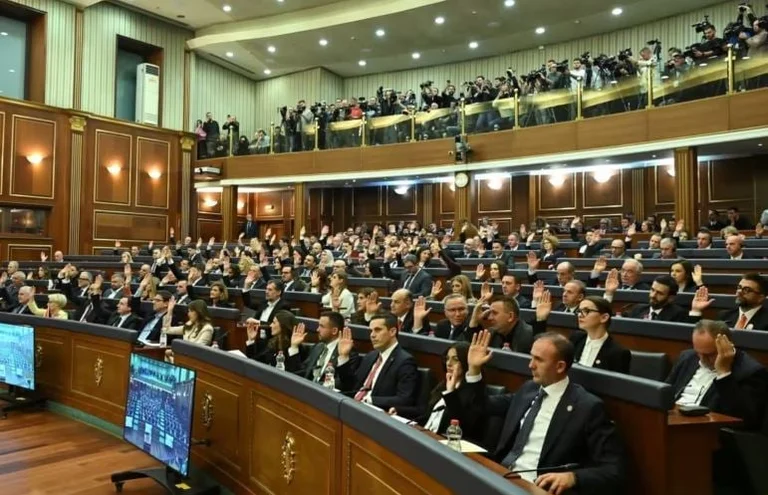
The election of the new president failed early last month precisely due to the lack of agreement between parties.
Glauk Konjufca and Fatmire Kolcaku-Muhrama were not even cast into the vote in the absence of quorum.
Kosovo's president is elected by two-thirds of the vote in the first two round or 61 votes in the third round, but 80 deputies in the hall are needed for the hearing to be held.
Vetevendosje Movement MP Artan Abrashi said Wednesday that the issue of electing the president depends on the meetings to be held.
According to him, Vetevendosje has “willpower and readiness” to find a compromise.
I wish that (the opposition parties' representatives) would reflect positively and that Kosovo would overcome this unnecessary crisis, which is at risk of leading us to the elections, still saying unnecessary”, Abrashi told the news agency “Economy Online”
After publishing the Constitutional Act, Democratic League of Kosovo chairman Lumir Abdixhiku said the main responsibility for the president's case remains with the parliamentary majority.
“The LDK remains ready to contribute to any serious efforts for solutions, guaranteeing stability and normal functioning of institutions. But, at the same time, there will be no one's alibi” failures, he said.
If the new president is not elected by April 4th, then the president's office will be exercised by Parliament Speaker Albulen Haxhiu.
According to the Constitution, the post of applicant of the presidential duty cannot be exercised for a period longer than six months.
Copying the post by Haxhiu, politicologist Arifi sees as one of the reasons why the Vetevendosje Movement is pushing to start discussions with opposition parties on electing the president.
According to him, although all political parties claim they are ready for elections, the time for holding them may be more appropriate for one side than for the other.
I think in this case the ruling party is playing with the time element in order to create pressure, but perhaps even a next crawl for setting the date of extraordinary elections”, he said.