5 minutes ago
Americans offer millions for airport management in Sarajevo and Mostar
Periskopi(4 months ago)
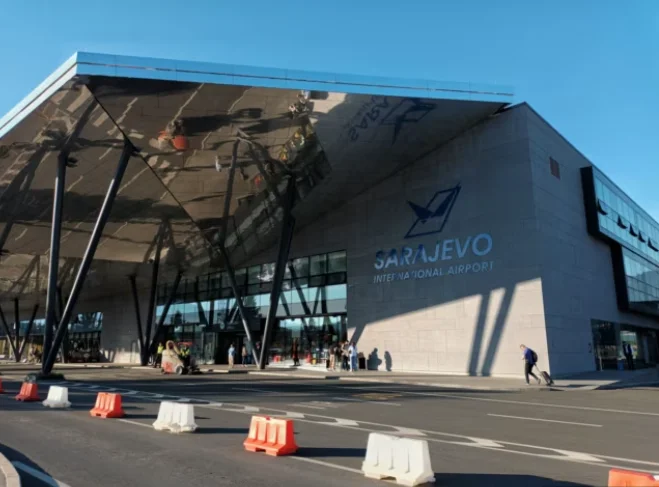
(4 months ago)More flights, cheaper tickets and more modern airports. These are the changes Bosnia and Herzegovina can experience if an American investor takes over management of airports in Sarajevo and Mostar. The offer comes from AAFS Infrastructure Energy LLC, which promises considerable investment and better ties to [...]
These are the changes Bosnia and Herzegovina can experience if an American investor takes over management of airports in Sarajevo and Mostar.
The offer comes from the AAFS Infrastructure Energy LLC company, which promises considerable investment and better ties to European destinations.
Sarajevo Airport, otherwise, is owned by the Federation of Bosnia and Herzegovina government.
Officials of this entity confirmed for Radio Free Europe that, in early March, they have accepted AAFS's proposal for a 30-year concession.
The issue is currently “in the public interest assessment phase”, near the Federal Ministry of Transport and Communications.
At the same time, the offer for Mostar Airport has been forwarded to Mostar City, which manages this smaller regional airport.
The city of Mostar did not answer Radio Free Europe questions about details of the offer for the airport.
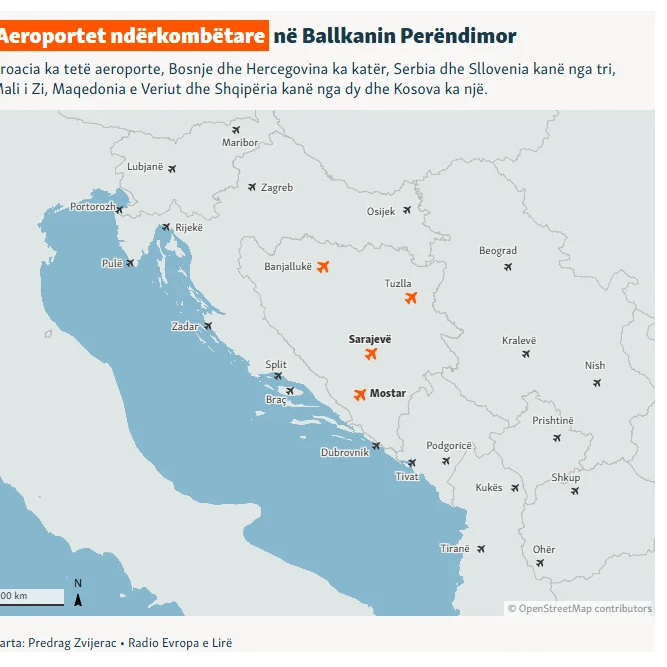
Bosnia and Herzegovina and Montenegro are the only countries in the Western Balkans that have not yet given major airports concession or private management.
What do the Americans offer?
The AAFS proposes taking the airport to Sarajevo with concession for 30 years, with the possibility of extending for another 20 years, the Federation of Bosnia and Herzegovina Government confirmed.
The bidder said it plans to invest approximately 250m euros in phases, over the first 5-7 years.
The airport will remain owned by the Federation Government, which AAFS, as airport operator, will pay approximately 1 per cent of the annual incomes about 720,000 euros.
Moreover, the new operator would pay in the entity budget 7 per cent of the pre-tax profit, which is about 2.5m euros annually.
The AAFS did not answer REL questions about plans for Sarajevo and Mostar Airport, their experience in airport management and conditions they have offered.
This American company is also interested in building and managing the gas pipeline “South Interconction”, which would link Bosnia and Herzegovina to the terminal on the Croatian island of Kirk.
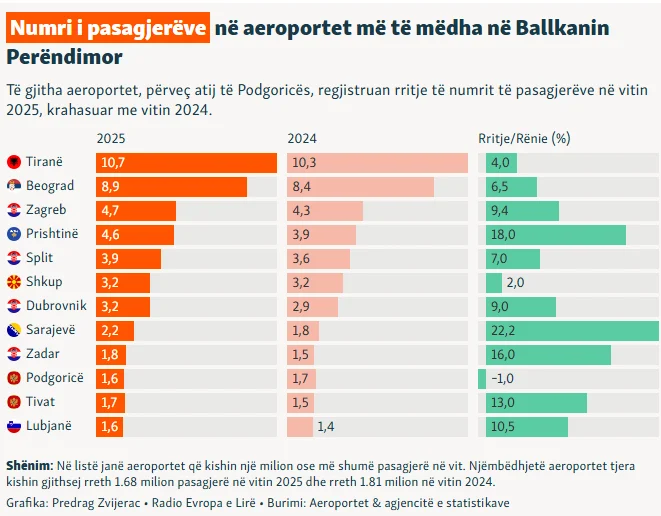
Sarajevo International Airport is marking one of the biggest increases in the number of passengers, airlines, routes and profits among major airports in the Western Balkans.
This airport reported to Radio Free Europe that in 2025 there were about 2.2 million passengers, compared to 1.8 million in 2024, an increase of more than 22 percent.
Authorities, at the same time, also pay the airport budget subsidies with the goal of developing tourism.
In 2021, the Federation of Bosnia and Herzegovina Government decided that the Sarajevo Airport's gain would not be paid in the entity budget for ten years, but would be reinvested in development.
Mostar Airport is much smaller and depends on subsidies. In February 2026, a package worth 1.75m euros was signed with Croatia, of which 950,000 euros are destined for the subsidisation of the Mostar-Zagreb line and 800,000 euros for security, infrastructure and airport expansion.
In 2025 he had about 72,000 passengers. Now, it plans to expand the terminal, renew light and track, as well as build a solar thermal power plant to cut costs.
If there are no concessions and big investments, Sarajevo Airport would actually remain in the range of two to two and a half million passengers a year with fluctuations associated with tourism and diaspora. With a concession that has a reputation and can open new roads, the potential is three to three and a half million passengers, which would bring Sarajevo closer to Skopje or Pristina”, says Free Europe Muharem Sohabq, professor at the Faculty of Transport and Communications in Sarajevo.
He adds that, in the long term, Sarajevo could reach five million passengers a year, but only with serious investments in infrastructure and strategic development.
Sabac adds that Sarajevo Airport, despite its growth, still lags behind regional competitors.
Limitations, such as short track and modest terminal, the lack of an air carrier based, as well as the least developed network of lines, slow down its full potential.
Additional challenges are frequent winter traffic interruptions, since fog often causes flight cancellations.
For this reason, says Shabja, the state must enter the process of final concession with clear data, detailed analysis and precisely defined public interest.
A similar message sends Bojana Mirkovic, a professor at the Faculty of Traffic in Belgrade.
According to her, the answer to the question of whether the concession is good or bad depends largely on what the state wants to achieve.
“Arsyet and the motives for providing an airport with concession can be very different, and it depends on them how important it is to study the experiences of neighbouring countries and in what context”, Mirkoviq tells Radio Free Europe.
And for passengers, like Feja Sharenkapa, owner of a small food store in Sarajevo, the most important thing is to have as many free flights as possible.
After a cheaper line was recently added from Sarajevo towards Baden-Baden, this summer, on his 50th anniversary, he will first enter the plane to visit his brother in Munich.
Now, the flight situation is a little better. But I don't think it's going to be a real airport until some serious foreign company gets it under its care”, says Sharenkapa for Radio Free Europe.
Who approves the concession?
Bosnia and Herzegovina's Civil Aviation Directorate (BHDCA) plays a key role in managing airports in this country.
This regulator does not decide for concession, but without its approval, a new operator cannot take over management.
BHDCA told Radio Free Europe that this includes, among other things, the certificateification, risk assessments, up-to-date operational manuals and the adoption of all changes to the security and operational system.
The granting of Sarajevo Airport with concession will also have to be approved by the Federation of Bosnia and Herzegovina entity parliament, while the decision on Mostar Airport belongs to the City Council.
International financial institutions, such as the World Bank, have analysed the concession of Sarajevo Airport even years ago, indicating that the idea of a public-private partnership is not new.
What are the experiences of regional airports?
Almost all major airports in the region have already been entrusted to large international operators.
Belgrade Airport has been run by French Airports Vinci since 2018, Zagreb has been under the concession of the Group ADP since 2012, while Skopje and Ohrid are headed by TAV Airports for years.
Pristina airport is owned by Turkish Limak Holding, and Ljubljana Airport is owned by German Fraport.
The concession patterns are different, but their common is that states, usually, receive a combination of early payments, income percentages and mandatory investment cycles.
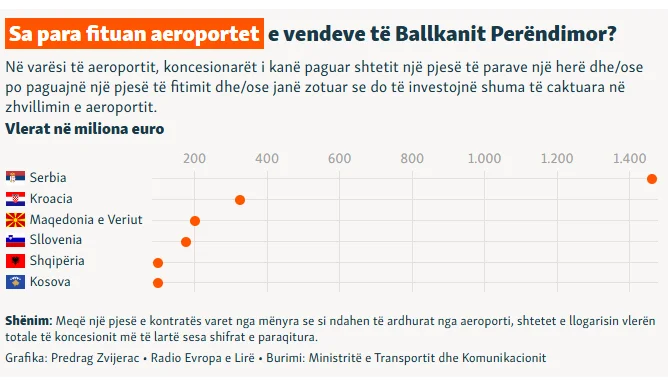
The value of concession agreements in the region ranges from about 200m euros in northern Macedonia -- over 320m euros in Zagreb -- to about 1.46 billion euros for Belgrade Airport.