27 minutes ago
Blockades in the Parliament and Persistence on Albulen Haxhiu, State: Political self-abiding, Kurti Sı has votes for government
Periskopi(a year ago)
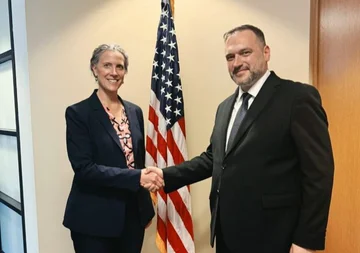
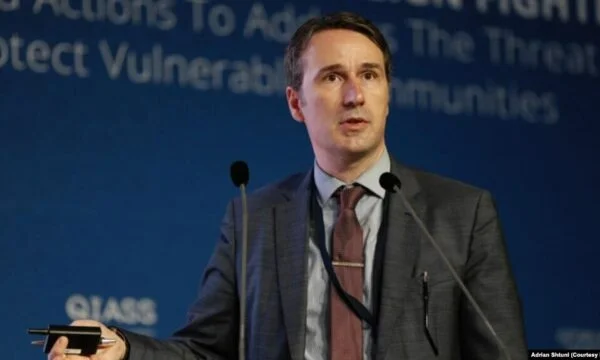
(a year ago)The lack of will for compromise and trust, which cannot assure the Kosovo Assembly three months after parliamentary elections, is the product of the lack of a common strategic vision for the country's future, says Adrian Steun, foreign policy expert and security operating in Washington, in an interview for Radio Europe [...]
He claims that no subject is willing to take steps that could weaken his political position, describing the situation as a “zuzwang bilateral” a moment when any political movement poses a danger.
Stein argues that Kosovo needs a stable government with a broad political or even technical basis, at least until the president's election in March 2026. According to him, the current stalemate is seriously costing Kosovo, not only in terms of lost time and developmental opportunities, but also in international perception of stability and functionality of the state.
Steden also speaks of the role of the international community, which, although not exercising public pressure, remains actively involved, and calls for awareness of the political class for solutions to come from within, not as a product of pressure from abroad.
On May 13th, for the next fifteenth time, Kosovo Assembly deputies failed to constitute the ninth parliamentary composition, released by the February elections.
Radio Free Europe: Mr. The state, to which political subjects does procrastinate the formation of new institutions in Kosovo, and what are the reasons you see for such procrastination?
Adrian State: The results of the February 9th elections, and the rages and strong clashes that have characterised politics in Kosovo recently, have brought the main parties in Kosovo to a situation called “zuzawang bilateral”. This means that they estimate that any move they can make will exacerbate their position, namely that no one prefers to move from the position they are barricaded with, so we have reached this institutional paralysis situation.
More clearly, the reasons for procrastination are because no one has a minimum of 61 votes, and no one has any real will for compromise or adequate trust in potential coalition partners.
This divisive situation, quite expensive for Kosovo, is certainly the product of extreme political polarisation in the country, but even worse, is the product of the lack of a common strategic vision for the country's future.
I'm talking about a long-term vision that exceeds party ambitions of election cycles, egos, resentments, and the narrow interests of the leadership of each party.
Radio Free Europe: But how can responsibility be shared for the current situation in Kosovo?
Adrian State: Of course everything is in order. Because Vetevendosje (LVV) movement has come first in the election, it has the first turn to move. Insisting on Mrs. Albulen Haxhiu, after 15 consecutive failures, uncovered not only the lack of will to unblock the situation, proposing an candidacy with broader support but also Mr. Albin Kurti, after all negotiations, does not have the votes needed for the government, which apparently moves him to think he costs him time.
For me, this is a harmful choice for the country, especially when Kosovo is filling two years under punishment measures from the European Union (BE) that block development funds, membership in the Council of Europe, and the path towards Euro-Atlantic integration.
To be clear, at this moment nothing costs Kosovo more than lost time.
Meanwhile, for the Democratic Party of Kosovo (PDK) it seems that the country's institutional paralysis is less harmful than a Kurti government 3.
They even estimate that the rise in the price of electricity and, in general, of the cost of living in Kosovo, along with three months of political stalemate in the country, have somewhat eroded LV's electorate.
That probably makes them think the new parliamentary elections could produce a more favourable result. I don't have enough data to calculate if this is a realistic assessment at this point, but I think the longer the country remains in an institutional paralysis situation, and the higher the economic and sociopolitical damage bill that causes this paralysis to the country, the higher the political cost for LVV in the upcoming elections.
But to be clear, even if 61 MPs were together, such a governing coalition would be very unstable, so for avoiding paralysis it would probably be the country's to consider a different formula, namely, a broad-based political government, or even technical, until the election of the next president or president, in March 2026.
The point here is that Kosovo needs a stable and capable government to make important decisions in turbulent times, not a government without stability and hand- bound.
Radio Free Europe: Practices to date have shown that when there has been political disagreement between parliamentary subjects, whether for the constitutionalisation of the Parliament or for the formation of the Government, there has been insistence by Kosovo partners and Western allies to postpone the process forward. This, in the current case, is actually not happening. Why?
Adrian State: Based on the meeting of QUINT ambassadors with the incumbent prime minister yesterday, May 12th, and their statements after the meeting, I appreciate that the interest of strategic partners in resolving institutional paralysis has not been missed.
On the contrary, there has been open encouragement and clear demand for the formation of the new government without delay because it is much work left out. The fact that the meeting of the QUINT ambassadors was held with Mr. Kurti, and not all the leadership of the main parliamentary parties, also shows where ambassadors think the key to unlocking the situation for forming the new government.
The question is what Mr. Kurt with this persistence? Will the approach to extend the hand of co-operation to other political parties change? Would it be such a reliable gesture, following insults that the opposition made on the day of victory?
I wish the answer was yes, but judging from the past, I'm not very optimistic.
Radio Free Europe: In light of geopolitical developments, are there signs, indicators or factors procrastinating the formation of institutions in Kosovo even converts one of the international partners, and why?
Adrian State: I don't think that this political self-invasion, which is taking place in Kosovo, consigns one of the international partners, but certainly enjoys those who often claim and propagand that Albanians do not make a state.
Without a doubt, this impasse convegates those who dream of Kosovo's failure. And, I strongly hope that consciousness and the solution will come without delay, and precisely from the will of the Kosovo political class, and not from outside pressure.
I think that the most clear indication of achieving the maturity of the country's political class, and of the state consolidation, is when the will for political solutions compromise comes as the organic product of the local leadership's awareness and political accountability, and not as a consequence of imposing by strategic partners. Even the concept of partnership requires discretion, skill, and cooperation on both sides, not dependence on one another.
This partnership format, on the basis of reciprocity and not dependence, is being sought with insistence by the current administration of the United States of America, as well as by NATO allies, in response to numerous geopolitical and security challenges and developments.
Therefore, the political factor in Kosovo would do well to read clearly this new dynamic in the international arena, and take on the responsibilities of the householder rather than expect solutions from heaven.Periscope/