6 minutes ago
Albania among 10 countries for the highest increase in food prices in Europe, here is Kosovo
Periskopi(a year ago)
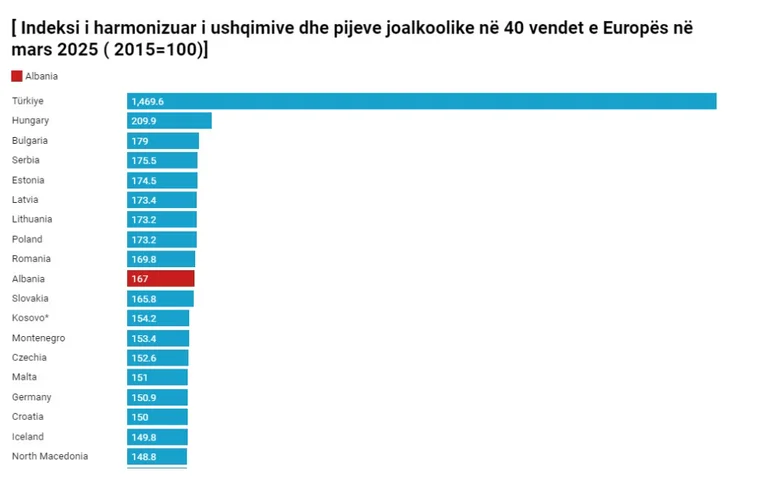
(a year ago)Albania ranks 10th in about 40 European countries for high food prices between 2015 and 2025. The data stemming from the harmonised Index the EU uses to compare price change in Europe shows that since 2015, Turkey led for high growth in food inflation [...]
The data stemming from the harmonised Index that the EU uses to compare price change in Europe shows that since 2015, Turkey led to higher growth in food inflation due to recent years' inflation waves (see the following graph), and Switzerland had the lowest growth on the other side.
Albania's non-alcohol food prices index marked 167 %15=100 in March), which means that from 2015 to March 2025 food prices in Albania have increased by 67 percent one of the highest levels in Europe.
Food prices in Albania increase 14% more than the EU average in this period. Eurostat ranks Albania as 10th in 40 economies, while ahead of us countries with unusual developments, with very high inflation (e.g. Turkey 1,470, Hungary 210).
Albania also had the strongest price hikes in the Balkan region, excluding Serbia.
The higher rate of food prices compared with other countries in Europe damages long-term convergence (achieving EU living standards).
On the one hand, consumer pressure from foreign visitors and on the other, population aging are creating an environment at higher prices and following.
Positive developments in tourism are not promoting agricultural production, and the country has increased dependence on food supplies from import in recent years.
As this addiction grows, policies addressing structural costs on the food supply chain are lacking.
To ease the effects of high inflation after the war in Ukraine, all European countries, including those in the region, applied aggressive policies in rising wages and pensions.
Albania has made several interventions especially in the public sector, but still lags behind.
In Albania, the average gross monthly salary for 2024, according to INSTAT, reached 77.5 thousand dollars per month, or about 770 euros.
The highest average gross monthly salary is in Serbia, at 1150 euros a month (135,403 Serb dinars). In Bosnia and Herzegovina, the salary is nearly 1100 euros (2140 Bam).
In Montenegro, the salary is 1083 euros. Even North Macedonia, on average, pays employees more than a thousand euros a month -- namely 62 thousand Macedonian dinars -- or 1020 euros a month. / MANITOR/