17 minutes ago
Conflicted Law for KKP to Send Presidents for Statement, says Constitutional Court
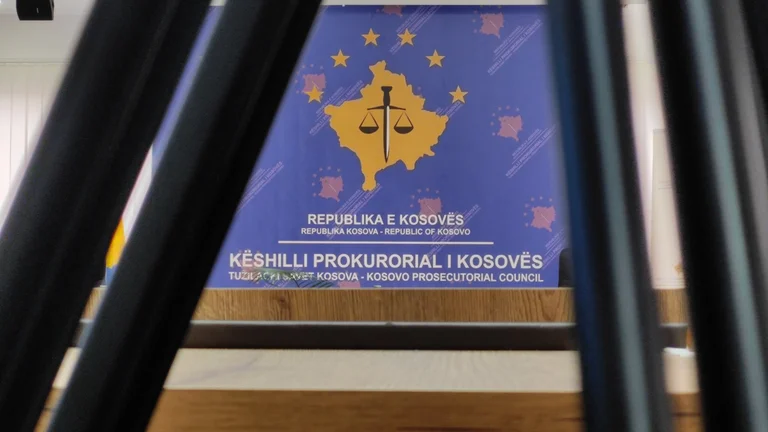
Periskopi(a year ago)
(a year ago)Photo: Callo. Kosovo's Constitutional Court has declared the demands of MPs Abelard Tahiri and nine other Parliament deputies acceptable, and the next request with the foreman Arben Gashi and nine other Parliament deputies, submitted to the Constitutional Court, in terms of assessing the constitutionality of nine, five, 6, 7, 13, and [...]
Photo: Callo. com
Kosovo's Constitutional Court has declared the demands of deputies Abelard Tahiri and nine other Parliament deputies acceptable, and the next request with the foreman Arben Gashi and nine other Parliament deputies, submitted to the Constitutional Court, in terms of assessing the constitutionality of provisions 2, 5, 6, 7, 13, and 16 of the Law No. 08/L-249 for Changing and Fulfilling Law No. 06/ L-056 for Kosovo Prosecutorial Council broadcasts Periscope.
The court has decided, (i) unanimously, to declare acceptable demands; (ii) to state, with six votes for and one against, that subparagraphers 1.3, 1.4 of paragraph 1, and subparagraphers 2.4 and 2.8 of Article 2 (not entitled) of Law No. 08/L-249 for Changing and Fulfilling Law No. 06/ L-056 for the Kosovo Prosecutorial Council are not at odds with Article 110 [Kosovo Prosecutorial Council] in interconnection with Article 7 [Verra] of the Constitution of the Republic of Kosovo; (ii) to state, unanimously, that paragraph 1 in Article 7 (without a title) of Law No. 08/L-249 for Changing and Fulfilling Law No. 06/ L-056 for the Kosovo Prosecutorial Council is not at odds with Article 10 of Article 65 [The Assembly Committee] in liaison with Article 4 of Article 110 [Kosovo Prosecutorial Council] of the Constitution of the Republic of Kosovo; as well as (iv) to declare, unanimously, that Article 16 (without a title) of Law No. 08/L-249 for Changing and Fulfilling Law No. 06/ L-056 for the Kosovo Prosecutorial Council is not at odds with paragraphs 1 and 4 of Article 110 [Kosovo Prosecutorial Council] of the Constitution of the Republic of Kosovo”.
“Based on the above findings, the Court also ruled that (i) the controversial Law is sent to the President of the Republic of Kosovo for the proclamation; and (i) The act goes into effect on the day of its publication in the Official Journal of the Republic of Kosovo”, the Constitutional Court reported.
The indictment explains that “as a result of the lack of specific arguments to pre-requisite claims and accuracy of the claim regarding the constitutionality of the provision specifying the decision with the simple majority of all members of the Kosovo Prosecutorial Council, the Court only praised claims regarding the quorum and decision-making of 4 (four) members in case of non-participation in the case of some members of this Council”.
“In the assessment of this claim, the Court reminded its judicial practice in the cases of KO100/22 and KO10122, as well as the Venice Commission's recommendations on the importance of counterblocking mechanisms in decision-making procedures in this institution, in order to ensure the operation of the Council”.
The Court subsequently estimated that the 4 (four) quorum definition of four (four) members and decision-making with votes of 4 (four) those attending the Kosovo Prosecutorial Council meeting, which applies only to cases (i) not to the continued participation of members in the meeting of this Council; and (ii) circumstances in which disciplinary procedure is initiated against the member, guarantee it will be performed in carrying out the constitutional and legal mandate, and an obligation of the Parliament to select members of an independent body, part of the justice system, in the service of direct justice and law enforcement. Consequently, the Court found that Article 16 (untitled) of Law No. 08/L-249 for Changing and Fulfilling Law No. 06/ L-056 for the Kosovo Prosecutorial Council is not at odds with paragraphs 1 and 4 of Article 110 [Kosovo Prosecutorial Council] of the Constitution of the Republic of Kosovo” was said among other things in the Constitutional Court Act.