8 minutes ago
Official NATO: Ukraine has legitimate military reasons to strike deep within Russia
Periskopi(2 years ago)
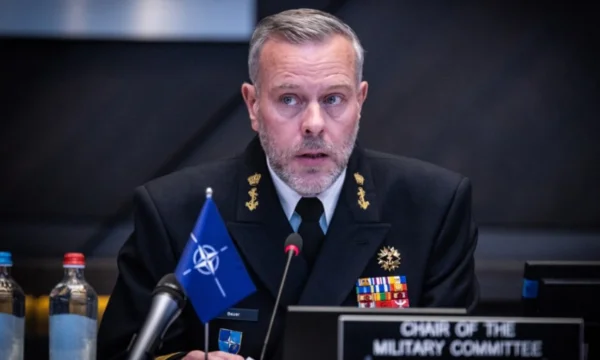
(2 years ago)The head of the NATO Military Committee said the question of whether Ukraine should be allowed to strike deep within Russia with long-range western weapons is “a political decision”, but, militaryly, it would be within Ukraine's legal right. Admiral Rob Bauer said in an interview for Radio [...]
Admiral Rob Bauer said in an interview for Radio Free Europe on September 14th that lifting restrictions is not a question that NATO is discussing, but in his opinion, as military leader, the answer would be yes.
“Based on the UN Charter and the law on armed conflict, if attacked by a state, you have the right to defend yourself”, Bauer said. “This protection does not stop at your borders. You are allowed to attack the enemy in his territory”
Bauer spoke of the REL as the NATO Military Committee spoke of the alliance's highest military authority, HINA, met in Prague for a two-day conference to discuss strategic developments within the alliance following decisions that were made during the NATO summit, which was held in July.
The meeting was held a day after British Prime Minister Keir Starmer met with US President Joe Biden at the White House to discuss whether Kiev's request to use long-range missile action in Russia should be approved.
Bauer said the threat expressed by Russian President Vladimir Putin and former President Dmitry Medvedev in response to these discussions demonstrated disappointment over how the war is going, two and a half years after Russia began its full-scale invasion of Ukraine.
I think it's evidence how unhappy they are because Russia has not achieved any of its strategic goals in Ukraine”, Bauer said.
Putin has said earlier this week that the West would be “at war” with Russia if it allowed Ukraine to attack with long-range missiles produced in the West, Medvedev said on September 14th that Russia could destroy the Ukrainian capital, Kiev, with non-inventional weapons if the West lifts its restrictions.
Medvedev, now serving as chairman of the Ukrainian Security Council, also said Russia could use nuclear weapons.
Bauer said these threats should be taken seriously, but what NATO and Ukraine's other allies are making “is within the UN Charter, within international law. And we're going to keep doing this”.
In his speech during the conference, Bauer praised the Ukrainian Army, which said it witnessed to the world that “there is nothing you can't do”. He said the Ukrainian Army needs to be backed up by its allies to achieve targets.
“They will have support, not only now, not only during the war, but also in the following decades”, Beuer said during the conference in Prague.
NATO allies, led by the United States, have donated billions of dollars of military equipment to help Ukraine develop the war, and Bauer said Ukraine's forces are growing, and each day more and more are becoming “more and more interoperating” with NATO forces, drawing the country closer to NATO membership.
“One day, we will sit together under NATO slogan”, he said. “Ukraina deserves our support, not only for what we stand as humans, but also as NATO”.
Bauer also said that NATO needs greater production capacities in the defence industry and should improve co-ordination in order to increase prevention.
Lieutenant General Karel Rehka, chief of the General Staff of the Czech Armed Forces, also spoke of the war in Ukraine. He said this war is a matter of survival for Ukraine and a struggle for principles of democracy, sovereignty and territorial integrity, which are principles for which NATO exists to protect.
It is important that we are at the helm of our armies to offer all necessary assistance to Ukraine, whether in the form of training or supplies with weapons and other military equipment”, Rehkha said during the conference. “Supporting Ukraine, we also strengthen our unity and keep under control the Russian threat”.
Bauer and Rehka agreed that there is a need for greater spending in the area of defence. Rehka said that “is clear that 2 percent of Bruto's domestic production for defence expenses is not enough”.
Rehka also warned that threats from Russia come not only through conventional battlefields but also through hybrid tactics, cyber attacks, denination campaigns and acts of kinetic violence.
All these actions are designed to sow fear and undermine the unity of our societies. We need to take a broad approach... that integrates our conventional military capabilities with powerful cyber defence and strong civil-military co-operation”. / REL