8 minutes ago
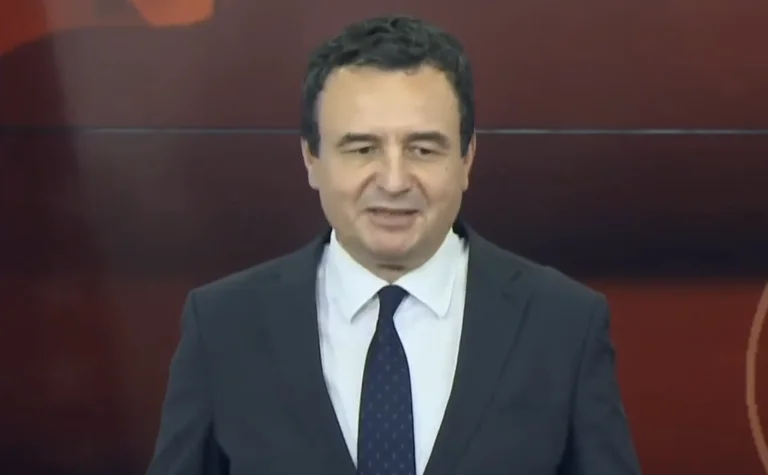
Kurti's “tactical alerts for the risk of conflicts by Serbia, what KFOR says
Periskopi(2 years ago)
(2 years ago)Despite talks for years, Kosovo and Serbia seem unable to find common language. Not only do they have difficulty communicating, but they constantly accuse each other of not wanting peace. For Serbia's president, Aleksandar Vuciq, Kosovo authorities exercise <x0 violence” against the Serb community in the north. With “arrogant and illegal moves, Pristina risks the security of [...]
Despite talks for years, Kosovo and Serbia seem unable to find common language. Not only do they have difficulty communicating, but they constantly accuse each other of not wanting peace.
For Serbia's president, Aleksandar Vuciq, Kosovo authorities exercise <x0 violence” against the Serb community in the north.
With “arrogant and illegal moves, Pristina risks the security of the Serbian population”, he has said, when Kosovo has closed down several parallel institutions of Serbia in the country's north.
Within a week, Kosovo Prime Minister Albin Kurti has warned at least twice of the risk of new conflicts by Serbia.
Asked by journalists on September 17th how he comments on some Vuciki's requests for northern Serbs to reintegration into Kosovo institutions, Kurti has said those “are not rational”.
“ [Vuchy's demands] are not at all peaceful, but, rather, are part of the aggressive campaign for new conflicts, which obviously have no place in Kosovo, nor anywhere”, Kurti has said.
Four days before that statement, Kurt made a similar warning even through his Facebook account, where he assured, as well, that Kosovo is ready for the protection of its citizens.
Serbia, led by Milosevic's minister, in co-operation with Russia, is preparing new threats and ultimatums towards Kosovo... Today, Kosovo is stronger than ever before, not afraid of threats. We protect all our citizens and their freedoms and rights”, Kurti wrote.
Kosovo President Vjosa Osmani has indicated in a similar spirit. But, according to her, “although” should not be feared by Vuciqi.
With the weapons that Kosovo has acquired and with the daily strengthening of security institutions, “we are much stronger than we used to be at”, Osmani said on 17 September in an address to reporters.
This month's 24th is exactly one year since an armed group of Serbs has attacked Kosovo police in Banjska near Zvecan and killed a policeman. Three Serb attackers have also been killed during the subsequent shootout.
In the indictment that the Kosovo Special Prosecutor has filed in the case, it is said that “group, through the use of heavy weapons, has attempted to divide the northern part of the territory of the Republic of Kosovo and unite that territory of the Republic of Serbia”.
Kurti and Osmani, in some statements, have directly blamed Serbia's state leadership for the attack, even though it has denied it.
Serbia is characterised as the key “threat to Kosovo's security as well as the country's Security Strategy for 2022-2027.
Kosovo and Serbia share a long border line of about 400km. Kosovo border security accountable with Serbia is Kosovo peacekeeping mission NATO, KFOR, while for the rest of the border line, is Kosovo Police.
Contacted by Radio Free Europe, KFOR says the situation on the ground is calm, but remains fragile.
Our <x0-minute mission has a visible and flexible presence, and is well-located to address any significant security developments, in line with its UN mandate. It is important to avoid actions that could create unnecessary tensions”, says a mission spokesman.
Former official of NATO, Jamie Shea, recalls that KFOR, following the Banjska attack, has increased its presence in Kosovo, and that, according to him, has provided “many lessons for security”.
Speaking of the Free Europe Radio Expo programme, Shea says it is important that the parties engage in dialogue on normalisation of relations.
I don't think it's okay to talk military threats. I don't see any particular tension at the border. Serbia has not added its troops to the border. KFOR has also increased its presence in northern Kosovo, following last year's attack on Banjska. So security arrangements are clear. I think we should stop talking about threats and go back to the chat table”, says Shea.
Marko Prelec, from the International Crisis Group, also estimates that the security situation in Kosovo is stable. According to him, the attack on Banjska has been “upsurgeon” for the risk that could threaten northern Kosovo, inhabited by Serb majority.
As a result, Prelec says, co-operation between KFOR and the US and Britain with Kosovo has also increased to track and prevent military activities.
This kind of [ Kurti's] statements should be taken as an attempt to attract international attention and gain international sympathy. Most Western allies are concerned with Russia. And for Kurti, whatever he can do to line up with the West and to put Serbia as a prorus, it seems to make sense”, Prelec says.
Russia strongly supports Serbia in rejecting Kosovo's independence, while itself considers it “malpractice”. It is often accused of activities affecting geopoliticalism in general in the Western Balkans.
Loshaj life, a researcher at the Kosovar Centre for Security Studies, says Kosovo is not immune to Russian influence.
According to her, Russia, through propaganda, false news, support for certain figures, whether in Serbia or Republika Srpska, manages to penetrate Kosovo in one way or another.
The frequency of the situation has increased in the last three years, for two reasons. The first is the full war Russia started in Ukraine in February 2022, and the second concerns the terrorist act in Banjska last year”.
“When we know Serbia's deputy prime minister [Aleksandar] The seal meets with [Russian president, Vladimir] Putin and the other leaders of the Russian Federation, and we also know Serbia's expansionist and hegemonistic aspirations in Kosovo, then the fear of the crossing certainly exists, says Loshaj.
Former official of NATO, Shea, acknowledges that Russia plays a negative role in the region, especially through deinformation. According to him, Russia exploits tensions, so the best way to reduce its impact is to reduce tensions, implementing agreements Kosovo and Serbia have reached in the dialogue on normalising relations.
Serbia's plan to restore mandatory military service, which has caused some surprise, Shea does not see as something that would increase threats in the Balkan region, where tensions remain high since the bloody breakup of the former Yugoslavia in the 1990s.
“Recruits will serve only for 75 days. This is not enough time to give them any serious military training. It appears that this recruiting is more a consequence of the inability to recruit professional soldiers in Serbia”.
About 12,000 Serbian professional soldiers have fled the armed forces over the past few decades, due to poor wages, poor conditions, poor equipment and others. So it seems more like an attempt to compensate for the drop in the number of professionals”, says Shea.
Serbia has abolished mandatory military service in 2011, but Vuciq has approved its return on September 14th. Neighboring Croatia has also announced that, starting on January 1st of 2025, it will restore mandatory military service with a duration of two months.
Prelec, from the International Crisis Group, says their goal, apparently, is to present the image of strong national protection.
But since NATO is so present in the region, it is hard to imagine any direct conflict, according to him. However, he adds, things can become more complicated in the longer term.
If things calm down in Europe, if there is a relatively rapid stabilisation of the situation in Ukraine maybe a truce, then I think things will calm down in the Western Balkans as well. If things escalate in Ukraine, or if they develop in favour of Russia, then they can have a very destabilising and damaging effect in the Western Balkans”, Prelec says.
To avoid such danger, Loshaj, from the Kosovar Centre for Security Studies, says efforts by Kosovo and its Western allies must be co-ordinated.
I think that beyond statements and visits by international leaders, there should be concrete steps. For example, if Kosovo gets the Partnership for Peace that comes on the eve of NATO membership, it would be a positive step. But, I think even our politicians should have more coordination, more communication, in any respect, with NATO and EU allies”, Loshaj says.
At least, the EU has made clear to both Kosovo and Serbia that integration aimed at this organisation depends on normalising relations. But until the tensions between them boil, progress seems like a distant dream.
The EU's special representative in the Kosovo-Serbia dialogue, Miroslav Lajcak, has said in an interview for Radio Free Europe on August 30th that societies in these two countries are not yet ready for normalisation.
And, in the words of Jamie Shea, “things can only move with international mega-pressure. The Western Balkans have no autonomous dynamics”. / REL