8 minutes ago
UNDP publishes Public Puls: Only 27.3% satisfied with Kosovo's economic direction
Periskopi(2 years ago)
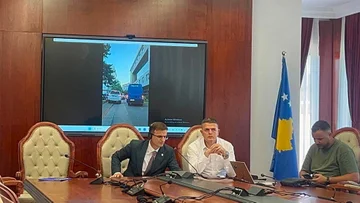
(2 years ago)The United Nations Development Programme (UNDP) in Kosovo published the 26th edition of the Public Pulse Summary at a media conference held today. Public Pulse opinion polls highlight people's perceptions of socio-economic, political and security issues. Data for this collection has been collected from April 17th [...]
The data on this collection has been collected from April 17th to May 7th 2024, reflecting the opinion of over 1,300 respondents covering all thirty-eight municipalities, including urban and rural areas, and including all Kosovo communities.
Some of the major survey findings include:
• The data shows that an average of 50.1% of people are satisfied with the work of Kosovo's main central institutions. •
Contentment with the work of the Executive Cabinet was registered at 53.3%, while the prime minister's work registered at 58.3%.
• Pleasure with the work of the Parliament was 52.10%, while contentment with the Speaker of the Parliament was 64.4%. The satisfaction with the President is recorded at 69%.
• The degree of satisfaction with courts was 27.1% and with the Prosecutor 26.5%) Poverty (16.6%), unemployment (16.3%) and prices for essential supplies (12.7%), were registered as the three main issues. Health care services (7.8%) and environment (5.6%) met five main problems.
• For Kosovo Albanians, the three main issues were unemployment (16.8%), poverty (16.6%) and prices for essential supplies (12.8%). For Kosovo Serbs, poverty (15.2%), urban space problems (13.8%) and interethnic relations (13.3%) were three main issues, while for other Kosovo communities, the main issues were poverty (19.5%), electricity supply. (14.2%) and urban space problems (11.1%).
• A total of 83.2% of respondents reported feeling safe from violence and crime when they are on the street. The gender-separated data showed 83.4% of men and 82.9% of women feel secure when they're on the street.
• The data shared according to ethnic affiliation showed that a greater number of Kosovo Albanians (85.3%) and other Kosovo communities (83.2%) compared to Kosovo Serbs (31.9%) felt safe when they were out on the street. 60% of respondents believe that private sector employment is earned on merit, compared to public sector employment, which only 32% of respondents have stated the same.
• A rise as in the Democratic Index ( IDs, as well as the Index of Economic Stability ( The IBE) was recorded in the latest opinion poll with IDs currently standing at 1.62 and IBE at 121.58% of respondents have claimed to be very satisfied or satisfied with economic direction, while 36.33% of respondents have been declared to be very satisfied or satisfied with the political direction towards which Kosovo is currently heading.
• On average, 19.9% of respondents have perceived that corruption exists on a large scale. Kosovo police with 12.40% have been perceived as the least corrupt institution, followed by international organisations at 13.70%. For 65.3% of respondents, information through the media is one that has shaped their perception of large-scale corruption. 26.8% of respondents have claimed that talking with relatives is what has shaped their perception, while 6.3% of respondents have confirmed that personal experiences have shaped their perception.
• Ethnicly divided data showed that a total of 81% of Kosovo's other communities, 76% of Kosovo Albanians and 54% of Kosovo Serbs were likely to vote if the elections were held soon.
• A total of 10.9% of respondents fully believe, and 40.9% of them believe that the agreement on the road towards normalising relations between Pristina and Belgrade will positively affect people's lives. Separated data according to ethnic affiliation showed that 52.9% of Kosovo Albanians and 51.6% of Kosovo's other communities had a positive view of the Agreement, compared to 25.7% of Kosovo Serbs.
The additional data received by this survey and previous surveys will be made available in the Public Pulse Visualisation Platform and ASCData: https://bit.ly/44GqPyment Meeting published twice a year and that more than twenty years has helped Kosovo institutions and acts to provide impartial and reliable data for key indicators concerning citizens' perception of socioeconomic, political, security and environmental issues.
Public Pulse 26 collection data has been collected from April 17th to May 7th, 2017, reflecting the opinion of over 1,300 respondents over the age of 18. The sample included the same number of men and women from all municipalities and areas of Kosovo, covering both urban and rural areas.
As for ethnic representation, the samples included 896 Kosovo Albanians, 210 Kosovo Serbs and 200 members of other Kosovo communities (Ashkali, Bosniaks, Egyptians, Gorana, Roma and Kosovo Turks).
The Public Pulse Project, which began in 2002, is funded by USAID in Kosovo.