13 minutes ago
Total interview: Kurt's association and US reports
Periskopi(2 years ago)
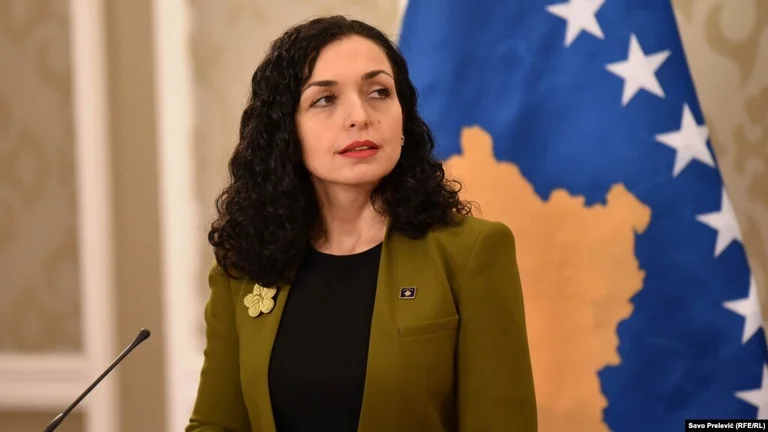
(2 years ago)Kosovo President Vjosa Osmani in an interview last night for Voice of America has said her country wants guarantees from international partners for implementing obligations stemming from the Ohrid Agreement. Osmani mainly referred to the issue of association, the hottest spot in disputes between Pristina and Belgrade. She spoke of guarantee [...]
Kosovo President Vjosa Osmani in an interview last night for Voice of America has said her country wants guarantees from international partners for implementing obligations stemming from the Ohrid Agreement. Osmani mainly referred to the issue of association, the hottest spot in disputes between Pristina and Belgrade.
She spoke of security guarantees, and international support for Kosovo's membership in international organisations, which would bring, as she said, more peace and security in the region.
Osmani added that Kosovo is not seeking to clear its obligations, but to have as “parallel implementation of the agreement reached in Brussels, known as the basic agreement and the Ohrid Annex, where there are obligations for Kosovo, but clear obligations for Serbia, which in their entirety imply de facto recognition of the Republic of Kosovo”.
President Osmani made comments while in Washington at the invitation of Secretary of State Anthony Blinken to participate in meetings held within the NATO summit.
On Tuesday, the U.S. State Department organised a meeting for women, Peace and Security attended by President Osmani.
President Osmani's office has been selected among the three global partners from Secretary Blinken's office to establish the Regional Excellence Centre for Women, Peace and Security in Kosovo.
Voice of AmericaMrs. President Osmani during these days in Washington you've had meetings with American officials, can you share with us what you've discussed?
Vjosa Osmani: In this 75-year-old NATO event, which is no doubt a historic event for all member states and all states that have benefited peace and security from this military and political alliance, for Kosovo is double a special anniversary because it is also the 25th anniversary, truly the historic anniversary of NATO forces' entry into Kosovo, led by the United States. As you know, over these months, Kosovo, with a host of activities in the country and through our embassies, has marked this extraordinary and historical contribution of NATO troops so that we can achieve our freedom and independence and democracy that we enjoy today. Therefore, it has been as important, for the first time in history, that Kosovo is invited into activities under the NATO Summit, and we are very grateful for the work done by Secretary Blinken's office, but also generally the entire American government that Kosovo is central to the attention of these achievements especially in terms of agendas for women, peace and security. Before waiting on this topic began, which was the opening of the NATO summit, in fact was the first event of the meeting organised in co-operation with NATO, I had a conversation with Secretary Blinken and of course discussed Kosovo's achievements. I had the opportunity to express the thanks of the people of Kosovo for all that America has done in these years, but at the same time also for the challenges that we have ahead of us that we must resolve together. Last night we had a meeting with a large number of senators and lawmakers who over the years supported Kosovo, but who are key names I would say both parties because support for Kosovo has always been two-party, which will have an important role in establishing lines, policies and the future. In addition to thanks for their contribution, we naturally discussed the road ahead. Meanwhile, we are also continuing our meetings with leaders of member states (of NATO). You know that Kosovo is not a NATO member state, it is not even part of the Partnership for Peace, yet as I mentioned it is an extraordinary achievement that Kosovo is involved in the framework of this summit and at the same time in meetings with leaders we are pushing ahead of what is inevitable to open Kosovo's doors and not only because of the aspirations of the people of Kosovo, where more than 96 percent are pro-member to NATO, but because Kosovo deserves it. We have an army which is built in full compliance with NATO standards. We are on a line with NATO's policies in terms of bilatheral, whether with the American or British armies, our army is contributing to peace and security missions around the world. So, Kosovo, even though it's a small state, has what to offer in such an organisation and we're making significant steps towards membership.
Voice of America: One of the meetings you have had in the United States is that of Assistant Secretary of State James O'Brian who said after the meeting with you that it was discussed at the meeting, as he put it on <x0). Meanwhile yesterday, in Pristina, Parliament Speaker Glauk Konjufca said Kosovo does not have to implement the agreement with Serbia as long as Serbia is violating it. In the face of these two different positions of Washington and Pristina, how do you see the future of dialogue?
Vjosa Osmani: I wouldn't call them different in terms of their final goals. In fact, both the Republic of Kosovo and all its institutions and the United States of America, as he has said in the first part of his post on the social network X Mr. O'Brian, work for the success of an independent and sovereign Kosovo with its current and integrated borders into Euro-Atlantic institutions. Kosovo-Serbia dialogue is not the whole Kosovo-American relationship. Do not reduce the special report between Kosovo and the United States just by what happens in dialogue with Serbia.
Of course, it is an important aspect for security in the region and for our Euro-Atlantic future to succeed in the dialogue process. That is why the continued insistence of the United States and our other allies because the more there will be successes in dialogue, the sooner Kosovo will take decisive steps towards the EU and NATO.
But we have to make something clear. In any contract, in each agreement there are two sides and it is the basic principle of international law that if one party withdraws from the agreement, then the other side has no obligation to implement its part of the agreement. What we are insisting on as Kosovo is not that we leave our obligations, but that there is parallel implementation of the agreement reached in Brussels, known as the Basic Agreement and the Ohrid Annex, where there are obligations for Kosovo, some of which have been difficult concessions, but there are also clear obligations for Serbia, which, if taken in its entirety, condition the de facto recognition of the Republic of Kosovo, as outlined by European leaders in their 26 October declaration.
So Serbia cannot openly declare and send a letter from the prime minister who is withdrawing as a whole and will not implement the agreement and we offer as volunteers to implement everything without taking guarantees on the other side.
What I've said in the latest interview actually about Voice of America a few months ago when I was at the Security Council session, is this: if we are all convinced that we and our partners that Serbia will not implement its part of the agreement, then we have to return to the 2007-2008 strategy, when negotiations on Kosovo's status took place. Our agreement, our agreement, has been with partners, not with Serbia, because Serbia did not want Ahtisaari, and we need such agreement.
If Kosovo is to implement all these obligations it has received, we need guarantees for security, international support, membership in international organisations, not as transactions, but as a project that eventually shuts down this topic and brings more peace and security to the region.
Voice of America: However, Mrs. President, you said Serbia is not fulfilling its part of the deal, but as far as the Association is concerned, which is the hottest part of it. There are observers who as a sovereign state, it is up to Kosovo to take steps in this direction. Here we are talking about your citizens, that percentage of the Serb community that are citizens of Kosovo. What is your opinion in this case?
Vjosa Osmani: Of course, it is up to Kosovo to take steps for Association and it is up to Serbia to take steps towards recognition and fact. Both are in the same agreement. We can't ignore articles 1 through 6 and jump to Article 7 alone and just ask for the implementation of a article. Kosovo is not saying that the Association will not be formed.
Voice of America: This is about the deal. I'm saying you as a state in relation to your citizens.
Vjosa Osmani: In relation to our citizens we should not create the impression that association helps Serbian citizens in Kosovo. In fact, the most advanced minority rights system exists in the Republic of Kosovo now, with the current Constitution, with the laws of the Ahtisaari package and other laws that we have adopted as a result of dialogue agreements.
With association, I assure you one thing, it only diminishes the rights of citizens and empowers a kind of power over them, so the leaders of association, which Vucic has at the moment intended to control and somehow make Kosovo dysfunctional. So the association does not give more rights to Serbian citizens, but rather gets more rights from below and sends them up, which is contrary to the basic principles of the Council of Europe, under which to strengthen minority communities must have more sovereignty from above and not opposite. Association actually does the opposite.
Even the secular lawyers of the Council of Europe have declared that it is not in line with the principles of the Council of Europe. However, we have given the promise and Kosovo is a serious state. When it takes on an international obligation, it must be implemented. But implementation of the Association is within a process and that process is the Basic Agreement.
Voice of America: In what environment would you make concessions to begin at least the process of establishing association, which could be, for example, the taking to the Constitutional Court? Not because you have no power over this...
Vjosa Osmani: The Constitution of the Republic of Kosovo and the very judgments of the Constitutional Court, especially that of 2015, have clarified the procedure. So there must be an act on the part of the Government, which approves that document and then I can send it to the Constitutional Court, but not without such an act at first. That's what the practice was after 2018.
But I must clearly say that the establishment of Association does not mean that Kosovo is willing to make concessions that harm its functionality, its borders, the principle of state unitability and principles that are in the current Constitutional Court and the Constitutional Court Act.
The association can be created, but only within these Sosa, without endangering Kosovo or even security in the region in the future. Again, as I have said in preliminary interviews, I think Kosovo would have to be willing to move forward if clear security guarantees and guarantees for Kosovo's membership in international and recognition organisations.
Voice of America: Didn't the partners offer these?
Vjosa OsmaniSo far it's been more than we'll try, we'll see, maybe. You finish it first and then we talk. I think the time has come for us to have a common plan with our allies, and when I say with my allies here, we need the lead role of the United States, because as our story proves, only then has our region succeeded in bringing lasting and lasting peace and security. So let's sit down with our partners, we do this, then we take the guarantees for security from our partners, because we have to make sure that what's going on in Bosnia, never happens in Kosovo.
Because it is not only in the interests of our citizens, regardless of which ethnicity, but it is neither in the interest of regional peace and stability and, therefore, our entire continent.
Voice of America: Mrs. President, you know your visit here to Washington is one of the rare high officials from Kosovo, due to the extremely problematic relations between Kosovo and Washington. What's your opinion? Are they at the lowest point today?
Vjosa Osmani: In the Constitution of the Republic of Kosovo, the presidential institution leads the foreign policy. So it's the most normal thing that invitations to Washington, to New York, to the summit of European Political Community, where I'm going to travel in a few days, to the EU Western Balkans Summit, to the Peace Summit for Ukraine, where I was, to be for president because that's the application of the Constitution of the Republic of Kosovo. And so it has always been with the former Presidents, who represented the Republic of Kosovo internationally.
In no way would I say that Kosovo is being ignored, there is actually no state of the region that is more present than Kosovo, whether in Washington or other summits, and wherever we are given the opportunity we are the most active state with our jobs, of course with our reports, with the states apart.
Now I don't want to act here as if I'm ignoring problems. Of course there have been differences of course in access, not in intent, but in access to certain cases, between American officials and the government of the Republic of Kosovo. However, as president of the Republic I constantly call on because of Kosovo's interest, and therefore we have to look much longer, and not just for some victory of the moment that the topics they have to do with security in Kosovo and in the region, since they all depend on our security partners, and because they're part of these value alliances, we have to agree, co-ordinate, speak to our partners in advance. Because mutual trust is the most important element in every report in domestic politics as well as international.
I am convinced that the actions that are taken as a surprise, in reporting to partners, regardless of the legitimate purpose and compliance with the constitution, in the long term cannot help Kosovo, only if they co-ordinate with partners especially with our US allies.
Voice of America: Presidential Lady after several months here in the United States will be held presidential elections. A portion of NATO leaders have expressed their concern in the event of change of administrations, seen in relation to Mr. Trump's attitudes towards NATO, scepticism towards the alliance. Are you concerned in this regard?
Vjosa Osmani: As president of the Republic of Kosovo, it is not up to me to comment on the candidate stances of the elections here in the US. What I mean is what the position of the Republic of Kosovo is on NATO. NATO is an alliance that has saved Kosovo from extinction, NATO is the most successful political-military alliance in human history. Being in NATO means being safe. The more NATO, the more NATO presence in our region, the more states in NATO, the more peaceful and promotional the world will be.