8 minutes ago
Who is guilty of being stuck in Kosovo-Serbia dialogue?
Periskopi(2 years ago)
(2 years ago)For nearly nine months, Kosovo and Serbia's leaders only went to Brussels once for talks and did not meet each other. The sides exchange accusations of failing to implement the agreements reached, but who is guilty that the process for normalising Kosovo-Serbia reports is stalled? Appointments recently held in dialogue [...]
For nearly nine months, Kosovo and Serbia's leaders only went to Brussels once for talks and did not meet each other. The sides exchange accusations of failing to implement the agreements reached, but who is guilty that the process for normalising Kosovo-Serbia reports is stalled?
Meetings recently held in the dialogue between Kosovo and Serbia, whether at the top level or at that of the chief negotiators, have a common denominator: conclusion without concrete results.
The parties, who dialogue from 2011 under the European Union's mediation, constantly blame each other for failing to implement existing agreements or for failing to dialogue, meanwhile, the EU has stressed that there is a lack of political will for implementing agreements.
Kosovo and Serbia also have different opinions on concluding the process of normalising the reports. Kosovo requires mutual recognition, meanwhile, Serbia wants to compromise where “neither side will be an absolute winner or absolute loser”.
The last agreement the parties reached, in 2023, was on the road to normalising reports known as the Ohrid Agreement, which Brussels considers great achievements.
This agreement, which has not been signed because of Serbia's refusal, envisions even a level of self-defence for the Serb community in Kosovo, as well as mutual recognition of state symbols. It calls for Pristina and Belgrade to implement, as well, all agreements made earlier, including the one for the Association of Serb majority municipalities, whose foundation Serbia insists, while Kosovo has so far refused.
“From normalization to crisis management”
Toby Vogel from the Council for Democratic Policy in Brussels tells Radio Free Europe that dialogue is not marking success that many years after, according to him, concentration has shifted from reaching a legally binding agreement on normalisation to crisis management, which erupted separately last year.
The blame for the impasse in dialogue, he attributes the three sides.
The key “Gengesa comes from Serbia”, states Vogel, under which Belgrade “does not want normalisation because it benefits from the current” state of uncertainty.
But neither Kosovo, according to Vogel, is interested in the dialogue process, because I know its European path “will be closed for many years”, as normalisation is set for European integration for both countries. The two sides are not interested in solutions, for now”, Vogel says.
And as for the EU, Vogel considers that Brussels has been mismanaging “ ” the dialogue process.
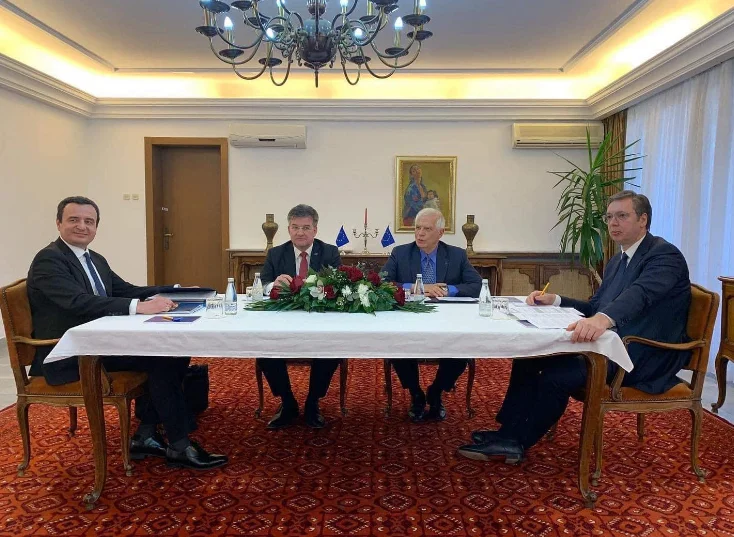
As meetings at the top negotiator level have been held, dialogue on the political level was non-existence for almost nine months. From September 14th 2023 to June 26, 2024, Kosovo Prime Minister Albin Kurti, and Serbia's president, Aleksandar Vuciq, did not go to Brussels for a round of talks.
In much of last year, tensions were high: from the May protests in the north, against the new Albanian mayors, to the escalation in Banjska, when a group of armed Serbs led by Milan Radovici attacked the Kosovo Police.
According to Vogel, the events in May, but also the September attack, should be “awakes to the EU for changing access to dialogue.
Vogel says that, even after Banjska, Serbia has continued not to face pressure -- at least not publicly from the EU -- already against Kosovo are still in force of punitive measures imposed due to tensions in the north.
Kurti's Conditions for Dialogue
In the final round of dialogue, on June 26th, though a meeting between Kurti and Vuciqi was warned to negotiate the Ohrid Agreement, the EU said Kosovo prime minister refused to sit at a table with the Serbian president, and set three conditions for further engagement in the process.
Kurti sought to sign the Ohrid Agreement on the parties, to withdraw a letter of December 13th 2023 of former Serbian Prime Minister Anna Brnabiq é, where Serbia says it will not implement some parts of the agreement, as well as hand over Radoviciqi and his group on the part of Serbia to the Kosovo judicial authorities.
Vogel does not name last year's pact as an agreement, because, he says, in Brnabisic's letter, Serbia acknowledged it would not be reconciled to what de facto recognition of Kosovo's sovereignty and independence implies. The meaning of normalization, according to him, is recognition.
Even the EU said on July 1st that “the logical sequence of normalisation would be recognition”. This EU stance, for Vogel, is signal that the “bloc has acknowledged that dialogue is not producing results”.
Conditions set by Kurti, Vogel sees them as reasonable and describes them as principled, but says he had to make them public before the parties went to Brussels.
But, American Ambassador to Pristina Jeff Hovenier, in an interview for Klan Kosovo on July 3rd, said he expects Kosovo and Serbia to implement all dialogue agreements “without precondition” and “emergency”.
Change of mediators
Later this year, leaders of key institutions are expected to be changed to the EU. EU diplomatic chief Josep Borrell's seat is expected to take over from Estonia's prime minister, Kaya Kallas, meanwhile, at the site of dialogue emissary Miroslav Lajcak, is still not known who will come.
While Kurti and Vuciq are seen as reluctant to normalise the reports, Vogel says that with the arrival of Kallas, the atmosphere in the dialogue will change, but Serbia must also be ready to face a little more pressure from the EU.