3 minutes ago
Ukraine, Putin and Biden: What Changes After Right Victory in European Elections
Periskopi(2 years ago)
(2 years ago)The European elections result raises a series of crucial questions for the international scenario -- what will now happen to support for Ukraine? Will something change in relations with Vladimir Putin? And Joe Biden? Will the joint European defence project continue? With the polls closed, a month [...] awaits us.
Will something change in relations with Vladimir Putin? And Joe Biden?
Will the joint European defence project continue?
With the polling stations closed, we are hosting a political-diplomatic month with at least three important deadlines.
On June 13th and 14th, after a few days, the G7 meeting, led by Italy. In 15 and 16 the Swiss Peace Conference, promoted by Voldymyr Zelensky, who has so far joined about a hundred countries (Russia has been excluded; China must not participate.
From 9 July to 11 July, the summit of NATO heads of state and government in Washington writes “Crrier Della Sera”, following the AP.
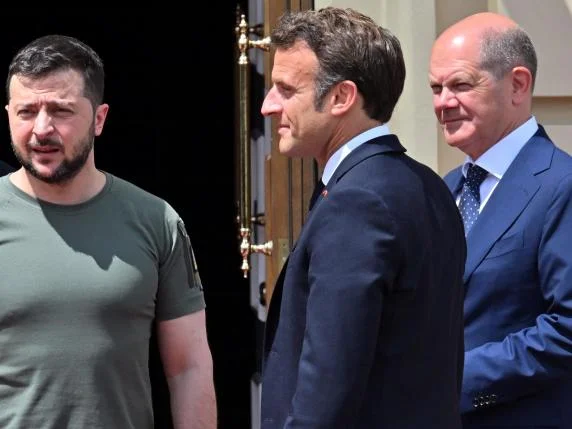
Attention, of course, will focus above all on the movements of two big losers, Emmanuel Macro and Olaf Scholz.
Parliamentary elections in France are scheduled for 30 June and 7 July, with a double round.
But even in the event of a clear victory for Marine Le Pen's National Convention, the French president will continue to hold the reins of international policy.
Macron, as the Constitution predicts, will remain the head of the armed forces and diplomacy, even in the event of co-existence with a government formed by the current opposition.
In theory, therefore, he can confirm the strategy followed so far to the international level: maximum support for Kiev, starting with sending more weapons.
However, this election could increase internal tension in France, offering, in addition, new arguments to Le Pen's supporters, who require, at least, to facilitate support for Zelensky.
Scholz's situation is also very complex, leading a government that was already plagued by many doubts about the war.
Hence, confusion and uncertainty may increase in the coming weeks.
Italian G7 could become a liaison step, with only one attainable goal: to use the interests of Russian funds blocked in European banks to guarantee loans granted to Ukraine.
The Peace Conference could result in a simple parade of principled statements, expecting the new political balance to be established in Paris, Berlin and Brussels.
Finally the Atlantic Alliance.
Also in this case, the French and Germans can take time, slowing Ukraine's path towards NATO.
Or Macron and Scholz can resume the challenge to their internal opponents, maintaining confidence on the already track-track political diplomatic path.
Americans, Britons and the eastern wing of the Alliance will surely pressure in that sense.
The calendar offers weeks of difficult tests and tensions.