6 minutes ago
Robertson: Vuchy's Kurt must find agreement on the contrary we will again be in the situation of the 1990s
Periskopi(2 years ago)
(2 years ago)Lord George Robertson, former secretary general NATO has spoken of NATO's air campaign to the former Yugoslavia, adding that it felt relieved as it was heavily involved in the Kosovo situation. “has been 25 years since NATO's air campaign on the former Yugoslavia, and that for Kosovars means something more. 25 [...]
Lord George Robertson, former secretary general NATO has spoken of NATO's air campaign to the former Yugoslavia, adding that it felt relieved as it was heavily involved in the Kosovo situation.
“has been 25 years since NATO's air campaign on the former Yugoslavia, and this for Kosovars
It means something more. 25 years of freedom. At the same time, Kosovars see you, Great Britain, the United States of America, NATO as savior”, he said
The full interview carried out with Lord George Robertson
RTV21: I want to ask, what does a man feel like who had the fate of a nation in his hands?
Robertson: Well, I just did the job I was given to do. I became Secretary of State for Defence from Tony Blair, which I understand was in Kosovo this week. And so, when the emergency came, we sat down with the ministers of France and Germany and some of the other NATO countries, and we looked at what intelligence told us, so we knew what was going on. You knew but the rest of the world didn't know how brutal and how terrible were the actions by Milosevic, his forces were in this part of the country, and therefore we had to do something about it. So I didn't feel a hand of history on me. I just did the job I had to do. I was a minister of defense. I was with the foreign secretary, Robin Cook, at the time, another Scottish. And we knew the action would be required. So we did. Okay.
RTV21: You were the Secretary of Defense of Great Britain at the time when the bombing campaign began and then ended. Months later you received the post of NATO secretary-general. Was it difficult to decide to bomb a country considering the diversity of the North-Atlantic Alliance?
Robertson: Well, I was the defence minister when the action was taken for Kosovo, and it returns a little further than 1999 to 1998, when NATO defence and foreign ministers gathered together at Vila Mura in Portugal. And we were told then, I remember having a sign of that time NATO Secretary General Javier Solana said we should do something. He said, Milosevic says a village a day keeps NATO away. He said terrible things are happening there. We know how bad it is and therefore, we have to do something. So at that meeting, we passed a UN Resolution 1244 resolution and we said, or else if he didn't do what the UN asked him to do and he didn't, then we said otherwise, which led to Mars 1999, in the decision to bomb Serbia and Kosovo without a UN Security Council resolution. It was a very, very important moment, and I remember it very well. It was historical, and a great responsibility was on our shoulders.
RTV21: But many criticise the international community for the NATO intervention and shelling what was left of Yugoslavia at the time. And many describe intervention as a violation of international law. Was this a turning point for international law and NATO?
Robertson: It was. Because we knew we should act, even without that Security Council resolution, that would give us power under international law. But international law, you know, came before the United Nations, you know, international law is a set of rules that it says cannot attack the civilian population in the way Milosevic was doing it. Thus, it did not matter for NATO member states and at the NATO Council table all felt it should be done, and all of them, all 19 member states would find their legal excuse to do what everyone considered to be the absolutely necessary step that world to prevent a massacre that was taking place. ethnic cleansing of Kosovo, Albanian population
who was being driven out of their country.
RTV21: And how did you feel when the war ended, when Yugoslavia surrendered?
Robertson: Well, I felt relief at the time because it was over. I felt the relief that the Russians had told Milosevic that they would only be if there were an Earth invasion of Kosovo, no, we had not planned it, but suggested it would happen. So we felt justified that we had saved a people. We saved a nation. And, you know, what we said at the outset was that Milosevic's army get out of NATO inside and refugees in the house. And if we hadn't acted, people, 2 million Kosovo Albanians, would have been scattered refugee camps around the world today. So I felt a degree of pride, a degree of satisfaction, and also a degree of relief.
RTV21: Lord Robertson, was it clear to you, to NATO, to Great Britain, to the US, since the bombing that Kosovo would have another status ever since. Was it clear to you that a new country would emerge after the bombing campaign?
Robertson: I think it was quite clear that Kosovo would not stay a part of Serbia. It couldn't be after what happened and what happened. But it would always be difficult. You know, you can't create a new country from what's already an existing country. Despite provocations, despite terrible actions. So we knew there was a challenge ahead. But I think it was quite clear that time Kosovo would never, ever remain part of Serbia.
RTV21: On first post-war visits to Kosovo, you said and I quote: NATO will not stand aside and see the creation of another ethnic Kosovo. 25 years later, where do you see Kosovo?
Robertson: Like a multiethnic state. It should be. Its democratic foundations, its economic development depends on how much a multiethnic state is. We didn't take that military action, we didn't risk thousands of people. We did not attack Serbian targets simply to create another monoethnic state. And therefore, it is very important that Kosovo Serbs and other ethnic groups in Kosovo feel part of the state now on the world stage. So I have a very strong message that I'm bringing to this anniversary, this is a multiethnic state. Must remain a multiethnic state. Its entire future depends on the fact that all ethnic groups in society feel part of it
RTV21: Lord Robertson. The need for a NATO peacekeeping mission has long been proven, many say they have played a role in stability not only in Kosovo, but throughout the Western Balkans. However, there are also voices saying NATO should have given more power to the Kosovo Force.A Is this the way to advance security, stability and ensure more peace?
Robertson: Kosovo's power. KFOR was the NATO force. If you are talking about the armed forces in Kosovo yes, they have now restored control, they are very efficient. We'll see them in the parade during tomorrow. And they are a small force for preserving peace here under the NATO dome is very small compared to the numbers that were initially set up. And they are here simply to support the armed forces of the Republic of Kosovo. There has been crisis in Kosovo for several years, including actions that were considered terrorist in the northern part of Kosovo. Was September last year a turning point in the position of the United Kingdom and international partners that security in the Balkans, by and large, in Kosovo, is endangered by Serbia. I think there is a danger that the region will be destabilised not only by Serbia, but by others playing in the Western Balkans for a growing problem that could lead to the terrible violence we saw in the 1990s. And I think that the international community in general wants to prevent and therefore there is a huge diplomatic effort going on to ensure that those differences of opinion, which is what they are, do not turn into a terrible violence that we have seen in the Western Balkans in the 1990s. So there is a need for a spirit of reconciliation, of compromise at this time. You know, and I told Prime Minister Kurti and I would say Prime Minister Vucic, if I were to meet him, you know, you could respect history, but you can't live in it, you should solve some of these problems with diplomacy and peacefully around the table. Not through confrontations in battles or on military battlefields, and therefore, tolerance, compromise is the sign of what Europe is. If you look at the relationship between Germany and France and take into account the years of conflict among the millions who died as a result of the wars between European countries against each other, then today is a miracle. Relations between France and Germany, between Belgium, Sweden and Spain, these countries that during generations fought each other, are now at peace, discuss the price of butter or how much money can be given in Ukraine instead of territory there as well. So the Western Balkans will have to grow if it wants to be part of the European Union and part of the family of nations. If you want to build prosperity for its people, then some major compromises will have to be made and will have to be made in Pristina and Belgrade. If the region wants to be rich and quiet again.
RTV21: We're talking about compromise. What concretely does compromise mean for Kosovo. We have seen that Kosovo is not ready to compromise for the Association of Communities with the Serb Majority in Kosovo. And on the other hand, Serbia does not want to recognise Kosovo as it has been, to say, hired in Ohrid and Brussels last year.
Robertson: You know, I'm very critical recently of the generals on duty, retired generals, who comment with authority what's happening on the battlefield, whether in Ukraine or Gaza or elsewhere. And I'm just as critical of the secretary-general on duty, giving up their responsibilities and letting another generation face it. So I don't want to go into the details of what is happening in relations between Kosovo and Serbia today. I regularly talked to Catherine Ashton, who was and is still involved. I spoke yesterday with Air Aviation Marshal Stuart Peach, whom the British government appointed as a special emissary for the Balkans. And they're deeply involved in issues here. But I'm not. I only call on all leaders in the Balkans to gather and recognise, you know, because history will judge badly if they don't compromise and if they don't cooperate and if they're not tolerant of other opinions. This morning I quoted Goran Svilanovic's words as being the first foreign minister after Milosevic's Yugoslavia, and he came to NATO headquarters and said: “And I was impressed that he was so smart and very relevant and so important. Criminals don't know ethnicity, they don't know borders, they don't know all territories. They just want to keep going and make money. And I think they need to close. But Balkan people should have the opportunity to take advantage of the fact that borders are incorrect ethnicities, other inaccurate. The future belongs, as the European Union has illustrated, to those who are willing to compromise and build things together. And this is the order I want to give today.
RTV21: You also have orders for the international community in the British Parliament when you spoke about Kosovo and the events in the northern part of Kosovo, and I am quoting you again: “Be harsh with Serbia pays off. People in this part of the world respect power”. Was a strong action by the international community really needed at this particular time. What do you think should have been done?
Robertson: A strong stand by the international community is always needed. Now Serbia recognises the force. So does Russia. You know, I've been working with Russia from a strong position without a dilemma. And we created the NATO-Russia Council and the declaration of Rome and all these things that Vladimir Putin has now left especially after he has now violated the UN Charter and all the agreements he personally was responsible for and which Russia was responsible for. So being persistent is important with Russia today, but also with everyone in this region who wants to recreate the 1990s conflict. It is unacceptable for the world to return to that terrible, unacceptable violence we saw then. And this message has to go to all politicians in the region. They must unite if they really want to bring peace and prosperity to their people.
RTV21: You have been loud in the United Kingdom Parliament many other members of the UK Parliament were also very loud talking about what is happening in the Western Balkans and in Kosovo in particular. But I would ask you, was it a mistake for British forces to withdraw from the Balkans a few years ago?
Robertson: No. We received military advice and politicians made the decision that we could withdraw forces to Bosnia. We had 65,000 troops in Bosnia when we stopped the war in 1995. Now, there are no NATO troops there, there is only one force for preserving peace from the European Union. Perhaps they should be reinforced because of what is happening in Republika Srpska today. But, you know, we did what we had to do back then. We heard military counsel and received a political trial about the reduction of troops over time. And now, we don't have the violence we saw in the '90s.
RTV21: And you are again, like United Kingdom active, pro-active in the Western Balkans, in Kosovo, especially seeing new forces, British forces in the northern part of Kosovo?
Robertson: Well, you know, I'm still a British parliamentary, not chosen, but I'm still in the House of Lords. I still engage in the Western Balkans. Kosovo was written in my heart because I was very involved back then. So I carefully follow him and give advice if asked. So I'm worried about what Russia is doing by interfering with this region. I worry that interethnic tensions create instability, which hinders foreign investment. I worry that we can go back to violence if politicians are not smart enough or reasonable enough to deal with their problems in a peaceful manner. As Madeleine Albright once said, I'm an optimist who worries. That's what I am.
RTV21: And you have good knowledge of the Western Balkans. Things seem to be heading towards the crossing following Ukraine's full invasion of Russia. Is there risk for any outbreak of the Western Balkans conflict in Bosnia, Kosovo, too?
Robertson: If Ukraine loses, if the enemy if Putin wins in Ukraine, I would actually worry about the Western Balkans, because it is an area where he is obsessed with future impact. It will not deal with NATO countries, because it means dealing with a nuclear alliance. But, you know, I would be worried if I said Moldova or Armenia or Azerbaijan today and surrounding areas. I would be very concerned in the Western Balkans if he arrived in Ukraine and with that aggression, then he would go to other areas and attack the West, not by military means, because he knows the consequences, but through hybrid warfare, cyber attacks, targeted murder, sabotage, election intervention. All of this is in the current Russian book, and they use it all. The cyberattack in London last week and the blood transfusion service that caused a blood test emergency in my country's capital. And people believe it was a Russian criminal organization, but criminal organisations are now headed by the Kremlin as well. So I'd be worried about the fate of Ukraine because their fate is related to our fate as well.
RTV21: Lord Robertson you've met President Putin before. You've had conversations with him, too. Was the Balkans the scope of his interest when you talked to him?
Robertson: On the days of meeting with Vladimir Putin, I met him about nine times during my time as secretary - general, relationships were friendly. He was on our side. He helped us in Afghanistan. He was excited about what we were doing. We created the NATO-Russia Council. We had conferences on military aspects of terrorism. We developed a partnership worker. He was a man very different from the aggressor of two years ago, a man unlike him who now believes he could just remove his responsibilities to the UN, you know, and all the agreements you signed, including what he himself signed with me on May 28, 2002. He's a very different man than the one we're seeing right now. But he must face it. He's made a terrible mistake. He thought he could stop NATO enlargement, and now there are two new countries in NATO. He thought he could separate Europe, and she's more united than ever before. He thought he could separate Europe from the United States, and they have joined together. He thought he could take over Ukraine in three days, and now two and a half years later he still struggles to maintain a minimal territory that won him in the initial stages. This was a total disaster for Russia and a total disaster for Vladimir Putin. And our fate depends greatly on the future of the Ukrainian people.
RTV21: Was Kosovo part of the conversation with President Putin at the time? Did he seek any compromise from the international community when the Kosovo issue opened in the discussion, let's say.
Robertson: I think that the Russians, including Putin, now retrospectally after the event, use Kosovo as an example of what they are doing. They say you took military action against Yugoslavia, you created Kosovo, so you created the example we are now following. But he was unaware of what was happening in Kosovo at the time and why we had to act. He was also ignorant of the fact that Russia was involved and engaged as well. At Pristina Airport, which was being managed by Russian troops. Russian troops served both in Bosnia and Kosovo. We were part of a joint effort to reconcile and control the forces of violence in the Western Balkans and in Kosovo as well. And I would only like him to remember that there were Russian troops who helped us here to preserve peace after Milosevic's troops withdrew. It would be something I think he might feel proud of, but he seems to have forgotten.
RTV21: Was Russian intervention... exactly on this day 25 years ago, when the Russians took over the Pristina airport and also when marching in Pristina, downtown Kosovo's capital. Was Russia and Putin's purpose to create instability at that time clear to you?
Robertson: No. President Yelts at the time ordered several small numbers of waterless and ammunition-free tanks, without protection to enter Kosovo and be there as part of the liberation. You know, they didn't go there to fight NATO troops didn't go there to fight with General Jackson and KFOR. They were there to be added to peacekeepers from whom they were asked to be in the country while Serb troops were withdrawing. And I think people forget that this is why this very small contingent came here. And in fact, General Jackson, whom I talked to this week, General Mike Jackson decided not to take action against these tanks and offered them protection from a very angry Kosovo Albanian population who saw them as enemies, while in fact, they were here to strengthen peacekeepers at the time. But General Jackson at the time said he was not ready to cause the Third World War.
RTV21: Exactly when Russian troops entered Pristina. Was it that dangerous? Was the situation so dangerous to cause a real conflict at that time?
Robertson: I think what General Jackson was saying was that the Russian troops were there to be there when our troops came in and Serbian troops came out. So they were part of KFOR, he didn't want a confrontation with Russia and President Yelts on behalf of Russia, he never wanted a confrontation with NATO.
RTV21: Lord Robertson, do you believe that with Mr. Robertson? Vuciq in Serbia and Serbia today, reconciliation with Kosovo is possible?
Robertson: Yes, of course it is. I think that if the leaders of Kosovo and Serbia recognise their obligations for the future of their people, then there will have to be a reconciliation. You know, President Vuciq, who is, as you know, an interesting person. You know, he's helping Ukraine, what pleases the Russians. On the other hand, Russia, it is close to Russia in other ways. You know, he's creating problems in Republika Srpska
and Bosnia and Herzegovina. And at the same time, he knows that his people want membership in the European Union. So, you know, he's a politician who faces at the same time in all directions. Therefore, you know, he needs to know that if he wants to make Serbia part of the European family must solve the problems he has in the region, prevent interventions in Bosnia and Herzegovina, recognise Kosovo as an independent state. This is part of the united Western Balkans, which itself can move towards the rest of Europe, towards economic prosperity, peace and fulfillment.
RTV21: But let me ask you: was the dialogue between Kosovo and Serbia a failure from what we have seen so far?
Robertson: We have heard and there are many voices saying it was a failure it didn't work out because, to call, “The international community's” towards Serbia. I don't know, and I won't get involved in the details of what's going on right now. These are sensitive talks, but I remember a conversation with Serbian Prime Minister Djindjic, a man, you know, that had a broad horizon, you know, that he had a vision of his country's future that was not limited by the history of Yugoslavia or Serbia as a whole. Now, Serbia lost a great power when Djindjic was killed. But I believe, Prime Minister Vuciq, he's an intelligent individual, he's a smart man, he knows what reality means, he's educated and although he's playing certain games at the present moment, he knows that if his country will be accepted into the international community, there are things Serbia should do. And he knows that
I'll do it after all. So, you know, those who are talking at the present moment with a very heavy load on their shoulders and I like them well. I'm not part of that anymore. And I have no regrets for a moment. But, you know, I think people should look towards the future, look at the little kids, you know, that they're walking on the street, in schools right now. Think of what they will desire.
What will they need in the future so that today's politicians are a little smarter and a little more conciliatory than they have been to date.
RTV21: You have met Kosovo leaders today and there are clashes between Kosovo and the international community these days. Have you had the opportunity to tell Prime Minister Kurti and Kosovo leaders, to clarify Kosovo's future and future relations?
With the international community?
Robertson: What I tell Prime Minister Kurti is to listen to the international community. I'm saying this as well as President Vuqic and the leaders of Bosnia and Herzegovina, Republika Srpska, that the international community has your interest in heart and if they are critical, if they make suggestions that are inappropriate even then listen to them. Because they know. They're smart enough. They are, you know, deeply interested in giving you advice that you should listen very carefully. So this applies throughout the Balkan region. So I don't say anything to Prime Minister Kurt that I don't tell anyone else if I have the chance to do this. The future of the people of Kosovo and Serbia is in their hands. If they use these hands incorrectly then the future is pale. If they are looking into the future, then there is no reason why Kosovo and Serbia should not be equally rich, equally part of the European Union, and equally part of Europe's future.
RTV21: I think you really trust Mr. Kurt and Mr. If they can produce results and both will agree to work together and move on?
Robertson: Not just faith. Obligation. I'm putting pressure on their shoulders to listen. You are two who give them right, helpful advice, perhaps unpleasant counsel from time to time. They both have to find a deal because otherwise, you know, we can find ourselves back in the terrible nature of relationships.
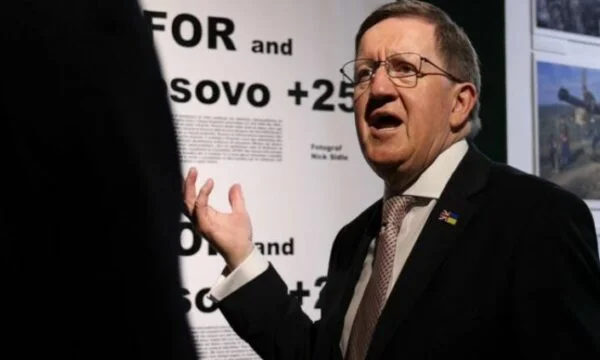
during the 1990s. So no one would want that for people. You know, I was part of an exhibition.
At the National Museum of Kosovo today. And I hope that as many people watching this program go to the museum and see photos there of peacekeeping troops that came after the war ended. You have to do with people, where most of the children in these pictures can be grandparents today you know, but the bodies that came and treated them with empathy and humanity and they thought when they fought there, that some of them are in Kosovo today, returning to relive the experience. They thought what they were doing was a glorious mission to save a country and allow these children to grow in peace with the same degree of security and peace that their children at home were experiencing at that time. So when people see these pictures
in the National Museum, I hope they will reflect on the hope we installed at that time and then engage in that hope for the future.
RTV: And how long do you think Kosovo will need NATO peacekeeping troops? How long is NATO
Ready to stay in Kosovo?
Robertson: Well, I believe, and yet I am not there anymore, but they are there as long as necessary
And as long as they're asked. I hope it will be a very short period of time, I hope it will be a short period and then the people of this region will take care of their jobs. After hearing the international community care about them.
RTV21: And let me ask you, there are some NATO member states that have not recognised Kosovo's independence. Despite that, do you believe that Kosovo has achieved its maturity to be in the Partnership for Peace or even a step further, NATO member?
Robertson: You're asking me to be a secretary-general again and I refuse to do that. At a certain moment, the North Atlantic Council will have to make a decision. I hope that Kosovo and Serbia will eventually become full NATO members. That's my purpose. This is my hope. Because these are two important countries that can add a lot to Europe's security. You know, this is not an impossible dream, but it's a dream that I have. The sooner he comes, the better.