8 minutes ago
What do the European Parliament elections bring us?
Periskopi(2 years ago)
(2 years ago)The five-year mandate of the outgoing European Parliament was marked by numerous challenges, some of which test European Union unity. The most significant events that marked previous years are the rise of Great Britain from the European Union (it participated in the 2019 elections), the COVID-19 pandemic, and Russian aggression against Ukraine. [...]
The most significant events that marked previous years are the rise of Great Britain from the European Union (it participated in the 2019 elections), the COVID-19 pandemic, and Russian aggression against Ukraine.
The issue that has caused more disagreement and division within the EU, since the large influx of migrants in 2015, is the policy of migration and asylum. It was on this topic that many extreme right parties benefited, not only in the European Parliament elections, but also at the national level.
The main topics discussed in this campaign are the security of the European Union, the situation in Ukraine, migration, the Green Agreement (plan for a climate neutral EU), living standards.
Polls predict the European People's Party (EPP) will win 176 mandates, which is less than 182 mandates it won in the previous elections. The group of Socialists and Democrats (S&D) will have 144 mandates instead of the current 156 mandates. It is expected that the political group Renew Europe will receive 82 instead of the current 108 mandates. The biggest decline is forecast for the Green/European Free Alliance political group, from 74 to 41. The left has also scored from 41 to 32. The extreme right ID and Democracy could win 66 mandates, 6 less than the actual number of mandates. The number of European conservatives and reformers is expected to rise from 62 to 72. This time around, the number of MPs to belong to the independent parliamentary club will rise significantly.
At the current meeting of the European Parliament, the coalition that has the majority consists of the European People's Party (EPP), the Socialists and the Democrats (S&D), Renew Europe (RE) and the Jelly. If polling results are confirmed in the elections, this coalition will have a majority in the upcoming European Parliament meeting. Largest political groups, such as the EPP and the EPS, ruled out the possibility of co-operation with far-right parties. That is what Ursula von der Leyeen, current president of the European Commission and PEP candidate for re-election, said in her speech during the recent television debate.
If you look at the National Alliance (Mine Le Pen) or the AFD, everyone has something in common: they are Putin's friends and want to destroy Europe”, said Von der Leyen.
One of the main leaders of the political group Renew Europe, French President Emmanuel Macron, in speeches and political initiatives, emphasises the need to reform the European Union, first of all, European architecture of security and defence so that the EU can respond. to contemporary challenges and threats.
In a lecture in Sorbonne, he noted that the EU wants to be a global “lider by 2030” in five strategic sectors: artificial intelligence, space, biotechnology, quantum information and renewable and nuclear energy capacities.

Green political group candidate Terry Reintke believes the rise of right-wing populists and their proximity to Russia is the biggest threat to Europe. She cited that a large number of right-wing parties express views that are favourable for Russia and that some EP members are “a extension of Vladimir Putin's hand” and that “several MPs allegedly received money from Moscow”.
In political grouping Identity and Democracy, the most influential parties are the National Alliance and Alternative for Germany (AFD) and Marine Le Pen, which have the largest number of MEPs within this group. As their priorities in the campaign, they declared the ban on illegal migration, preventing European Islam, fighting bureaucracy in the EU, and increasing security.
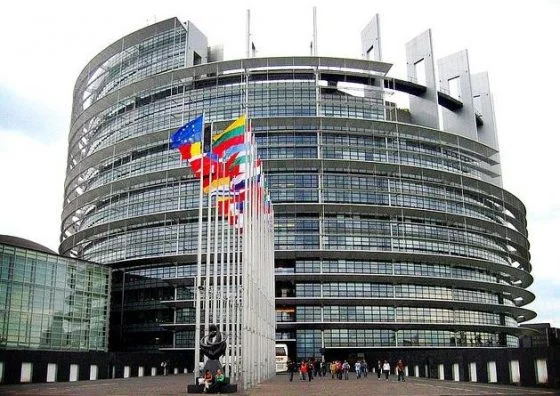
The vote on the election of European Parliament MPs begins today in the Netherlands and will be held in all 27 European Union member states by Sunday, June 9th. Over 350 million voters will elect 720 members of the European Parliament, fifteen more than 705 currently.
The largest number of members in the European Parliament will be Germany 96, France 81, Italy 76, Spain 61, Poland 53 and Cyprus, Luxembourg and Malta will have at least 6 members each.
The number of members of the European Parliament that has every country is proportional to its population. A group of MPs could be formed by at least 23 deputies from 7 countries. The European Parliament is the only European Union institution whose members are elected directly in the elections.
In the recent European Parliament elections held in 2019, the highest exit since the 1994 elections was recorded, and it was 50,66 percent, which is 8,06 percent more than in 2014.
Tests showed that this growth was the result of a greater youth response, which increased by 14 percent. From 1999 to 2014, attendance was below 50 percent. However, major differences in participation among member states remain, ranging from 88.47 percent in Belgium to 22,74 percent in Slovakia. Voting is mandatory in five European Union countries: Belgium, Bulgaria, Luxembourg, Cyprus and Greece.
The main issues that encouraged citizens to vote were economic and growth (44 percent), the fight against climate change and environmental protection (37 percent), promoting human rights and democracy (37 percent), the way the European Union should function. in the future (36 percent) and immigration (34 percent). Economics and growth were the main issues for voters in 16 countries, while climate change and environment were the main issues in eight countries.
According to the report published by the European Parliament, after the 2019 elections, 75 percent of Europeans are very or very satisfied with free and fair elections (a 5 percent increase), 74 percent with freedom of speech (+5 percent), and 73 percent with respect to basic rights (+ 8 percent). The lowest levels of pleasure are noted in the fight against dezinformation in the media, and it reaches 48 percent at an 8 percent increase, and the fight against corruption 43 percent, an increase of 7 percent compared with previous elections. /Telegraphy/