13 minutes ago
Why is the Declaration of “throughout the country”, which includes Kosovo?
Periskopi(2 years ago)
(2 years ago)A statement calling for unity of Serbs and for the protection of their interests, which emerged from a gathering that gathered Serbs from around the Balkan region in Belgrade, disturbed the United States as it received Russia's support. But what is said in the approved document? Call for Unity [...]
Calls for unity of Serbs in the region and for the protection of Serbian interests, under the motto “A people, a Serbia and Srpska” assembly.
These are envisioned by a declaration adopted by Serbia and by Bosnia and Herzegovina's Serb entity, Republika Srpska, on 8 June in Belgrade.
Members of the Serbian Orthodox Church and of the largest Serb party in Kosovo, the Serbian List, and other Serbs in the region also participated in the so-called “Country across the country.
The United States of America was disturbed by this organization, which was greeted by Russia.
Diplomatic Diary Wolfgang Petritsch, former senior international representative in Bosnia and Herzegovina, said Serbs should be united only under the umbrella of the European Union.
“History is very important for us, Europeans. When Nazi Germany created a nationwide parliament, a nationwide movement, we ended up in World War II. I don't want this to happen to Serbs”, he said.
However, many Serbs do not think the same.
Branko Radivojevich, resident of Banja Luka, went to Belgrade on June 8th to support the idea of unity. The “they [Serbs] must live in a state”, he said.
Tsveta Radulovic, resident of Belgrade, joined the crowd to experience again “national energy” she said she believed that “has lost”.
To enter into force, the Declaration of “All-Serb” will have to be ratified in Serbia's Parliament and Republika Srpska within 90 days.
What does the Declaration say?
The document consists of 49 points. It says that the Serbian people make up a single entity and that although “throughout history, the Serbian people have lived in many states with different names, they have the right to maintain their rich 48x1> tradition.
Some believe that if it is implemented precisely, co-operation between the two sides will be much greater, and that Serbia will increase its influence in Republika Srpska, therefore in Bosnia.
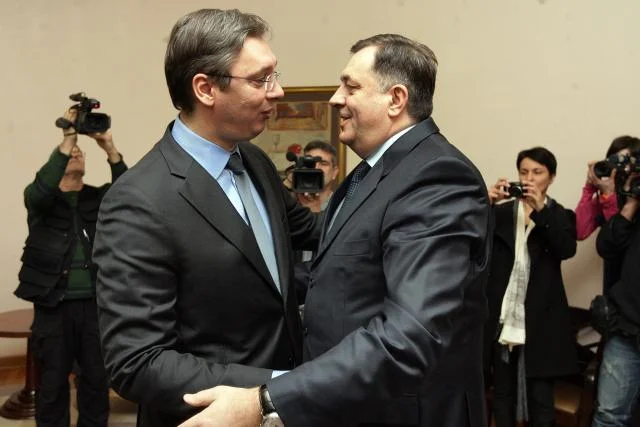
The joint statement was adopted at a time when Republika Srpska President Milorad Dodik . . . . . . mention the possibility of Bosnia's secession.
Serbia's president, Aleksandar Vuciq, said the document was compiled in accordance with resolutions, with international law and the Dayton Agreement, which has ended the 1992-1995-year fighting in Bosnia and Herzegovina, and created two entities -- the Muslim-Croatian Federation and Republika Srpska.
Vuciq called on representatives of Republika Srpska to resolve all problems in line with the Dayton Agreement, though he reiterated that Serbia “would never leave Bosnian Serbs” in the mud.
Some saw Vuciki's stance as “attempt to calm nationalists in Bosnia and Herzegovina”.
A Common Day of Citizenship
The statement mentions that, instead of January 9th, Republika Srpska will mark the day of citizenship on February 15th, the same as Serbia.
For some Bosnian Serbs, this decision constitutes “object on January 9th” ʹ the declared unconstitutional date for such a holiday in Bosnia and Herzegovina, as it coincides with starting fighting in this state in 1992.
The American Embassy in Sarajevo named the Declaration dangerous, with many errors. In a post on social platforms, the embassy said that “Republika Srpska is not a state and can only exist within Bosnia and Herzegovina”.
Part of Kosovo
Points 11-14 are dedicated to Kosovo, which in the Declaration is considered an inevitable part of Serbia.
It mentions that Serbs in Kosovo, as well as all other citizens who are loyal to Serbia, must protect monasteries, churches, private properties, graveyards and other endangered objects.
It's also talking about the non-negotiable living conditions of Serbs” in Kosovo, not to mention any concrete fact ʹ and the need for the creation of an association of Serb majority municipalities.
Petritsch has said that the <x0 leadership across the region is directed not to take unilateral steps that would jeopardise positive achievements in dialogue” between the two countries, which is mediated by the EU.
US Ambassador to Kosovo Jeffrey Havenier said the June 8th Declaration did not match US and other Western countries' positions.
Support From Russia
Russian Foreign Minister Sergei Lavrov, from Moscow, told participants that “Russia would never close its eyes on injustices against the Serb brotherly people and attempts to demonise them”.
Diplomat Petritsch dismissed Lavrov's claims.
There is no Serb demonisation. This is not the way forward. We, in Europe, really want to have good relations with the peoples of the former Yugoslavia. We are not against correct relations with Russia or China, but Serbs should know they are integral parts of Europe”, he said.
Serbia claims it aims at membership in the European Union, but maintains close ties with Russia and refuses to sanction it differently from the European bloc for the war launched in Ukraine in 2022.
Petritsch believes Serbs do not benefit almost anything from Russia, that they do little business with it, and that they are also far away geographically.
Serbia is an integral part of Europe's history, European culture and policy”, he said. /Radio Europe Free/