5 minutes ago
Association ambush on Kosovo's road to KiE
Periskopi(2 years ago)
(2 years ago)To support Kosovo's membership efforts in the Council of Europe, Western states imposed on it a condition: taking concrete steps to establish the Association of Serb majority municipalities. This they confirmed for Radio Free Europe from the German Embassy in Kosovo. “The surrender of the draft [the Association] state at the Constitutional Court for Review will [...]
That's confirmed for Radio Free Europe From the German Embassy in Kosovo.
“The surrender of the draft [the Association] draft at the Constitutional Court for Review would be such a step [concret]”, said in response.
Kosovo Prime Minister Albin Kurti dismissed the condition, arguing it had nothing to do with the country's admission to the Council of Europe.
Speaking at a cabinet meeting Wednesday, he said the issue of association It has to do with dialogue on normalising relations with Serbia.
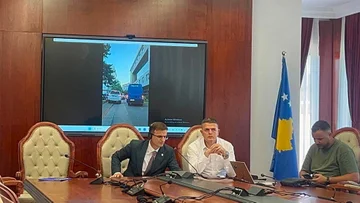
But Wednesday, US Special Envoy for the Western Balkans Gabriel Escobar said at an online meeting with reporters that there are concerns that Kosovo may not have the votes to be admitted to the Council of Europe.
He said some Council of Europe member states have asked Kosovo to establish association, and added that this is a continued international community requirement.
Escobar: There are concerns that Kosovo may not have votes for KiE
Bodo Weber, senior associate of the nongovernmental Council for Democratic Policy in Berlin, believes that the issue of Kosovo's membership in the Council of Europe will not be at all on the agenda of the Foreign Ministers' Committee meeting on May 16th and 17th, when the final decision on Kosovo's accession was expected.
“This would prevent a negative vote -- that is, an unsuccessful vote” -- says Weber for Radio Free Europe.
For Kosovo to become a member of the Council of Europe, the largest human rights organisation on the continent has to be supported by at least two-thirds of the 46 member states.
What is the Association of Serb majority municipalities?
The agreement on forming the Association of Serb majority municipalities was reached in 2013, under the dialogue for normalising relations between Kosovo and Serbia, which is mediated by the European Union.
Then, in 2015, the parties also agreed on the principles of association.
But, in the same year, the Constitutional Court of Kosovo has found that they are not fully in line with Kosovo laws, though they can be harmonised with a statute or the government's underground act.
Thus, Kosovo has refused to form association, with the argument that it could be harmful to the internal functioning of the state.
The Western states, however, insist on forming this association, which would have to provide members of the Serb community in Kosovo with a certain level of self-advancing.
In October 2023, Western diplomats have handed over to both sides a draft status for forming Association.
Initially, leaders of both countries have said they accept it in principle, but Kosovo Prime Minister Albin Kurti has later stated in an interview for Radio Free Europe on 19 March that he does not accept it.
Kurti said on Wednesday that his government will not send the draft Association status to the Constitutional Court for review, because it is part of dialogue with Serbia taking place in Brussels and not Strasbourg, where the Council of Europe is at headquarters.
He argued his decision even with the fact that Serbia has refused to sign the Agreement on the road to normalisation of relations, which the two countries have accepted in 2023.
The European Union, as the mediator of dialogue, has said earlier that the agreement, which has become known in public as the Ohrid Agreement, is legally binding for both Pristina and Belgrade, even though it has not been signed.
Kurti, speaking even after a meeting with representatives of foreign embassies in Pristina on May 6th, has said the process of normalising relations with Serbia should not be mixed with the issue of Kosovo's membership in the Council of Europe.
According to him, Kosovo has met all conditions for membership in the Council of Europe, and establishing new conditions conflicts with the 16 April vote.
On April 16, Parliamentary Assembly MPs The Council of Europe's Council has overwhelmingly approved Greek MP Dora Bakoyannis's report, which recommends the Council of Europe's Foreign Ministers Committee to accept Kosovo's application for membership in the organisation.
Radio Free Europe addressed the Kosovo Presidency and the Ministry of Foreign Affairs over the new condition of Western states for Kosovo's membership in the Council of Europe, but received no response.
Kosovo “ra” in informal conditions
Weber tells Radio Free Europe that Kosovo “ra” in the informal conditions of Western countries, in terms of membership in the Council of Europe, and adds that such political requirements towards official Pristina could be expected.
He adds that Western countries presented these informal requirements very late.
“We have a combination of self-defences from Pristina and delayed signals from the most important representatives of the European Union”, says Weber.
According to him, the new situation could harm the political dialogue between Kosovo and Serbia, and shows that the Ohrid Agreement has not relaxed the reports between the parties at all.
The responsibility, he adds, falls on Western countries.
“There is a complete blockade, an severity of relations between Belgrade and Pristina, Pristina and Kosovo Serbs, as well as Pristina and the West”, says Weber.
Does Association have the key to the Council of Europe?
Kosovo has applied for membership in the Council of Europe in May 2022.
On 27 March, the Council of Europe's Commission for Political Affairs and Democracy has approved the report of Dora Bakojannis, rapporteur of the Parliamentary Assembly of the Council of Europe for Kosovo.
Positive reports have preceded the Kosovo Government's decision to return 24 hectares of land and the Decani Orthodox Monastery, on the basis of a Kosovo Constitutional Court decision, which for years has refused to implement.
As for the Association of Serb-run municipalities, Bakoyannis's report reportedly is the internal issue of Kosovo.
Serbia, on the other hand, has formed a working group for co-ordinating the activities of state authorities against Kosovo's accession to the Council of Europe.
Serbia's new prime minister, Milos Vuchevic, has also said it will do everything to prevent Kosovo's accession to the Council of Europe, even though, as it has indicated, chances are slim.
The Council of Europe was established in 1949. It advocates freedom of expression and media, equality and minorities in member states.
One of the direct benefits of Kosovo's citizens from eventual membership in the Council of Europe would be access to the European Court for Human Rights in Strasbourg. / REL/