9 minutes ago
Spanish Opinionist argues that Spain recognises Kosovo, says country is holding contradictory positions
Periskopi(2 years ago)
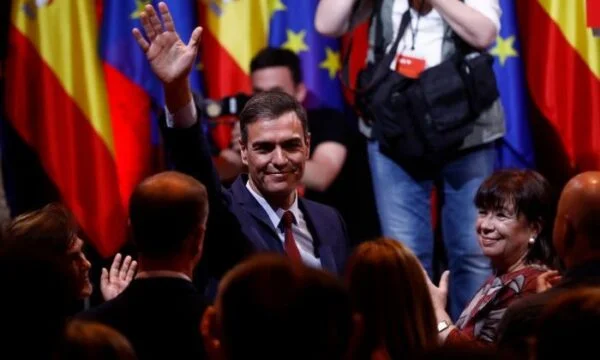
(2 years ago)Pedro Sanchez's government has announced that it is willing to recognise Palestine as an independent state. Taking this as a trigger, opinionist Guillem Pursals in the Spanish newspaper “El Independent” writes that prior to Palestine it would be important to address the situation in Kosovo. If it's urgent, as Sanchez said, the recognition of Palestine, we [...]
Pedro Sanchez's government has announced that it is willing to recognise Palestine as an independent state. Taking this as a trigger, opinionist Guillem Pursals in the Spanish newspaper “El Independent” writes that prior to Palestine it would be important to address the situation in Kosovo. “If it's urgent, as Sanchez, the recognition of Palestine, we must recognise Kosovo”, the Spanish newspaper article said.
“Spain is one of the few European states that does not recognise Kosovo's independence. The rest are Romania, Moldova, Slovakia, Greece, Serbia, Cyprus and Bosnia and Herzegovina. The latter because the Serb minority blocks recognition”, the article says.
Pursals writes that when Spain contributes to Palestine as part of the UN, it deepens the contradiction with Kosovo's non-recognition.
Moreover, there is an important contradiction in the Spanish position, as in Greece, Romania and Slovakia. As of January 1st this year, Kosovo is part of the Schengen area and, as a result, any Kosovo citizen can travel without the need for visas through all states signed in the same free movement treaty, despite being no part of Schengen. The European Union, like the rest of the Balkan states, such as Albania, Bosnia and Herzegovina, Northern Macedonia, Montenegro and Serbia, which are all internationally recognised. Thus, the fact that Spain wants Palestine to be in the United Nations as a sovereign and independent state deepens even more contradiction with Kosovo's non-recognition. ”
The Spanish opinionist writes that the Russian invasion in Ukraine has sparked tension in the Western Balkans, while Vuciq increasingly uses his ultranationalist rhetoric.
On the one hand, Kosovo is recognised as a state linked to the Schengen Zone, and Kosovo's passport is therefore recognised. On the other hand, Bosnia and Herzegovina opens the door to entry into the European Union, while Albania moves towards membership. In this context, Kosovo could not stand on anyone's ground.
Serbia, in turn, is withdrawing in terms of civil and political freedoms, as confirmed by Freedom House's latest report, and has closed security agreements and co-operation with Russia amid its invasion in Ukraine. Therefore, it would be advisable for the EU to coordinate its position on the issue, if Serbia decides to go further, without knowing what the afterlife will be. President Vuciq said he would move to another phase if Kosovo were a member of the Council of Europe and, as a result, would be recognised as another state. ”
It has also cited the withdrawal of Spanish troops within KFOR in 2009, which it says became a strange “ ”.
Pursals estimates that if Spain advances in the recognition of Palestine, it should also advance to recognition of Kosovo, as difficult times in the Balkans are approaching, taking into account Ukraine's conquest and the “ultranationalist” movements of Milorad Dodik and Aleksandar Vuciq.