6 minutes ago
Macron reminded Vuchy Banjska: Will Belgrade resolve the Kosovo attack case?
Periskopi(2 years ago)
(2 years ago)Although it was more than half a year after the attack on Kosovo Banjska, Serbia did not file any indictments against Milan Radojici. The Supreme Public Prosecutor in Belgrade did not answer Radio Europe's repeated free question about the course of the procedure against former Serbian List Vice President, who claimed responsibility for the attack on [...]
Although it was more than half a year after the attack on Kosovo Banjska, Serbia did not file any indictments against Milan Radojici.
The Supreme Public Prosecutor in Belgrade did not answer Radio Europe's repeated free question about the course of the procedure against the former Serbian List deputy chairman, who claimed responsibility for the 24 September 2023 attack.
Kosovo police, Africa Bulnjak, were killed in that attack.
In the last response REL received on February 8th, the prosecution said it was “verifying the testimony of the suspect” Radoiciq.
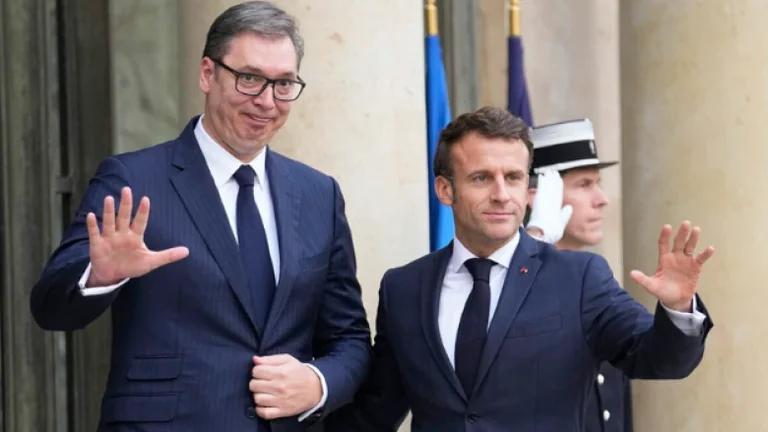
On 8 April, France's president, Emmanuel Macron, spoke of the importance of resolving the case in Banjska, during a joint address with Serbia's president, Aleksandar Vuciq, in Paris.
The next day, Vuciq told reporters that talks with the French president on Kosovo were not easy, but that he thinks Macro “understands Serbia's” position.
However, he did not mention the results of the Banjska investigation.
There can be no progress in dialogue between Kosovo and Serbia, while there is the threat that Banjska will repeat”, says Engjelouse Morina, from the European Council for Foreign Relations, for Radio Free Europe.
“Autors must be brought to justice, because the security situation should be good, so that the Kosovo-Serbia dispute can be resolved”, she says.
Morina adds that, despite calls for the dawning of the case, the international community is not putting enough pressure on Serbia.
The “what we're seeing now and in recent years has more to do with concessions, not so much with duties”, she says.
What do international officials say?
France's President Emmanuel Macron said on April 8th that his country will make sure that every step of the Ohrid Agreement between Kosovo and Serbia is fulfilled for normalising relations.
During a joint address with Vuciqi in Paris, Macron said that Kosovo's “issue is a promise and commitment to the future of the region”.
He, too, said it is important that participants in the Banjska attack be arrested.
The “is just a confirmation that Europeans have not forgotten what Vuciq would like to forget”, Serbian foreign policy commentator Bosko Jaksic estimates, for Radio Free Europe.
He adds that the fact that Macro did not raise the issue “in a private way” indicates the importance of the Banjska case.
“ [Macron] thought he should say that in front of the public”, Jaxpic says.
In his speech, Serbia's president accused Kosovo of failing to meet obligations by the Ohrid Agreement and of failing to prosecute criminal cases of attacks on Serbs in Kosovo.
“Everyone already mentions only Banjska”, Vuciq said in Paris.
On September 24th, 2023, an armed group of Serbs attacked Kosovo police in Banjska, where police officer Africa Bulnjak was killed. Three Serb attackers were also killed in the subsequent shootout.
Kosovo accused Serbia of standing behind the organisation of this attack, but Belgrade denied it.
Milan Radocic, who later resigned from the post of deputy head of the Serbian List, the largest Serb party in Kosovo, which has Belgrade's support.
Morina from the European Council for Foreign Relations estimates that Serbia's president “is aware that certain actions must be taken when it comes to Banjska”.
“ ... but, he tries to buy as much time as possible by November [US elections], when he hopes the administration in America will change”, Morina says.
She adds it is very important that European leaders do not ignore the armed attack in northern Kosovo.
The dispute between Kosovo and Serbia has become a security issue, and serious, in the political context in which Europe is located. The Euro-Atlantic community is carefully monitoring possible instability in the region”, she says.
Is the EU considering punitive measures?
The international community, sometimes, has called for accountability and has demanded that those involved in the attack on Banjska be brought to justice.
Brussels did not answer Radio Free Europe's question if it is considering imposing punitive measures against Serbia, which Kosovo insists on.
The latter considers terrorism to be the case.
Earlier, the EU told the REL it is still waiting to complete formal investigations by Kosovo authorities.
“The EU does not independently investigate this attack, nor does it have a mandate to do so. The EU has strongly condemned the attacks, provided support in the process, and, at the highest political level, has stressed the need for investigations to be completed quickly and all persons involved to take responsibility”, Brussels' statement said.
Jaksic believes that the requirements for punishing the responsible will intensify.
Serbia's “Hopes [for that event to be forgotten] are based on the practice Government implements in Serbia, which is a technique to forget things”, he says.
Adds that <x0-relativeisation” of the Banjska case in Serbia is a short-term policy, which “will not pass without consequences”.
British Foreign Secretary David Cameron said at the beginning of the year that disappointment should be expressed over the behaviour of the Government of Serbia after the events in Banjska.
We should show that we are disappointed with the behaviour of the Government of Serbia. I don't know if the European Union and the United States share this disappointment. But because of my conversations, I have found that there is disappointment because Banjska has been a moment of great danger”, Cameron said on January 9th.
US envoy for the Western Balkans Gabriel Escobar said the US is investigating Serbia's ties with the attack on Banjska.
“We think there were some financial and organisational ties, but we're investigating it as a whole”, Escobar said in an interview for Radio Free Europe March 15th.
He, too, said it is unacceptable for Radojic to be still at large.
What did Serbia do so far?
After taking responsibility for the attack on Banjska, Radojic spent a day in custody in Belgrade.
He was arrested on October 3rd under charge of “co-ordination of criminal acts: production, possession and illegal trafficking of firearms and explosives, as well as serious crimes against overall security”.
He was released a day later, provided he did not leave Serbia.
The Office of the High Public Prosecutor in Belgrade told Free Europe Radio on February 8th that, in co-operation with police and customs, “is collecting evidence to determine the origin of weapons and channels through which they are introduced in Kosovo”.
Serbia's institutions did not respond to whether someone else is involved in the investigation except Radojici.
Earlier, Serbia's president has said he will come up with proposals for the indictment “at the right time”.
This is the job of competent prosecutors, we'll see what crimes we're talking about, as well as how”, Vuciq said on February 2nd.
Until the attack on Banjska, Radociq has been one of the leaders of the Serbian List, which Serbia's president has named a “protector of the Serb people in northern Kosovo”.
Lately, a photograph appeared on social networks, where Radoic is seen in the company of Serbian Ambassador to Washington Marko Djuric, at a restaurant.
Because when and where the photograph that was published on the X network on March 9 is not known. Neither is the author known.
Djuric, who after publishing the photograph, said that “is not ashamed of his contacts”, did not answer Radio Europe's free questions about the details of the meeting with Radojchiqi.
Serbia's president said on March 10th that “has not asked Djuric when, where and why” the photograph has been taken.
What do they say in Kosovo?
Radojciq is supposedly in Serbia.
Official Pristina requires his extradition so it can be tried in Kosovo for terrorism.
Belgrade answers that this is the impossible “” and that Radojic will be tried by local courts.
The Supreme Public Prosecutor in Belgrade did not answer even the question of whether Serbia is willing to co-operate with Kosovo institutions and the international community for lighting this case.
There is still no indictment against Radojici in Kosovo, though it has been warned it will be established by the end of March of this year.
Kosovo Justice Minister Albulen Haxhiu said earlier that she joins Kosovo Prime Minister Albin Kurti's calls, that the Banjska case should be prosecuted urgently by competent institutions.
In December 2023, the International Police Agency (INTERPOL) issued an arrest warrant for Radocicin.