4 minutes ago
Joseph: EU alone cannot preserve peace in Balkans
Periskopi(2 years ago)
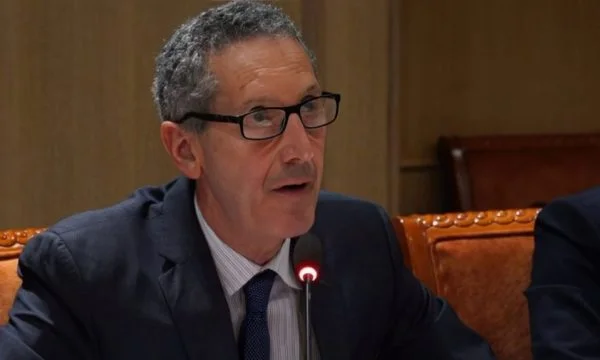
(2 years ago)American professor Edward P. Joseph, who is a good connoisseur of developments in the Balkans, has answered questions on a panel of “Budapest Balkans Forum” for the region and the approach the US and EU have towards it. In a scenario when former US President Donald Trump returns to power and attracts American forces from NATO, [...]
In a scenario when former US President Donald Trump returns to power and attracts American forces from NATO, what would happen to the Balkans, Joseph says that would be bad news.
If this is the question, what would happen if the U.S. forces were reduced, that would be very bad news, because alone. The EU is unable to maintain peace in the region. However, the EU is doing better, but still does not take as seriously as the US. The main examples are both in Bosnia and Herzegovina and Kosovo, where everyone sees the US as leader”, he has said.
Meanwhile, in question of how the EU can solve the Balkan knot, Joseph said the EU is responsible for the problem.
Perhaps, in some way, the EU is 100 percent responsible for the problem. And the answer is theoretically yes, the EU can change that with the US. And we explain the knowledge of crisis management in a report published by Johns Hopkins University and the Wilson Center; it's called From the Convergous Crisis. It's actually a very simple explanation”.
“How can problems related to the Balkans be so simple?”, was the question for the American professor.
We simplified this. Much of the problem is Serbia. Serbia refuses to choose its orientation. Belgrade essentially refuses Western rule for the region... They are within their current borders, and minorities within them have rights. But we're not there to create new states, we're not there for further divisions. So, how's the EU responsible? It is also very simple because Serbia would choose Western orientation if the EU, even within NATO, had unified attitudes. This is key”.
Joseph is in favour of the West having a unified stance on Kosovo's status.
Kosovo's uniform recognition is essential. The problem is that five EU countries (Cyprus, Greece, Romania, Slovakia and Spain), four of which are in NATO, do not recognise Kosovo. Because of this, even Serbia does not recognise him. This game requires Serbia's participation. Because there are minorities in Croatia, in BiH, in Montenegro and in Kosovo. So she can play this game with her minority, projecting”.
For the use of Belgrade's Serb minority to achieve its goals, Joseph considers more of a political problem.
But if they change their position, even towards NATO alone, it is possible to resolve. In my next letter, I explain that if Ukraine recognises Kosovo, then others will have to follow suit. I've entitled this article as Catalist Kiev-Kosovo”. /Express/