13 minutes ago
Why did Iran attack Israel and why are they enemies?
Periskopi(2 years ago)
(2 years ago)Iran issued fears and rockets towards Israel after pledging revenge for a deadly attack on its consulate in the Syrian capital, Damascus. Israel has not said it has carried out the consulate's attack, but is widely believed to have been behind it. And this is the first time Iran has directly attacked Israel, follows [...]
Iran issued fears and rockets towards Israel after pledging revenge for a deadly attack on its consulate in the Syrian capital, Damascus.
Israel has not said it has carried out the consulate's attack, but is widely believed to have been behind it.
And this is the first time Iran's attacked Israel directly, it's sent back to Telegrafi.
Previously, Israel and Iran were involved in a shadowy “ ” war, attacking each other's assets without accepting that.
These attacks have increased significantly during the current Gaza war caused by the Palestinian group Hamas' attack on nearby Israeli communities last October.
Why are Israel and Iran enemies?
The two countries were allies until the Islamic revolution of 1979 in Iran, which brought a regime that has used opposing Israel as a key part of its ideology.
Iran does not know Israel's right to exist and requires its “eradicate”.
The country's supreme leader, Ayatolah Ali Khamenei, has previously named Israel a <x0 carcinative” that “will undoubtedly be eradicated and destroyed”.
On the other hand, Israel believes Iran poses an existential threat, as evidenced by Tehran's rhetoric, its establishment of representative forces sworn to Israel's destruction, the financing and arming of Palestinian groups, including Hamas and the Lebanese Shiite group Hezbollah, as well as “the groundbreaking program”, though Iran denies seeking to build a nuclear bomb.
Iran wanted to retaliate after the consulate attack
Iran says Saturday evening's bombing of Israel is a response to the April 1st air strike in an Iranian consulate building in the Syrian capital, Damascus, which killed senior Iranian commanders.
Iran blames Israel for the air strike, which it saw as a violation of its sovereignty. Israel has not said it has accomplished it, but is widely assumed to have done so.
Thirteen people were killed, including General Mohammad Reza Zahedi, a senior commander in the Wood Force, branch abroad of the Republican Guard of Iran (IRGC).
He had been a key figure in the Iranian operation to arm Lebanese Shiite Hezbollah's armed group.
The consulate's attack follows a pattern of air strikes against Iranian targets widely attributed to Israel, a writing said. BBC
Several top IRC commanders have been killed in air strikes in Syria in recent months.
The IRC channels weapons and equipment, including high precision missiles, across Syria towards Hezbollah.
Israel is trying to stop these shipments, and is trying to prevent Iran from strengthening its military presence in Syria.
Who are Iran's allies?
Iran has built a network of Allied and representative forces in the Middle East that, according to him, are part of a “resistance framework” challenging US and Israeli interests in the region.
He supports them in different ways.
Syria is Iran's most important ally. Iran, along with Russia, helped Bashar al-Assad's Syrian government survive the country's ten-year civil war.
Hezbollah in Lebanon is the most powerful of the armed groups Iran supports. That group has exchanged crossfire with Israel almost every day since the war broke out between Israel and Hamas. Tens of thousands of civilians on both sides of the border have been forced to flee their homes.
Iran supports several Shiite militias in Iraq, which have rocketed US bases in Iraq, Syria and Jordan.
The US retaliated after three of its soldiers were killed in a <x0 military checkpoint” in Jordan.
In Yemen, Iran provides support to the Houthi movement, which controls the country's most populated areas.
To show support for Hamas in Gaza, the Houthi have fired rockets and fears in Israel and have also attacked commercial ships off its shores, sinking at least one ship.
The US and Great Britain have hit Houthi targets in response.
Iran also offers weapons and training to Palestinian armed groups, including Hamas, who attacked Israel on October 7th last year, sparking the current war in Gaza and confrontations in Iran.
However, Iran denies any role in the October 7th attack itself, Telegrafi conveys.
How are the military skills of Iran and Israel likened?
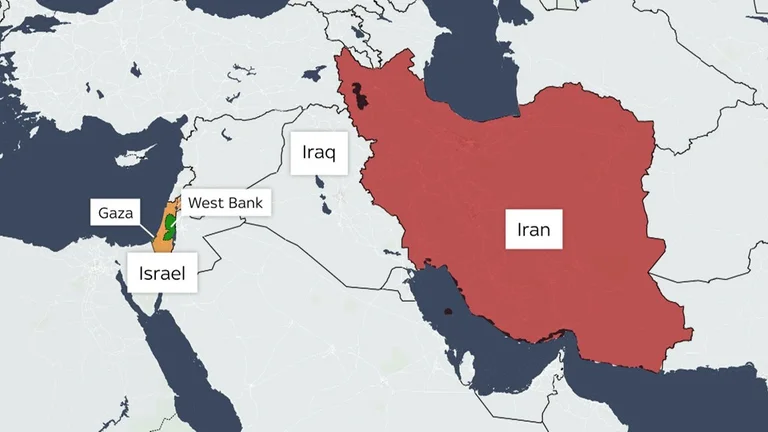
Iran is much larger than geographical Israel and has a population of nearly 90 million, nearly ten times that of Israel, but it does not translate into greater military power.
Iran has invested a lot in rockets and drones. It has a large arsenal of its own, but it has also supplied significant amounts of “to its representatives” Howthy in Yemen and Hezbollah in Lebanon.
What he lacks are modern air defence systems and fighter planes. Russia is believed to be co-operating with Iran to improve them in exchange for the military support Tehran has given Moscow in its war with Ukraine, Iran has offered offensive fears, and Russia is now reportedly seeking to produce its own weapons.
On the other hand, Israel has one of the most advanced air forces in the world.
According to the IISS military balance report, Israel has at least 14 aircraft teams including F-15, F-16 and the latest F-35 stelath planes.
Israel also has experience in carrying out deep attacks within hostile territory.
What message is Iran sending through its attack?
“We blocked. We bugged. Together we will gain”, which is how Israeli Prime Minister Benjamin Netanyah praised matters.
But Tom Fletcher, an adviser to the foreign policy of several United Kingdom prime ministers and a former United Kingdom ambassador to Lebanon, said the Iranian attack was a “s signal of Iran's cooling capacity and expansion”.
Leaders in both Iran and Israel were both “under pressure in the country, facing international criticism and are clearly ready to play with fire”, he warned.
But he told the BBC that Iran's unprecedented attack seemed to have been carefully calibrated.
<x0Iran launched these attacks in advance, which made it easier to rein in”, he said, comparing it to the fire exchanges he had seen as ambassador to Lebanon, where the “objective is to show the ability, but not necessarily to have escalation”.
He also said it was <x0-positive” Iran chose to respond directly rather than via Hezbollah.
While Sanam Vakil from the expert group Chatham House said the attack had been a success from Iran's perspective.
“This is the first time Iran has violated and directly violated Israel's sovereignty”, it told the BBC.
“Sulmet were certainly calibrated, directed to military installations in order not to cause too much damage or hurt anyone”.