2 minutes ago
Green light for Kosovo at Parliamentary Assembly Association, following Council of Europe membership
Periskopi(2 years ago)
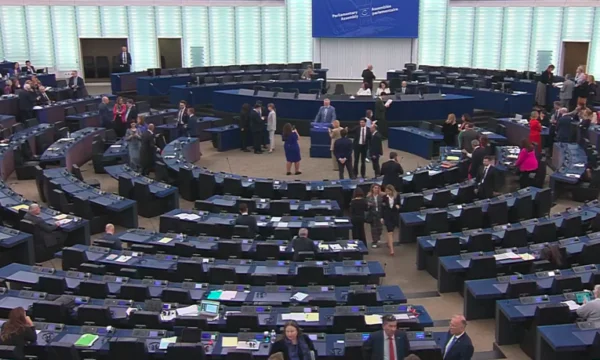
(2 years ago)On Tuesday, the Republic of Kosovo, green light for membership was given to the important European organisation, the Council of Europe. For voting 131 deputies, there were 29, while 11 abstained. Initially, there was debate about two hours between MPs from member states, of which there were objections. MPs from France said it would be good that [...]
On Tuesday, the Republic of Kosovo, green light for membership was given to the important European organisation, the Council of Europe.
For voting 131 deputies, there were 29, while 11 abstained.
Initially, there was debate about two hours between MPs from member states, of which there were objections.
MPs from France said it would be good for Kosovo to take the first steps towards establishing the Association of Serb majority municipalities before the final vote of ministers in May.
Serbia had submitted amendments to reject Kosovo's membership steps in the KiE.
Through them, Kosovo was required not to be accepted into the Council of Europe until the UN Security Council decides on Kosovo's status.
Serbia also demanded that Kosovo continue the process, as the foundation of the Serb majority municipalities' association is set.
But all the administrations, one by one, were rejected.
The rapporteur for Kosovo in the Council of Europe, Dora Bakoyannis, said during the hearing that Kosovo is a functional parliamentary democracy with strong guarantees for judicial independence and fundamental human rights.
It has cited three issues that it has considered most problematic to be resolved -- the one for the Decani Monastery, expropriation and Association of Serb-run municipalities.
“During my engagement in this file all state parties have warned me that no progress can be expected on any of these cited issues. But with a Persian job, real progress has been observed. The Parliamentary Assembly has managed to resolve what has been identified as one of the most important cases of law violations, implementing the Constitutional decision that would restore the monastery property”, it has said.
After that, Serbia's representative to the Parliamentary Assembly of the Council of Europe, Biljana Pantic, has called Kosovo's rapporteur on the Council of Europe, Dora Bakoyannis.
“Zj. Bakoyannis I want to congratulate you on what you're doing today because you will be marked in history as someone who in the most brutal way violated all international rights standards. You have clearly said that the so-called Kosovo must meet three conditions for having a positive opinion”.
The first “and the most fundamental condition has been the foundation of the Serb majority municipalities' association. The establishment of association is the basic prerequisite of dialogue between Pristina and Belgrade. If you invite the so-called Kosovo to the Council of Europe without the establishment of association, it will never be established. It was you who said: The establishment of association is considered a necessary condition for effective protection of national minorities and their rights. You've demonstrated that you don't have integrity and you're hypocritical”, she stressed.
After the vote, the Parliamentary Assembly of the Council of Europe (PACE) through a communique announced it has decided to monitor the fulfillment of a wide list of commitments and obligations since its membership.
According to Council of Europe procedures, the Assembly must first give its opinion on any application for membership before a final decision is made by the Committee of Ministers, the organisation's executive body consisting of foreign ministers.
In his statuteial opinion, based on a report by Dora Bakoyannis (Greece) and approved 131 votes for and 29 against 11 abstentions, the Assembly said membership would lead to “strengthening human rights standards by providing access to the European Court for Human Rights for all those under Kosovo jurisdiction”.
It would be “the calculation of a dialogue that has developed into a two-decade time span, but in no way should it be seen as the end of a process. Rather, membership must cattalyise the moment for Kosovo to continue to make progress in strengthening human rights, democracy and rule of law”.
Membership would also help Kosovo enhance its extraordinary challenges and issues of concern”, parliamentarians stressed, including the gap between standards and effective implementation, the need to better protect the rights of non-competitive communities and promote a favourable climate. To trust, reconciliation, and involvement.
The assembly hailed it as “a major breakthrough” implementing the Constitutional Court's decision in the case of the Decani Monastery, which it said was the “a tangible sign of the government's commitment to act fully in accordance with the rule of the law. Despite political considerations”.
The establishment of an association of Serb majority municipalities would be “an important step” to ensure the protection of the rights of Kosovo Serbs, and “should be included in the upcoming review by the Committee of Ministers for Kosovo's application for membership in the Council of Europe as a commitment after membership”.
Acknowledging the “unprecedented circumstances of application “, given that a number of Council of Europe member states do not recognise Kosovo as a state, the Parliament called for “diplomacy, dialogue and compromise”. The assembly invited the Committee of Ministers to ensure that Kosovo's membership is “without prejudged the positions of individual member states regarding Kosovo citizenship”.
Council of Europe Where Kosovo has applied for membership in 2022, it is a leading organisation in Europe in the field of human rights.
Its share is 46 states, including 27 European Union member states and all countries in the region.
One of the direct benefits of Kosovo citizens from eventual membership in Council of Europe will be approaching the European Court for Human Rights. [ GEDNJ].
This court in Strasbourg is considered one of the most effective legal means in all of Europe.
It could be a new door opening for Kosovo citizens, and for Kosovo as a state, if one party believes it has been treated Unfair in preliminary court processes.