19 minutes ago
Exports fall, producers say they have demands, but no conditions
Periskopi(2 years ago)
(2 years ago)If the production industry had more space to exercise its activity, the value of Kosovo exports would be significantly increased, says entrepreneur Bujar Rama. For years, he leads the company “Behari” in Drenas, which deals with the production of garage doors. Speaking of Radio Free Europe, he says [...]
If the production industry had more space to exercise its activity, the value of Kosovo exports would be significantly increased, says entrepreneur Bujar Rama.
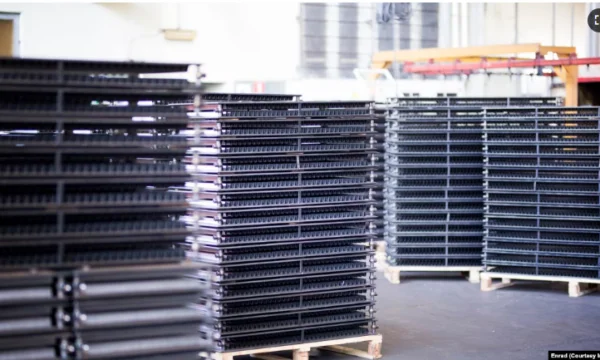
For years, he leads the company “Behari” in Drenas, which deals with the production of garage doors.
Speaking to Radio Free Europe, he says his company has no capacity to cope with all requirements for export, so it requires support of institutions.
Kosovo's Ministry of Industry, Trade and Trade says businesses have supported hundreds of millions of euros last year, with the aim of increasing exports.
Despite this, however, their value fell in 2023 compared to a year earlier.
What was the value of exports?
Kosovo faces a high trade deficit for years, which means it imports much more than it exports.
On average annually, it imports goods worth 5 billion euros, while exporting below 1 billion.
Last year, the number of exports dropped to about 820m euros from about 920 million in 2022, or about 100 million, according to Kosovo Central Bank data.
Officially, no information is given about why this happened.
The Ministry of Industry says it is meeting the Government's programme for 2021-2025, which envisions “commitment and support” of the production industry, however, “creating favourable conditions, investments in production capacities, advancing production technology and processing” and others.
“Over the past year alone has been supported by 71 businesses for purchasing manufacturing machinery, worth 1.7m euros, while 400m euros have been earmarked for ten profitable companies, with the aim of boosting exports”, a statement by the Ministry of Industry granted Radio Free Europe.
To that end, according to the ministry, another 100 production companies have been supported for participation in 18 international fairs, “promoting over 900 products, services and tourist packages worth 1.3m euros”.
Through a report on March 27th, this ministry called on micro, small and medium-sized companies to apply for grants this year, worth 2.5m euros.
The ministry did not respond to REL's request to comment on the claims of entrepreneur Bujar Rama, who says that, for two years, it has asked her to provide greater space for the exercise of business activity.
Businesses Want Greater Support
Had the institutions “helped me, Rama says the value of his exports outside Kosovo would triple.
He does not want to show how much he exports in a year, but says the requirements for his company's products, both from the region's countries and those of the European Union, are on the rise.
His company is located in the Drenas Central Kosovo Business Park.
This park was built in 2010 by the Ministry of Industry, which provided physical infrastructure for businesses, such as roads, electricity, water and channeling.
Currently, 41 businesses with different activities are located on this 24 hectares surface.
Rama's company settled in about 2011 on a surface of 1,200 square feet [1,200 sq m], with 60 workers.
He says that over the years, it has increased both production capacities and the number of workers, and that it has required a greater space for use of up to 3,500 square metres to meet customers, he says.
To that end, he says he also addressed the Ministry of Industry.
But, “all the demands have dragged on, no other space has been given to me”, Rama says.
It shows that he has recently purchased the necessary surface and equipment worth more than 400,000 euros. It says that they had to rent an object.
I don't know when I can build [the new object] because of the many permit procedures. If the state offered me conditions, I would already increase the value of export, hire the largest number of workers, not do construction”, Rama says.
Remember Zvi, a member of the Kosovo Club of Producers Board, claims that lack of space is one of the challenges of many production companies.
According to him, the Ministry of Industry tries to place as many companies as possible for numbers”.
It would be more convenient to give more space to companies that have provided international markets. Even if they're in the smallest number of”, Voter told Radio Free Europe.
He adds that even his company “Scampa”, which deals with plastic bags production and is found in Drenas Business Park, has a lack of space.
According to him, the will of institutions to help businesses is not missing, but those “fail to identify relevant companies for support”.
Because every government tries to make numbers, helps the initial companies... That's good, because they also grow and develop, but priority should be the conveniences for production companies that have managed to secure international markets and preserve them”, says Gjavori.
Here, according to him, “also focuses on the” problem with the loss of exports.
Why are exports important?
Exports include those goods produced within a country's territory and, therefore, are part of national income.
Exports and a positive trade balance are important factors for the country's success and growth of the economy.
In Kosovo there are about 2,400 production companies, but the country imports much more than it exports.
In the “report, the identity of products with potential for export and replacement of import”, published by the Ministry of Industry in October 2023, it is said that in the preceding year, products that have been exported mostly have been: mattresses, tiles, doors, windows and plastic frames.
The report also mentions that 36 other potential products have been identified to replace import. Most are in the category of food and drink and are followed by wood and textile products.
Kosovo exports focus mostly on Albania, Northern Macedonia, Germany, Switzerland and the United States of America.
Kosovo Central Bank data shows that, last year, the country has imported products worth 5.7 billion euros.
Imports come mainly from neighbouring countries and those of the European Union and include a range of products from food to construction.
For this year, the World Bank predicted increased gross domestic production in Kosovo for 3.9 percent.