6 minutes ago
UN Debat: Genocide in Srebrenica be condemned globally
Periskopi(2 years ago)
(2 years ago)Genocide in Srebrenica must be punished at a global level, its support should be expressed for the victims, denial of genocide must be prevented, and it must be condemned to deglore war criminals to prevent genocides and war crimes in the future. Denis Becirovic and Zelko Komsic, members of the Presidency, have made this known. [...]
Genocide in Srebrenica must be punished at a global level, its support should be expressed for the victims, denial of genocide must be prevented, and it must be condemned to deglore war criminals to prevent genocides and war crimes in the future.
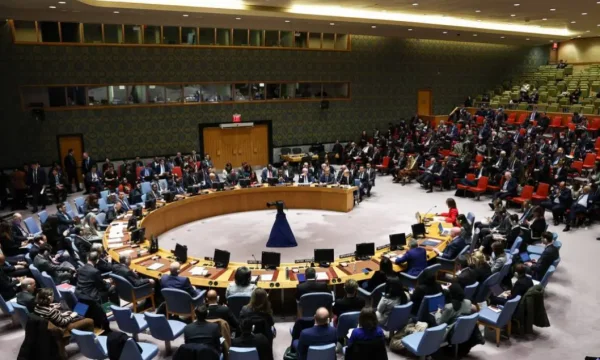
Dennis Becirovic and Zelko Komsic, members of Bosnia and Herzegovina's presidency, have made this known during a speech to UN ambassadors April 19th in New York.
Becirovic initially recalled that the genocide in Srebrenica was determined by UN court decisions, as well as courts in Bosnia and Herzegovina, and stressed that the proposed resolution for genocide in Srebrenica “is no threat to any nation”.
There are individual criminals. There is no single sentence for collective responsibility,” said Becirovic, adding that false propaganda that the resolution is against the Serbian people must stop.
Becirovic, during the media conference regarding preparations for the commemoration of the 29th anniversary of the genocide in Srebrenica, including the draft resolution for “International Memory Day and the 1995 Genocide Memorial at Srebrenica”, said the resolution calls for the International Day for the Memory of 1995 Genocide in Srebrenica.
Among other things, he said member states are required to include genocide in Srebrenica in their educational programmes in order to raise awareness and prevent genocides in the future.
Becirovic said the UN resolution for genocide in Srebrenica is necessary to strengthen the culture of memory, preserve peace, rule of justice and strengthen trust.
As he said, the resolution is also necessary for future returns, reconciliation in the Western Balkan region, protection of UN courts and civilising values, as well as solidarity with victims and their families.
“If you look at the text of the resolution, you will find no argument that this resolution is against any nation or state,” said Zelko Komsic, member of the Bosnia and Herzegovina Presidency of the Croatian people.
Komsup, among other things, said the aim of the resolution is to prevent denial of evidence proven by the bias of international and local courts, respectively, that genocide has been committed in Srebrenica.
He stressed that <x0 people were systematically killed because of their religion and nation”.
Asian Osmanovic, a survivor of Srebrenica who lost almost all members of his closest family in genocide, also testified.
I could easily be among the thousands killed. We hid at the UN base in Potocari. I've heard the screams, I've seen the execution of people from the base that killed”, Osmanovic said.
Early in the announcement at the United Nations Assembly building, a film of the genocide in Srebrenica appeared, among other things, that more than 8,700 people were killed, including 563 children, that 85 mass cemeteries were found and that more than 800 people are still missing.
It was also said that more than 2,500 people took part in genocide, that 75 were sentenced to 783 years in general, and five life sentences were handed down.
The initiatives of the Srebrenica resolution are Germany and Rwanda. Later, the United States of America, France and other countries said they support this resolution at the UN.
UN member states can express their opinion on the final resolution, which is still being worked on, at the UN General Assembly session in early May.
Neither the Serbian people nor collective responsibility are mentioned in the draft resolution.
In the document, in which Radio Free Europe had access earlier, it is required, among other things, to unreservedly condemn any denial of genocide in Srebrenica, as well as actions praising war crimes convicts, including responsible for the genocide in Srebrenica.
The resolution would announce July 11th as the International Genocide Memorial Day in Srebrenica.
Despite international courts' decisions, Belgrade officially and Republika Srpska authorities deny that genocide was committed in Srebrenica in July 1995 and calls the killing of more than 8,300 Bosnian civilians a terrible “crime” or “masacre”.
On April 18th, a rally against the draft resolution was held in Banja Luka, and on the same day, the Republika Srpska Assembly approved a report denying genocide in Srebrenica. / REL