8 minutes ago
American historian: Russia aims to undermine Kosovo's relations with US
Periskopi(2 years ago)
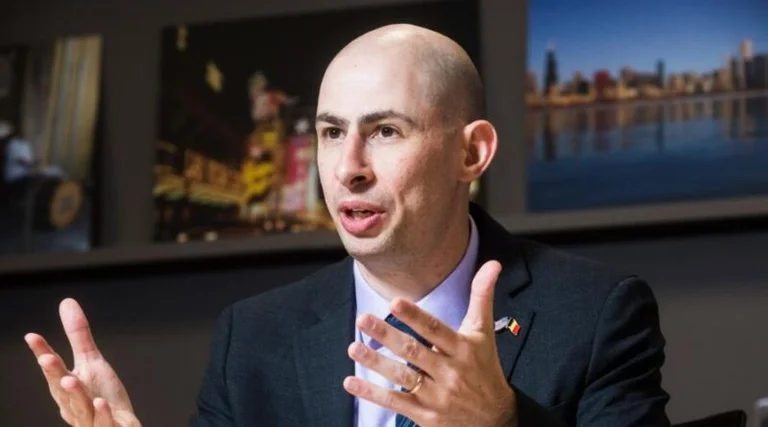
(2 years ago)In the last decade, the Western Balkan countries have been targeted in Russia's disinforming campaigns. American historian Jason Steinhauer, who recently attended a conference on this topic in Kosovo, says it is about a Russian plan meant to undermine relations between Kosovo and the States [...]
In an interview for Voice of America, Steinheur says that so far this plan has marked moderate success due to financing, internal discontent and historical reasons.
You were recently in Kosovo, where you attended the first Balkan conference on dezinformation. What were your impressions of how Balkan societies and countries are facing this challenge, and how are they fighting it?
Steinhower: General impressions of Kosovo are very positive. Kosovo has a stable population that inspired me. However, the country faces numerous challenges, starting with pollution, climate change. There are numerous challenges to dezinformation, with media situations and media knowledge, and all Balkan countries have this problem.
You are the author of the book “History, interrupted”, where you wrote about how history was influenced by social networks...
Steinhower: Yes, my argument is that as we have felt the impact of social networks on politics, public health and journalism, social platforms have changed the way we speak and how we tell our story. At the Pristina meeting, I argued that the more we use social networks to communicate for the past, the more social networking values become our values. In other words, we changed the way we tell the story and how our stories of history adapted to the spirit of social networks, privileged certain kinds of stories, while others are neither seen nor told, because we are all aiming to be more present on social networks. When presence replaces accuracy, as the main driver, who has long been the main element in analysis and history studies, there will be great consequences for the history we learn and the stories we face. Currently, in our public realm, we have stories that are obvious, because we're all using social networks to achieve that goal. But does this mean that the history we are seeing is accurate? And as we try to analyze the accuracy of the information on a certain event that we see online, this mirror becomes more complex and problematic.
In a writing on your impressions of Kosovo you speak of Russia's role. How is Russia's propaganda affecting history?
Steinhower: History can become a powerful weapon. We've seen such a distorted history in particular when it comes to Russia and Ukraine. Usually, when we think about history, we ask questions and try to find evidence to answer questions. And so we conclude that something might have happened or that it didn't happen in the past.
In the case of Russia and Ukraine, for example, we have seen actors like Russia, such as Putin, who have tried to reverse this historic process. In other words, they first conclude that they are interested and then invent evidence to support their claims. Because we look at so much historical information on our social networks every day, it is often difficult, as consumers, to understand how this historic conclusion was reached. Are they designed on the basis of accurate and honest methodology, or through a malicious goal to reach an already predetermined conclusion?
In countries like the Balkans, we see a lack of critical media reading and a challenge with critical reading of history. It's part of my job to try to build this skill in society.
In this case, what are the disinfectants that are dominant, and how should countries like Kosovo fight them?
Steinhower: I think critical reading of media and history is of vital importance. We need to teach people how to evaluate arguments and appreciate the methodology behind them, just as we teach people to evaluate literal journalism. We need to teach people how to understand whether it's a well - researched story or not.
As for the disinformations I have encountered during my stay in Kosovo, there are several major topics, as well as individual examples that reinforce these topics. In Kosovo, the main theme is not to trust the United States, not to be trusted with Europe, that integration into the European Union is not the right answer. That democracy is not the solution, that democracy is not working for you. They aim to undermine ties between Kosovo and Europe and of course the United States, or in the case of northern Macedonia and Bulgaria, their relations with Europe and the US, and to push these countries to look more sympatheticly at Moscow's views and ultimately support its actions, such as the case in Ukraine. So it's about a plan that tries to reorient this part of the world towards the Kremlin and take it away from alignment with the transatlantic alliance, with the United States and Europe.
Have such efforts been successful?
Steinhower: From what I've seen, the impact has been moderate. There are experts who have studied these issues in more detail, but when you're there, you feel that disappointment, as you see concretely how it works.
In many of these countries, unemployment is high, inflation is large, there is pollution, corruption, and it all fosters discontent. And often in a society where there is discontent, it is easy to seek fault and in this case the culprits are the European Union, the United States and the transatlantic alliance. It's easy to blame them for very complex challenges. As a result, these theories gain weight. When you are dissatisfied, unemployed, unable to realize your goals in life, these theories can become very poisonous. The way they are used makes them influential. And, of course, disinformive campaigns know how to create divisions and sow divisions in society. They also exploit major structural issues that have not yet been resolved.
What are the main obstacles in the fight against disinformation and distortion?
Steinhower: The main thing is funding. When I visited Kosovo, northern Macedonia, Bulgaria and Georgia, I met with extraordinary organisations that are trying to do important jobs in this regard. But they have chronic problems with lack of funds. The future of these organisations is unclear because donors constantly change their priorities. Thus, more investment is needed to support civil society in these countries. For example, Russia spends about $1 billion to $4 billion annually on information warfare, while in northern Macedonia, Bulgaria and Kosovo we have organisations working on annual budgets of $20 or $25,000. It's not an equal fight. So more investment is needed in this area, more support. We need to restructure our educational system and make sure that our students learn to read critical media, ask critical questions about what they see on their mobile phone... And it takes more commitment between the United States and Europe. All efforts must be supported not only financially but also politically. It has to be a priority and we have to invest if we want results.
What are the reasons for this average success, as you put it, that Russia has had?
Steinhower: Russian campaigns were successful, initially, because they had many financial resources. There are agents working daily, 24 hours, seven days a week to disinform, and no doubt, because of such a large number, some of these campaigns would succeed. Russia spends about 1 billion to 4 billion dollars each year in this regard. They already know how social platforms work and understand the weak points of each society, know where to touch them, and how to use dezinform campaigns to cause division and create divisions. Second, there are structural issues in many of these regions, including in the United States, where we have not yet found real solutions. And as a result, many disinformive campaigns are responsible for certain groups, a certain religious belief, a certain ethnic group, or are simply conspiracy theories allegedly orchestrated by the United States, the European Union or Israel. These types of campaigns are very successful because they give simple solutions to complex problems.
And third, there are also historical reasons. Countries like Latvia and Estonia have considerable Russian-speaking populations; Serbia and Russia have an alliance based on common Slavic culture. These historical and cultural ties also give credibility to some of their messages and carriers. For example, when I was visiting the Balkans recently, I heard that Orthodox churches are a source of many dezinforms. There is a powerful link between the Serbian Orthodox Church and the Russian Orthodox Church. Many people rely on these churches to maintain community ties, and they serve as holy places for millions of people. This belief that they enjoy among these communities makes that when it is said something that may not be true, is forged, or disinforms, it takes on a special weight. So there are historical and structural reasons. It's a complicated problem that requires investment to be resolved. / VoA/