8 minutes ago
“Reporting Liberty” 25 years ago NATO enters war against Serbia, Pentagon: First rockets launched by ships in Adriatic
Periskopi(2 years ago)
(2 years ago)“NATO enters war against Serbia. Recent diplomatic maneuvers have not convinced Milosevic to accept the Western plan for Kosovo”. This is the title of the French newspaper Liberty on March 24, 1999, the day the Western military alliance, NATO launched bombings on Belgrade to end the war in Kosovo. “I was informed by the Supreme Allied Commander [...]
“NATO enters war against Serbia. Recent diplomatic maneuvers have not convinced Milosevic to accept the Western plan for Kosovo”. This is the title of the French newspaper Liberty on March 24, 1999, the day the Western military alliance, NATO launched bombings on Belgrade to end the war in Kosovo.
“I have been informed by the Supreme Allied Commander in Europe, American General Wesley Clark, that NATO air operations against targets in Yugoslavia have begun”, then the then Secretary General said. NATO in Brussels, Javier Solana, stressing that the top “responsibility for air strikes belongs to President Milosevic, who refused to put an end to violent actions in Kosovo and to negotiate with confidence”. Later in the evening, then British Deputy Prime Minister John Prescott clarified that NATO “has hit hard and will continue to hit hard until it achieves its” military targets.
According to the Pentagon, the first shots were carried out by rockets launched by ships sailing in the Adriatic and by six B-52H bombers, who had fled from their base in Great Britain by 1: 00 p.m. These attacks targeted mainly military targets, linked to Serbian antiaircraft defence. At the same time, more than 79 NATO aircraft were established from Italian bases, especially those of Aviano, Istrana, Andmenola, Piaceza and Gioia del Cole. Four Mirage 2000 French took part in the attack. For the first time, two B-2 flight planes engaged from their base in Missouri, U.S.A. Eight countries are involved in the operation, which appeared massive: The United States, Great Britain, Canada, France, Germany, Italy, the Netherlands, and Spain reported the French newspaper that day.
The planes attacked Yugoslavia from Croatian, Hungarian and Albanian airspace. Yugoslav defence claims it has crashed a plane in northern Kosovo, information denied by the NATO Army. US Defence Secretary William Cohen said air battles had been brought against the Allied aircraft against Serb fighters. According to German Defence Minister Rudolf Scharping, Serbian aircraft were clearly fired “. Around 10: 00 p.m., Allied planes (F-16, F-15, Mirage 2000D, Tornado, Harrier, F-18, EA-6B, A-10, C-130, F-17) were back on their bases, reporting followed, the newspaper Express quoted.
Since 9: 00 p.m., the Serbian General Staff reported that the ongoing <x0-perception” targeted “more than twenty targets” in seven municipalities in Kosovo and Serbia: Pristina, Kursumli, Uzice, Danilovgrad, Novi Sad, Pancevo and Podgorica.
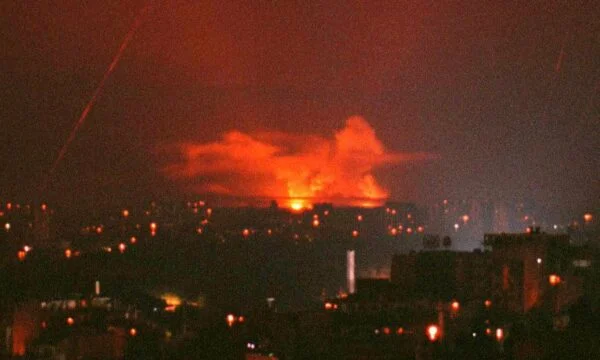
At 20:10, warning sirens were heard in Belgrade shortly after two bright orange glows in the sky. Eight explosions were reported in the capital, especially in the south, where Rakovica's radar station is located. In Novi Sad, the main northern town, five major explosions were reported. Other blasts were heard near Batajnica's large military base and near Montenegro's main airport. At the same time, three strong explosions have been heard in the vicinity of Pristina, Kosovo's capital. An hour later, five new shots, each with a distance of one minute, hit the city's suburb. At 9:30 a large explosion in the Kosovo capital has been reported. Just before midnight, Tomahawks again hit a barracks, triggering a large fire.
According to US President Bill Clinton, NATO forces are targeting “Serbian military targets”. He also blamed the Milosevic situation, which “in the last decade has launched terrible wars in Croatia and Bosnia, and again prefers aggression instead of peace. He rejected a balanced and just peace agreement. Jacques Chirac urged Milosevic to return to the negotiating table”, while new European Commission President-appointed Romano Prodi called for a “peace conference” after military action. UN Secretary General Kofi Annan considered NATO intervention “legisation”, but considered that the Security Council “should be included in any use of force”.
The attacks against Serbia sparked Russia's anger. President Boris Yelts stated himself “fairly indignant” by NATO military action, described as “aggression open”. He decided to review Moscow's relations with the Atlantic Alliance and withdrew its representative to NATO. Jelcin also stressed that in the event of an extension of the military conflict, Russia would reserve the right to receive “adequate measures, including military nature, to ensure its security and that of Europe”. At Moscow's request, the Security Council meeting was to be held Wednesday evening. Chinese Foreign Minister Tang Jiaxan said the attacks were unacceptable “” and warned of “severe consequences” of these operations.