7 minutes ago
K IPRED: Russia s '%e wants Kosovo-Serbia dialogue completed under Western projects
Periskopi(2 years ago)
(2 years ago)Russia does not want the Kosovo-Serbia dialogue process to end successfully according to Western projects, says a report published on March 1st in Pristina by the Kosovar Institute for Research and Development of Politics (KIPRED). A successful conclusion of the dialogue, mediated by the European Union, and supported by the United States, will [...]
A successful conclusion of the dialogue, mediated by the European Union, and supported by the United States, would testify to Russia's reduced influence on world affairs, according to the report.
Dialogue between Kosovo and Serbia facilitated by the EU has started since 2011. The goal is to normalise relations between the two countries. Kosovo has declared independence in 2008 and is recognised by 117 states, but Serbia continues to consider part of it.
According to the KIPRED report, the successful conclusion of this dialogue would lead to the consolidation of Kosovo's state and citizenship and regional security, while closing up problems with Kosovo would spur Serbia for Western orientation.
“Consequently, abandoning Russian orbit in which Serbia is currently moving”, the report says.
Serbia has not joined EU-set sanctions on its ally, Russia, due to the unprotested war in Ukraine.
What are Russia's intentions?
Ruining the foundations of Kosovo's citizenship, discrediting Western policies towards dialogue and directly regaining Moscow's active role in the process are some of Russia's goals, according to the KIPRED report.
The report also says that war in Ukraine has revealed the depth of political, security and economic relations between Russia and Serbia.
Russia began its unprohibited and illegal invasion of Ukraine on February 24, 2022, and now war has entered in the third year.
Kosovo has joined European Union sanctions against Russia because of its war in Ukraine.
“Russia tries to take advantage of Kosovo's case (invention of NATO in 1999 and declaring independence in 2008) as a currency for the collection of benefits in Ukraine and Georgia to legitimise its annexing wars”, the report said.
“
American researcher Ivana Stradner tells Radio Free Europe that Kosovo is of particular interest to the Kremlin because “can use it for several purposes”.
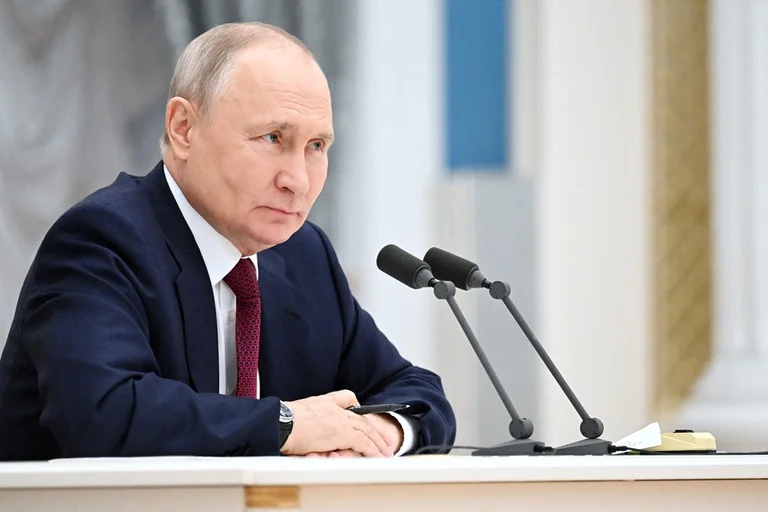
To make sure that the conflict remains frozen (Vladimir) so that (Vladimir) Putin can scale it and position itself as “intermediation”, so if the West does not want the conflict to continue further, they must negotiate with”, she says.
She adds that it is also useful for those who, according to her, are Putin's representatives in the region.
Stradner here mentions Serbia's president, Aleksandar Vuciq, as she says, “is using the crisis to escalate and then escalate the situation, and to position itself as a source of stability in the eyes of the West, to stay in power”.
Propaganda Against the West
Stradner says Russia, also uses propaganda to misrepresent the West.
“Since NATO marks the 75th anniversary this year and also the 25th anniversary of intervention in Kosovo, Moscow will use information operations to charge NATO for the use of impoverished uranium in Serbia, allegedly increasing the number of cancer cases”, she says.
It will also accuse the US of hypocrisy and parallel the war in Ukraine. We already know the scenario he's been around for a long time”, Stradner adds.
Stradner expects continued tensions in the region, particularly mentioning Bosnia and Herzegovina and Kosovo.
“Europe and the US are confused with internal issues, such as elections. It is a dream come true for Russia to cause more chaos in Europe. Moldova and the Balkans are part of the same” strategy, she says.
According to the KIPRED report, the lack of unanimity within the Euro-Atlantic community towards Kosovo, with the five non-recognitional states, has created more maneuvering space for Russia, preventing Western efforts and “to engage insistently in the collapse of the foundations of Kosovo's citizenship and to destabilise the” region.
The report stresses that a significant Russian push to influence Kosovo-led dialogue Serbia is its power to block Kosovo's membership in the United Nations and the OSCE.
University professor Bekim Sejdiu, who is also a researcher in the KIPRED, tells Radio Free Europe that Russia is interested in delegateing the state of Kosovo to the international arena.
“Also, Russia aims to discredit Western involvement in this” process, he says.
The only “Russia is not that it can have any crucial role in the dialogue process, but when we especially take into account the lack at certain moments, of the coherence of the West, as well as the consensus within the European Union and NATO, in terms of Kosovo's independence, it necessarily creates a greater maneuvering space where Russia finds the opportunity to exercise this”, he says.
He says Russia's primary goal is not to allow Balkan stabilisation according to Euro-Atlantic parameters.
The effect of this is open issues, conflicts and continued instability that we see not only in some parts of Kosovo, but also in some parts of the region, such as Bosnia, Montenegro and so on”, he says.
Recently, even the Royal United Services Institute. [ United Kingdom-based RUSSIA said Russia is rebuilding capacities to destabilise European states and expand its influence in the Middle East and Africa, thus creating a strategic threat to NATO and its members, who are focused on fighting in Ukraine.
Among other things, the report also mentions how the extent of influence is done, as well as through various charitable associations, and among these is the Ahmat Cadyrov Foundation, which seeks to popularise Cadyrov as a religious figure.
The European Islamic Forum, an organisation that has headquarters in Brussels and was founded in October 2018, does similar works.