12 minutes ago
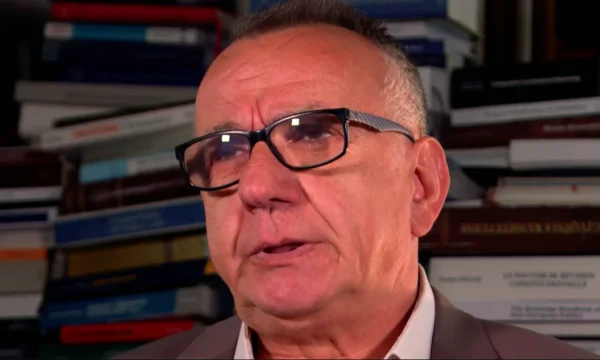
INT ERVIEW/ Enver Hasani: «Reismatisation of the majority population in Kosovo has taken on tragic size»
Periskopi(2 years ago)
(2 years ago)An interview with jurist Enver Hasani, the first president of the Constitutional Court of Kosovo, who recently published the book “en route to Damascus”, in which he first speaks of his education and then about the basic Kosovo problems his book tries to shed light on, such as the risk it poses for [...]
Interviewed: Dragusha Light
GE: You've just published the book “en route to Damascus”. Let's talk about the title, because as we know this title, it bears one of the most famous paintings of the great painter Michelangelo Meris da Caravaggio. Why did you decide this title?
Enver Hasani: The book holds this title based on a scripture that was published in September 2013 at “Koha Ditore”, following the administration Obama's failure to crack down on Syrian President Bashar al-Assad's criminal regime following mass poisoning of civilians. I had compared President Obama to St. Paul's mission, hoping he would end the terror of innocent Syrian civilians. This, however, did not happen: President Obama stepped back and, furthermore, invited Russia's President Putin as a partner in managing the tragedy that was unfolding in Syria. Putin skillfully exploited this, empowered the Syrian president, his client, and received a clear message that the West was in defensive in relation to it. Then came the Crimean annexation and aggression in Ukraine. None would have happened if President Obama had hit the regime in Damascus in 2013. The turning point for the worse in American foreign policy is exactly this inaction of President Obama.
GE: In the book, besides references coming from the field of justice, your professional field, there are also many references from philosophy, literature and history. How much have these areas affected or how important they were in your formation as lawyers and also as judges?
E. Hasan: The truth is, my early professional formation has been that of the general lawyer, while I've studied international law and, then, civil rights, to continue regular studies of master and doctorate in international relations sciences. I am actually a doctor of philosophy, while doctoral studies have been multidisciplinary and have included right, history and philosophy. The latter mainly had international relations focused. Each time, as a student and not only, I had passion for history and literature, and the areas I studied were closely related to these two dimensions of human knowledge. This has made my writings reflect the impact of history and literature. In my early formation, the educational system has been one that has strongly imposed the reading of literary works, which has also contributed greatly to my intellectual orientation.
«Beyond political philosophy can be answered in the big questions that have accompanied man from antiquity: What is human happiness and prosperity? What is justice? What is freedom? After those theoretical questions have been answered, dilemmas come about on practical issues: How is happiness maximized? How is human freedom and equality best achieved? How can human rights be respected?»
GE: What is the role of philosophy in your shaping?
E. Hasani: Amazing, especially one of its branches, the main branch of political philosophy. I don't think a good lawyer can't be like that unless there's any clear humanity's political philosophy, in particular the Western world, which in most of the time after Christ has dominated mankind. How can it be a normal lawyer if there is no clear sense of Plato's philosophy of Archaeology, Thomas Hobbes, Russo, Monteskies, and 20th century justice philosophers like Hans Kelsen and Karl Schmitt? How can the jurist, who represents the abception of the continental system of law, understand the philosophy of Cyceon, Mark Aurell, Titus, and other Roman philosophers, the philosophy upon which the republican and imperial Rome were built? How can a man who does not understand the importance of ancient and medieval philosophy in the construction of modern Europe and its state be a lawyer? How can a person be a normal lawyer who doesn't understand when and why the modern state was born and how it was produced in global proportions? In short, the story of political society cannot be understood by a lawyer who does not possess the language of political philosophy. This branch of philosophy is, as it is known, covered with practical issues regarding the organization of social life, the physicalization of government, the role and rights of citizens, the duties and restrictions of the State. Only through political philosophy can the answer be given to the big questions that have accompanied man from antiquity: What is human happiness and prosperity? What is justice? What is freedom? After those theoretical questions have been answered, dilemmas come about on practical issues: How is happiness maximized? How is human freedom and equality best achieved? How Human Rights Can Be Respected These jurists can never understand by dogmaticly interpreting right, which itself is a social phenomenon, but only through the profound teaching of philosophy about right, role, and position in human society.
GE: What is literature for you and how much does it affect you?
E. Hasani: As I told you, literature has been a very influential factor since early youth, and this is dedicated to the model of education in Kosovo at the time. For summer holidays, there has always been an obligation to read at least 5 novels or novels: their selection has been very careful and with little ideological influence; I can say that it has been primarily a classical-oriented approach, which has obviously influenced the formation of my width in the literature report. Greek literature, suppose, has been known since high school. Radio and television in my youth have also played a major role in this: There have been regular literature and history shows that have enriched and filled up what we learned at school.
I started law studies in 1980. After 1981 and the extreme politicization of life, the establishment of national awareness of Albanians under the former Yugoslavia, a particular kind of literature was introduced into my life -- political literature. Sylejman Krasniqi's historical novels, book “Blood Snakes” Adam Demach, Ibrahim Rugova's “Literacy “and Sabri Hamiti's Sabri, drama “Futa” of the latter, and so on, have dominated the method of reading in my years of formats like jurists. Reading literature has cultivated a critical thought in a special way.
GE: How important is history not only for one country and society but also for a lawyer?
E. Hasan: Kosovo belongs to the Roman Greek university of law, so we teach the philosophy of creation, development and extinction of Greek and Roman civilizations, which are the foundation of the legal culture of the law system in Kosovo and the Western world in general. Disrecognition of the history of this civilization is a huge indices, and this is noted by man in public presentations and in the writings of Kosovo lawyers, which are published in the country and in the outside world. Those presentations and writings are dominated by depletion, dogmatic interpretations of normative structures, which in most cases end up in tautology, precisely because they lack basic knowledge of Western history and philosophy.
What politicians have to do is to issue good laws that prohibit the politicisation of the judiciary, to assume, by preventing judges from running for policymakers, to seek strict professional criteria, such as academic and practical experiences of judges, to provide transparent processes of selection of constitutional judges according to Western countries and so on. In the past, unfortunately, there have been cases where politics has entered the jurist system with professional fly preparation, policy serviles, who previously served in politics blindly»
GE: We now return to the central theme this book affects, or more specifically, the Constitutional Court. What is the policy report or politicians with the Constitutional Court? Because, as we already know, Kosovo politics and politician is still not incarnated with the constitutionalist outlook?
E. Hasan: When the Constitutional Court began its work, in June 2009, I had the honor of being its first chairman. It was a whole new experience. Its first decisions were commented on by lawyers who had been molded with communist law-educated from the constitutional judiciary of the former Yugoslavia, which had been quite different. The values it has defended have been the values of the Yugoslav communist system, where the individual had no role and no constitutional protection. Jurists' criticism of the Constitutional Court's decisions was an Atavism because they were based on knowledge of Yugoslav constitutional judgment. The public should remember completely banal criticism of how it is possible for the Kosovo Constitutional Court to issue judgments, only regular courts will reveal these lawyers (like!). They, therefore, did not understand the fundamental dimension of the Western constitutional court, under which the Constitutional Court of Kosovo is modeled. Such banal criticisms have continued all the time that I was mayor, to be interrupted after my departure. There has been a time of calm against the work of the Constitutional Court, as if a silent pact was created between politics and the Constitutional Court. With Vetevendosje Movement's coming to power, criticism of constitutional trial took on dramatic proportions: criticisms taking place in GeneralBy declaring traitors and corrupts the entire judicial body. This was a barbarous approach to the justice system, never before seen, and has continued for years. The irony of fate is that the same leaders who have led this promotional campaign to the justice system, the days before were forced, without dignity, to send a formal letter to the Council of Europe, with which they vowed that they made bea and lightning, as the people say they will no longer use street languages and will not interfere with the work of the Constitutional Court and the regular judiciary.
What politicians have to do is to issue good laws that prohibit the politicisation of the judiciary, to assume, by preventing the candidacy of judges of policymakers, to seek strict professional criteria, such as the academic and practical experience of judges, to ensure transparent selection processes of constitutional judges according to Western models and so on. In the past, unfortunately, there have been cases where politics has introduced lawyers with professional fly preparation, political servile, who previously served in politics in a blind way.
«The Union of Serbian municipalities, such as the umbrella of Serbian political-territorial autonomy, has no connection with the Association of Serb majority municipalities, which has been envisioned in the 2013 Agreement and the Constitutional Court Act of 2015. The 2023 Brussels and Ohrid Annex Agreement have cut Cesareic with Kosovo pledges of 2013, confirmed with the 2015 Constitutional Court Act
GE: Your book is divided into six chapters, and the last chapter seems to be only the most important chapter in the political present. In this chapter, you address the material aspect of the constitution, and you even entitled: “Mby the Material Constitution of Albin Kurti”. What is the material constitution?, first and second; why did you identify this “material conditions” with Prime Minister Albin Kurti?
E. Hasan : The material constitution is not my discovery. It has been used by the Italian lawyer of ancient origin, Constantine Mortati. According to him, justice cannot be separated. In this grey area between politics and law, K. Mortati has built the theory and practice on the material constitution, which puts him in the light of the idea and concept of the material constitution. This dichotomy enables, on one hand, to investigate the report between formal legal texts and the material context in which they operate, revealing the importance of political goals and social forces supporting such goals. On the other hand, this shift of focus from formal legal texts to socio-political relations that support texts in question creates room for emphasising the superiority of institutional and organisational aspects towards extra legal dimensions. The formal constitution and norm structures, regardless of the form in which they appear, are a photographic description of an existing order. Their role is thus limited to simple organisational and technical tasks. What gives norms and norms to a constitution, the real core of the constitution, is found, respectively, only in its material reality in which it operates. That material reality forms the material constitution and It is made up of two distinct elements. The first is called the typical essential content of the constitution, which Mortati calls fine politics (political goal) while the second is made up of norm material elements that shape the essential content of the constitution.The latter consist of a certain configuration of power reflected in relative power and the specific organization of social groups. As such, this configuration is always an expression of power relations, where one or more groups are able to impose on others: group or group end up shaping fine politics and give substance to norms the constitution. There are forces that dominate and forces that remain outside the picture or forces that are dominated. The latter can either passively accept dominant status or challenge it and oppose it actively. It is movements sparked by competition between dominant forces and dominant forces that explain changes in the sense, efficiency and value of formal constitutional text, all constitutional standards, no matter the form in which they appear. Kosovo's political goal has been declared on February 17th 2008 and has had to do with the creation of a unitary, sovereign and independent state, where the state is not defined in ethnic but civic terms, and where communities are equal, regardless of their number or geographical concentration. The 2008 Declaration of Independence and Constitution are based on these premises. With the Brussels and the 2023 Ohrid Annex agreement, these political goals have been overturned, because the unitary character of the state of Kosovo has been destroyed, while the Serb community has been separated from other communities, gaining significant political-territorial autonomy in the realm of political representation, in the cultural, spiritual, economic sphere and in any other realm. The political goal stated with the Declaration of Independence has been overturned, especially with the fact that Serbia has won the right to prejudice Kosovo's status, renounce recognition and conversion of dialogue with Serbia in a process that never ends. The security of the forces, built on February 17th 2008, has been overturned so that Serbs from now on gain institutional representation, executive and judicial structures, shared by central power based on the 2008 Constitution. The Serb municipalities' community, as an umbrella of Serbian political-territorial autonomy, has no connection with the Association of Serb majority municipalities, which was envisioned in the 2013 Agreement and the Constitutional Court Act of 2015. The 2013 Brussels and Ohrid Annex agreement of 2023 has made cesareic cuts with Kosovo's pledges, confirmed by the 2015 Constitutional Court Act, because they have created a detailed system of territorial political autonomy, with institutional structures and mechanisms for resolving disputes, which are not based on the 2008 Declaration of Independence and Constitution, but on UN Security Council Resolution 1244.
The latest «re-enforcements that have made Qrevra Albin Kurti with the Brussels Agreement and the Ohrid Ankes lead to what I am saying, respectively, in terms of future formation of a formal state link between Kosovo and Serbia. For now, it is difficult to determine the modes of this connection. Safe is that, however, the Brussels Agreement and Ohrid Anex have opened the doors to such a project, more than the entire agreements previously linked between Kosovo and Serbia»
GE: Finally, in (re) the ongoing designs being done to the Republic of Kosovo, how do you predict its future, when you consider the fact that in addition to the spread of popularism throughout Europe, fascism, nationalism, many disturbing expressions continue to be religious fanaticism? Where is the Republic of Kosovo in this respect?
E. Hasan: Reinventions that are constantly being done to Kosovo's institutional and constitutional structures are disturbing because they have no stop. In a future, it should not be surprised if the proposal for a loose and asymmetric relationship with the state of Serbia comes. The recent pensioners that have made Qériva to Albin Kurti with the Brussels and Ohrid Ankes Agreement lead to what I am saying, in terms of future formation of a formal state link between Kosovo and Serbia, respectively. For now, it is difficult to determine the modes of this connection. It is certain, however, that the Brussels Agreement and Ohrid Anex have opened the door to such a project, more than the entire agreements previously linked between Kosovo and Serbia. Previous agreements have not affected the fundamental political goals proclaimed on February 17th 2008, nor have the social forces' configuration changed in Kosovo. Ideal changes in Europe, in essence, do not affect the report between Kosovo and Serbia: changes in geopolitical configurations that dictate Europe's strategy towards Kosovo and its state status. The only change that affects Europe's position on Kosovo is religious change: turning Kosovo into a Muslim state, radically changes the approach of Europe and the West towards the state of Kosovo. In fact, I strongly believe that the reviews being done to the Kosovo State project, drawing it closer to Serbia every time, more and more, concern the disturbing trends of radical and massive Albanian cultural stock. The change we see today has taken on the tragic proportions of population resizlamism. This has nothing to do with geopolitical changes in Europe and beyond. It should never be forgotten that many countries in Europe have had serious reserves for NATO intervention in Kosovo in 1999, precisely because of fear that a Muslim state might be created. That's not what I say, but Madeleine Albright in her memoaries. I believe that and that is my greatest concern, the staggering spread of radical Islam among Kosovars, of the Selafist Islam and the ideology that support it, respectively. The traditional Islam of Kosovo, Islam Hanef, over the centuries has not produced fundamentalism and has not presented any problems in reports with the West. What we are now seeing is different and should disturb everyone in Kosovo and not alone.