3 minutes ago
The agreement with Serbia ʹ Kurti says again: Five times I offered my signature, five times I refused.
Periskopi(2 years ago)
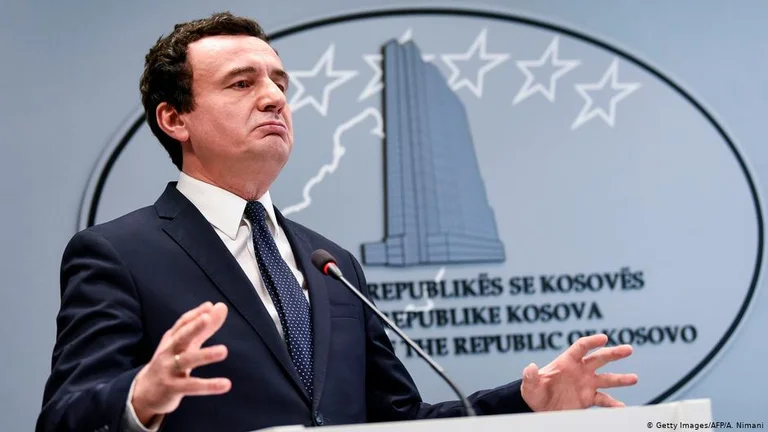
(2 years ago)Radio Free Europe: We move on to the issue of high-level dialogue... What is happening to the process of high-level dialogue between Kosovo and Serbia? Where is it stuck? Albin Kurti: It's stuck in Serbia's violations of the deal. At least eight out of 11 provisions of the basic agreement, Serbia has violated them. [...]
Radio Free Europe: We move on to the issue of high-level dialogue... What is happening to the process of high-level dialogue between Kosovo and Serbia? Where is it stuck?
Albin Kurti: It's stuck in Serbia's violations of the deal. At least eight out of 11 provisions of the basic agreement, Serbia has violated them. And this has culminated in former Prime Minister Anna Brnabyq's letter, which will now be head of Serbia's Parliament, where she says she practically withdraws from the basic agreement and from the annex of implementation [ over] Ohrid. The basic agreement is at least mutual recognition, de facto. Maybe even more, but at least de facto recognition is.
And they withdrew because they said “we will never accept Kosovo's independence, we will never accept Kosovo's territorial integrity, nor the seat for Kosovo at the United Nations Organisation”.
They, practically, withdrew from the deal because they had violated it all year round. The problem I have with European and American mediators is that they have tolerated violating the agreement, disrespecting the ongoing agreement that Belgrade has made over the months, weeks and even days of 2023, which culminated in December 13th at the European Council summit, where Mrs. Brnabiq said we are withdrawing from this agreement.
So, we can't have the agreement implemented without respect. Brussels and Washington have consistently insisted on implementing the agreement, but how can an agreement be implemented that is not respected? They violate the deal every day. And, the two main events we've had last year is April 24th, when Kosovo passed its first phase towards membership in the Council of Europe, and Serbia's president, Vuciq, held a conference in which he said that Kosovo's north is occupied, does not accept the agreement so on, to the refusal Brnabic made in mid-December.
Meanwhile, on the ground we had paramilitary attacks on security personnel, in May, where over 90 KFOR soldiers, but also police and journalists, were seriously injured and injured, and the murder of Kosovo Sergeant, our hero, Africa Buxaku, on 24 September. On February 27th, we make deals, on 18th is an annex to implementation. See what happens later.
Radio Free Europe: As a process, of all that you told us, the process is stuck where it was or is it going back?
Albin Kurti: I believe there are steps back, because the moment the agreement is violated and the referee, the mediator does not condemn this violation, it is step backwards. Because the violator of the deal will take this as a permit to continue with the old avaz.
Radio Free Europe: Do you think that an alternative can be found that might push both sides forward?
Albin Kurti: Both sides, I don't know... I know about the Republic of Kosovo. The Republic of Kosovo, whose prime minister I am, is fully committed to the basic agreement, which I have offered five times to sign at various meetings. Five times I was rejected. Meanwhile, for the other side, I believe Brussels and Washington decide. Do they intend to sanction it for terrorist and criminal attacks in Kosovo on the one hand, and for continued violations of the agreement on the other?
Radio Free Europe: When we're under attack... US officials have confirmed that they are investigating organisational links for the attack on Banjska. Do you have any information on this matter from...?
Albin Kurti: For information I have, as prime minister, thanking the Ministry of Internal Affairs and the Kosovo Intelligence Agency first of all, what has been necessary to inform the public, we have done at a joint conference with Minister Svecla at the end of last year, when, if I am not mistaken, there were three months of the terrorist attack on Banjska that killed our police sergeant, Africa Bulnjak. But, the Kosovo Prosecutor's Office, on March 24th, will mark the sixth month of failing to have an indictment against Milan Radiochi.
For my obedience, that's the problem, I can't raise charges. The Act must establish Kosovo's Special Prosecutor, the State Prosecutor. On March 24th, it's six months since Milan Radociq has no charge of the terrorist attack that killed our state police.
Radio Free Europe: Would it be better, perhaps, to wait for information to be collected and then an accusation to arise?
Albin Kurti: How much can you expect, for example?
Radio Free Europe: For a time until all the evidence and expertise are collected?
Albin Kurti: But he admitted himself... He said I did. In Serbia, Milan Radovici stated that he has also made organisation and the execution of the attack that killed us African Bulnjak and there is no indictment in Kosovo. What's going on? Find me another democratic state, where the assessment, consent, credibility of the president, prime minister and prime minister is twice the size of the justice system. The opposite may be, when judges, prosecutors, the justice system has doubled the assessment of state leaders. But in Kosovo it is the opposite. President Osmani, Chief Prime Minister Konjufca and I as prime minister have twice the assessment of the justice system.
Radio Free Europe: Let's talk about the Decani case... Mr. Prime Minister, has everything been accomplished about the lands around the Decani Monastery?
Albin Kurti: We have been notified since three preconditions that were said to be, in fact, there is only one. And this happened after a visit that was conducted by Chief Prime Minister Konjufca with Deputy Foreign Minister Ahmeti and the meetings and communications that Deputy Prime Minister Donika Grovall has developed. So, just a prerequisite. But this also harmonizes with the report of the dominant lawyers.
This has been to enforce the Constitutional Court's act on 24 hectares, which are within the particular area at the Decani Monastery. There has been a tendency to have other preconditions, but there is only one precondition. From our point of view, this case is closed. This week, it would be necessary for rapporteur Dora Bakoyanis to hand over her report to the Committee, pass to the Committee, mid-April, pass to the Parliamentary Assembly of the Council of Europe. At the end of May, we will also become full - fledged members. And I think it's an extraordinary historical and geopolitical moment. The Russian Federation outside, the Republic of Kosovo, membership.
Radio Free Europe: Did you get information from Kadast that everything was done in this case to notify the monastery that...?
Albin Kurti: There have been technical differences, all addressed by the Cadastral Agency. There are numbers parcels, there are special appointments...
Radio Free Europe: You mean it's not done yet?
Albin Kurti: Look, as far as I know, it's all done. But, on these technical issues, I think we'll let you know when we get a notice from Kadastri. And this has to end now because Dora Bakoyanis is the one who has to deliver the report to the Committee.
Radio Free Europe: If Decani's question of membership were not conditional on the Council of Europe, would you do so?
Albin Kurti: First of all, I disagree with the Constitutional Court's act. In my sound mind, the critical reason... I've never understood how the Decani Monastery becomes a party addressing cases in the Constitutional Court, but many other issues. But look, we have to do our best and good with a bad and bad heritage, which is far from minimal. And that's what we're doing.
Radio Free Europe: So if it wasn't for the Council, you wouldn't do that?
Albin Kurti: We couldn't consider it with such urgency. We have a unique opportunity to have seats this spring near other member states.
The Council of Europe, because all indicators of prestigious organisations for the basic values of the Council of Europe, we fully satisfy them, namely, the rule of law and human rights and democracy. There are partial fulfillments but not even the fulfillments of member states. While Kosovo, which aspires, complements them generally. So I guess you deserve that. But in the current context, geopolitical, the unique case is this spring. If we don't win this case, then it's all delayed in a year.
Kurt for the dinar case: There are no proposals that are accepted and contrary to BEC regulation