2 minutes ago
VOA: 16th anniversary of Kosovo's independence amid tensions with Washington
Periskopi(2 years ago)
(2 years ago)The United States played a key role on the road to Kosovo's independence and recognised it one day after it was proclaimed by the country's leaders on February 17th 2008. As Kosovo prepares to celebrate the 16th anniversary of its declaration of independence on Saturday, relations between Washington and the country's government, which is often considered as [...]
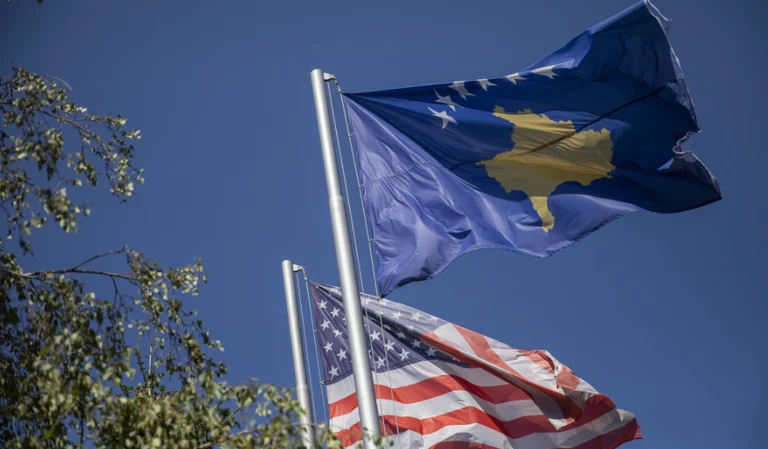
The United States played a key role on the road to Kosovo's independence and recognised it one day after it was proclaimed by the country's leaders on February 17th 2008. As Kosovo prepares to celebrate the 16th anniversary of its declaration of independence on Saturday, relations between Washington and the country's government, which is often considered among the most pro-Americans in the world, are at the lowest point. The material brings a look at America's ties Kosovo, from the American commitment that it will be supporting Kosovo forever to questioning the partnership between the governments of the two countries.
Every weight date in Kosovo's modern history relates to American support. Regardless of which party led the White House and despite domestic American political conflicts, support has been bipartisan.
“We and our NATO allies have started shelling only after repeated efforts to find a peaceful solution to the Kosovo crisis”, former US President Bill Clinton said on 24 March 1999.
From NATO air strikes to declaring independence and securing recognitions so far, Washington has played a key role in these processes.
“Independence is the goal and that's what the people of Kosovo need to know”, President George W. Bush in Tirana in June 2007, about 8 months before Kosovo's declaration of independence, as he became the first American president to visit Albania.
A day after Kosovo's declaration of independence, US Secretary of State Condolezza Rice through a statement announced that Washington recognises Kosovo's independence.
The conclusion of the statement says: “While Kosovo begins its life as an independent state, the United States vows that they will continue to be its close friend and partner. ”
In July of that year, President Bush hosted the White House, Kosovo counterpart Fatmir Sejdiu and Prime Minister Hashim Thaci, making this pledge:
The UN will continue to work with nations that have not recognised Kosovo to persuade it to do so as quickly as”, President Bush said.
“I strongly believe in Kosovo's independence and territorial integrity and its aspirations to become a full partner in the international community and member of the European Union and NATO”, Hillary Clinton said as President Barack Obama's first administration state secretary.
A few years later, the Kosovo government's ties with Washington have suffered the greatest impact, as confirmed during Assistant Secretary for Europe James O'Brien's interview with the Voice of America:
If we are not treated as partners, we too will not treat the Kosovo government as partner”.
In Pristina, the government is treating this statement as if it had not been made. Prime Minister Albin Kurti, who is at the centre of O'Brien's messages, spoke in Prizren the following day, saying US-Kosovo relations are intact. He hinted, however, that he does not back down from the decision that caused the recent tensions with the US, the removal of the Serbian dinar from use in Kosovo.
I am concerned that public statements by the Kosovo government suggest that partnership with the US will not be affected by this situation. I must be clear: this is simply not true”, US Ambassador to Pristina Jeff Hooverier explains on Thursday.
Kurti's government, however, has friends in Congress who disagree with the American government's approach.
I disagree with the American government's approach. It is another thing to express concerns privately to an ally, who is fully appropriate and something else to publicly shame and underestimate an ally”, lawmaker Richie Torres, told the Voice of America in Washington who is also the leader of Albanian affairs in the House of Representatives.
I'm happy to be here not only on the day you're celebrating independence, but also that corresponds to Valentine's Day. So it is a double love day”, US Deputy Assistant Secretary of State Gabriel Escobar said on February 14th, the day the Kosovo Embassy in Washington organised expectations in Congress Library to mark the 16th anniversary of Kosovo's independence.
The atmosphere in this event gave the impression that everything is in order in relations between the two countries. But Escobar made an explanation for this in his speech:
The “The United States is and will always be Kosovo's strongest protector; the most pro-Kosovo state in the world. Our relationship is with the people of Kosovo, not one person or one party. When Kosovo is ready for a closer relationship, we will always be ready and we hope that day will come again very soon”, Escobar said.
“The need to promote recognition of Kosovo is American politics and has been since Kosovo's independence. The implementation of this policy faithfully should never depend on whether the State Department likes Prime Minister”, said the lawmaker Torres, who replaced the former Albanian co-chairman of affairs in the House of Representatives, Eliot Engel.
Kosovo's Ambassador to the US, Ilir Dugolli, in an 11-minute speech, cited Kosovo's partnership with allies almost 10 times directly and not.
Kosovo adheres to the vow in the Declaration of Independence and Our Constitution, which we have drafted along with our closest partners”, Ambassador Dugolli said among other things.
This is not the first time the US has expressed concern for the lack of partnership by Kurti's government. On 30 May of last year, Washington suspended Kosovo's participation in the “Defender Europe 2023” exercises. It was because of the government's failure to co-operate with Albin Kurti's actions in northern Kosovo.
In that period and especially after the attack on Banjska, support for Kosovo grew, as did Western criticisms that its policy is wrong, that it uses harsh language and has imposed restrictive measures on Pristina and does not do so with Serbia, which continues to co-operate with Moscow. Belgrade is the only one who has refused to join EU sanctions following Russia's aggression in Ukraine. It is also the only European country, besides Belarus, that continues to sign co-operation agreements with Moscow.
On February 14th, Serbian President Aleksandar Vucic announced that his country has received a new amount of weapons from Moscow.
I think the American government should think again about what is really happening in the Balkans and what is the situation between different countries and have a more realistic view of this”, former American Ambassador to Pristina Greg Delawie, who served in Kosovo from 2015 to 2018, told the Voice of America.
The situation changed with Kosovo Central Bank's decision not to allow the use of the Serbian dinar in Kosovo.
Kosovo must pay more attention and think how important it really is to friends for its continued prosperity and freedom”, Ambassador Greg Delawie said of the Voice of America.
No US official, so far, has said something concrete about possible restrictive measures against Kurt's government, but the other concern is whether it means a deeper change of American foreign policy towards Kosovo.
The “appears to have had a deterioration of relations between the Kosovo government and the State Department. But I see no evidence that there has been a change in Kosovo's relationship bases with the US and American politics towards Kosovo”, Democrat lawmaker in the House of Representatives Richie Torres said. / VOA