6 minutes ago
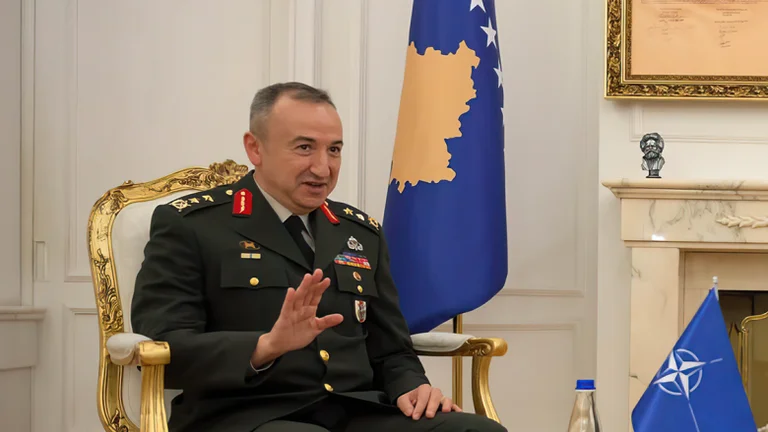
Uluta: Attack on Banjska and against KFOR unacceptable, situation in quiet north but fragile
Periskopi(2 years ago)
(2 years ago)KFOR commander in Kosovo Ozkan Ulutas has described the attack on KFOR in the north 29 May and the September 24th attack on Kosovo Police in Zvecan Banjska, unacceptable. He said such attacks should no longer be repeated until he added that their authors should be held responsible and [...]
KFOR commander in Kosovo Ozkan Ulutas has described the attack on KFOR in the north 29 May and the September 24th attack on Kosovo Police in Zvecan Banjska, unacceptable.
He said such attacks should no longer be repeated until he added that their authors should be held accountable and brought to justice.
Asked whether Banjska's case with Serbian military command could be discussed, which was charged with releasing military assets for training the terrorist group, Ulutas said “K FOR regularly and transparently communicates with all international and local actors. We are discussing all relevant security developments in the region”.
KFOR commander stressed that they have asked Kosovo and Serbia to conduct the necessary investigations in order to verify all facts.
“Pics first, the May 29th attack on KFOR troops and the September 24th violent attack in northern Kosovo were unacceptable and should not be repeated. The authors of this violence must be held accountable. We have called on relevant authorities in Pristina and Belgrade to conduct the legal investigations needed to confirm the facts and bring those responsible to justice. All these points were also made very clear by the secretary - general NATO, Jens Stoltenberg, during his visit to the region last November. In the continuation of violence, NATO landed about 1,000 additional peacekeepers and the worst armoured forces in Kosovo. This has been the largest reinforcement of our contingent in Kosovo over a decade. This shows that NATO is ready to maintain peace”, he said.
Ulutas said KFOR's peacekeeping forces in Kosovo are willing to face any situation.
“KFOR has a fast, flexible and visible presence throughout Kosovo. We remain vigilant and focused on the daily and impartial implementation of our UN mandated mission. We are well equipped and willing to face any situation that can affect the security environment and continue to operate in close co-operation and co-ordination with the Kosovo Police and EULEX”, he said.
Among other things, KFOR commander also talked about co-operation with the Kosovo Defence Ministry and the Security Force (FSK).
“NATO, which is divided by KFOR, has a mandate to work side-by-side with the Kosovo Security Force, in line with the original KSF mandate, as a civil defence force”, he said.
Ulustas quoted the NATO secretary-general, who had said the KSF landing in the north requires KFOR's consent.
“NATO, Jens Stoltenberg, was very clear at this point during his visit to Pristina in November. He stressed that “any landing of the Kosovo Security Force in northern Kosovo requires KFOR's consent”. We welcome the continued respect of this pledge by institutions in Kosovo. Secretary - General NATO also stressed that “We are awaiting consultations on any action of the Kosovo Security Force or the Kosovo Police that may have an impact on regional security”, he said.
He stressed that he is in regular contact with “representatives of Kosovo security organisations and with the Chief of Staff of the Serbian Armed Forces”.
I account for their continued co-operation, as these communication channels remain key to supporting sustainable security throughout Kosovo and preserving stability in the region”, Ulusta concluded.
KFOR commander has declared that the situation in northern Kosovo, though generally calm, remains fragile.
Ulutas said that after increasing tensions in last year in northern Kosovo, NATO has sent hundreds of additional troops, redoubled KFOR's presence and tripled the number of patrols.
“generally, the situation is calm, but remains fragile. After increasing tensions in the past year, NATO deployed hundreds of additional troops. We doubled KFOR's presence in northern Kosovo and tripled the number of patrols, including those along the administrative border line. Our mission force is currently around 4,500 troops, with contributions from 28 countries, including NATO allies and partners. These are careful steps to ensure that KFOR's mission continues to fulfil its UN mandate, based on UN Security Council Resolution 1244 of 1999, to provide a safe and secure environment for all communities living in Kosovo, as well as freedom of movement, at any time is known impartially <x>, he said on the <2X> Fivet<3> show in Dukagjin.
Ulutas, meanwhile, added that they would continue to prevent the crossings by their efforts. He said they are willing to respond to possible challenges.
We will continue with our efforts to prevent crossings and we are willing to respond to possible challenges, adapting our presence, as necessary, in line with our UN mandate. We continue to act as the third security responsibility, behind the Kosovo Police and the EU's mission for Sundiating Law (EULEX), as the first and second responsibilities, respectively, with whom we co-operate and co-ordinate” regularly, Ulutas said.
Ulitas has re-focused NATO Secretary General's position during his visit to the Western Balkans last November that NATO strongly supports dialogue between Kosovo and Serbia.
As Secretary General put it NATO during its visit to the Western Balkans last November, “Stability depends on all sides, choosing diplomacy before violence. NATO strongly supports dialogue facilitated by the EU between Belgrade and Pristina. Both parties should engage in trust. This was the only way to reach solutions that respect the rights of all communities”.
While questioning what the overall situation in the border areas with Serbia is, Ulutas says that, impartially, KFOR is providing a safe and secure environment.
KFOR's “mandate is clear, based on UN Security Council Resolution 1244: to provide a safe and secure environment for all communities living in Kosovo, as well as freedom of movement, at any time and impartially. KFOR troops are carrying out patrols throughout Kosovo, including joint patrols with the Kosovo Police, and patrols synchronized with the Serbian Armed Forces on each side of the administrative border line”.