4 minutes ago
A year from the Kosovo-Serbia agreement: Instead of normalisation, stress of situation
Periskopi(2 years ago)
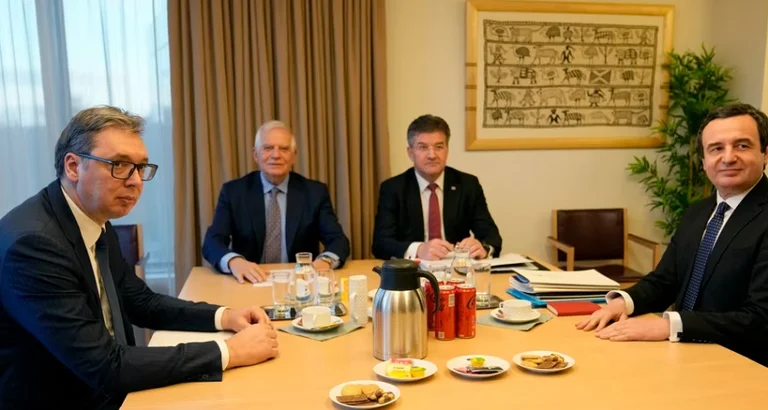
(2 years ago)Maintaining peace, good neighbourly relations, resolving disputes exclusively with peaceful means and refraining from threats or use of force are some of the provisions of the Agreement for normalising relations, which Kosovo Prime Minister Albin Kurti -- and Serbia's president, Aleksandar Vuciq -- reached a year ago in Brussels. Agreement, [...]
Maintaining peace, good neighbourly relations, resolving disputes exclusively with peaceful means and refraining from threats or use of force are some of the provisions of the Agreement for normalising relations, which Kosovo Prime Minister Albin Kurti -- and Serbia's president, Aleksandar Vuciq -- reached a year ago in Brussels.
The agreement, mediated by the European Union, would have to resolve all open issues between the two countries from recognising state symbols to the greatest rights for the Serb community in Kosovo.
However, what happened on the ground during the past year was almost the opposite of this: increasing tensions in northern Kosovo after Albanian mayors of majority Serb municipalities took power; clashes between Serbs and members of NATO's peacekeeping mission in Kosovo, KFOR; armed attack by Serbs against Kosovo police; removal of the Serbian dinar.
Members of the Albanian and Serbian community, surveyed by Radio Free Europe in North and South Mitrovica, say they are disappointed by politicians, on whom their lives depend, and that they have lost hope “for a better tomorrow”.
Even a poll by the nongovernmental organisation active for the attitudes of the Serb community, which was released on February 26th, shows that there is a <x0-> a deep concern and a great disappointment of the citizens of the Serb community in Kosovo, in terms of the current political situation”.
“has a greater degree of pessimism compared to all previous years, as a result of growing fears of a potential open conflict”, is the key find of the organisation with headquarters in northern Kosovo.
The Kosovo government and the Office for Kosovo of the Government of Serbia did not answer Radio Free Europe's question if they are willing to continue with the implementation of the agreement.
Artan Mujariri, sociologist and political analyst from Pristina, says Kosovo and Serbia have shown that they have no will to implement this agreement, which is considered a positive “basis for normalising relations” and “guarantees possibilities for qualitative progress”.
Speaking to Radio Free Europe, Naim Leo Beshiri, from the Belgrade Institute for European Affairs, says Kurti and Vuciq agree on the international plan, but that “do everything to sabotage the agreement at local level”.
What happened to the deal?
Twenty days after Kosovo and Serbia accepted the deal, on February 27th, 2023 -- which until then was known in the opinion as the “Franco-German plane” in Ohrid -- agreed to an annex-document for its implementation.
Although not signed, the EU said the agreement is legally binding and that the obligations that come out of it are integral parts of the European road to Kosovo and Serbia.
However, senior Kosovo and Serbian officials repeatedly expressed attitudes that hinted they are not willing to adhere to the agreement.
Kurti insists on signing the agreement, since, as he considers, it would be a guarantee that Serbia would also fulfill its obligations.
In mid-January of this year, he also said that the Association of Serb majority municipalities “is not a priority” for normalising relations with Serbia and that it should not be isolated.
In October of last year, Western diplomats presented Kosovo and Serbia with a draft state for forming association, which was drafted by the EU and which the parties said would accept.
Vuciq, on the other hand, repeatedly repeats that Serbia will never accept Kosovo becoming a member of the United Nations.
In mid-December last year, Serbia's prime minister, Anna Brnabiq, sent him a letter The EU, where it expressed reservations to obligations stemming from the agreement on normalising relations with Kosovo, including the annexe-document of implementation.
In that letter it said, among other things, that the agreement is only acceptable in a context that does not refer to the de facto and de jure recognition of Kosovo.
What happened on the ground?
Of all the points of the agreement, so far only those dealing with missing persons and recognition of the license plates were implemented.
In May 2023, Kurti and Vuciq adopted the Declaration of Missing Persons during the Kosovo War, with which the parties took over to allow access to all the documents they possess, including “concidential”.
The two sides also recognized each other's license plates. By January of this year, Kosovo citizens no longer cover the state symbols with white posters until they move with vehicles on Serbia's territory, and vice versa.
But, the issue of license plates caused a series of crises in northern Kosovo, due to the Government's insistence that Serbian license vehicles be reregistered with Kosovo license plates.
Consequently, Serbs left Kosovo institutions in the north in November 2022. But at the end of 2023, citizens replaced the plates, as the Government of Kosovo requested.
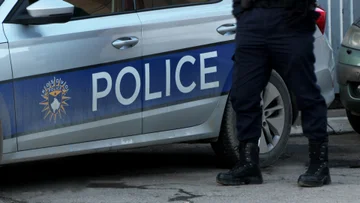
The crossing of Kosovo's license plates occurred after the September 24th attack on Banjska village in northern Kosovo. Armed groups of Serbs attacked Kosovo police there, killing a policeman. Three Serb attackers were also killed in the subsequent clashes.
Kosovo accused Belgrade of this attack, but officials there denied they were involved.
Milan Radociq, former deputy chairman of the Serbian List, recently took responsibility for the largest Kosovo Serb party, which has Belgrade's support.
Earlier, in April last year, Serbs in northern Kosovo boycotted local elections, which resulted in the arrival of Albanian leaders in power.
The situation escalated in late May, when a group of Serbs opposing Albanian leaders clashed with KFOR members.
The European Union held Kosovo responsible for these tensions, and after it did not respond to calls for the enlargement of the situation, The EU undertook punitive measures against it.
Now, the international community again warns potential ethnic tensions, due to the Kosovo Central Bank's decision to remove the Serbian dinar from circulation.
In this currency, members of the Serb community in Kosovo receive different incomes from Serbia, such as salaries, pensions and additions for children. /rel/