14 minutes ago
The deputy prime minister agrees that with the Zajednica draft being accepted by Kurti, the state within “ ”
Periskopi(2 years ago)
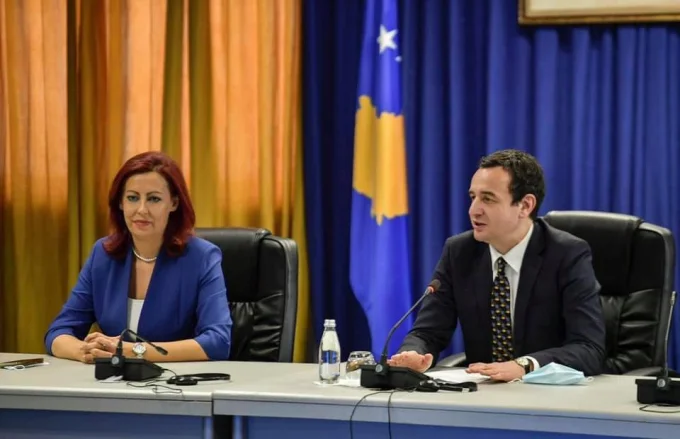
(2 years ago)Kosovo Deputy Prime Minister Emilia Rexhepi calls the draft status drafted by the international community for the establishment of the Association of Serb-run Serb-run municipalities, according to her, creating opportunities to create a Republika Srpska similar to what exists in Bosnia. During an interview with colleague Artan Haraqi, the representative of the Bosniak community of Kosovo [...]
Voice of America: Mrs Rexhepi, Kosovo is under constant pressure to establish the Association of Serb majority municipalities. What steps is your government taking to fulfill this obligation that is part of the agreement reached in Brussels and Ohrid?
Emily Rexhepi: As a new government, Prime Minister Albin Kurti has inherited this problem. I am one of those who voted for the establishment of this association in 2015, although this is a question from 2013, assessing that the Serb community should integrate into the state of Kosovo, as we have done, to have the right to live, to be educated, to work. But now this is quite another issue, as I appreciate that the current draft gives them many rights, that the executive power of association, if established, would be great and that would harm our state. If such an association were to be established, the possibility is to establish a second Serbian Republic as it was established in Bosnia and Herzegovina. We as a government have the position based on the Constitution of the Republic of Kosovo and will expect the Constitutional Court's position not to do anything that goes against our state.
Voice of America: You say the Project- The status that has come from the EU, the international community is at stake...?
Emily Rexhepi: The bill we have seen gives executive power to Association and can come to the creation of a new state within our country.
Voice of America: So you object to the draft and you won't accept...
Emily Rexhepi: I am always against it and it is not against the Serbs, but it simply creates space in the future, so that this part of the territory will be cut off and declared perhaps another republic.
Voice of America: Then why does the Kosovo government not draft a draft statute of its own, and why has it not so far, because it has been a time since it has become an international condition that Kosovo must meet?
Emily Rexhepi: We have co-operation and have close talks with the United States of America, with the European Union, and the path towards the EU is something that offers progress and perspective for us and we will not give up on it. Our government will undoubtedly rely on the Constitutional Court, wait for its position and then take the matter into our own hands and draft a new statute for Association.
Voice of America: Another issue that has caused problems between Kosovo and the international community is holding elections in the four municipalities in the northern part. Although Western diplomats preferred the resignation of mayors, your government chose a more complicated process through a petition already signed. Are these delays at the expense of Kosovo's processes and relations with the international community?
Emily Rexhepi: We don't have problems with international representatives and the international community because I appreciate that we did the right things. With Serbs we always have problems starting with car registration, the reciprocity process, as Serbia benefits more from exports than Kosovo. Then you saw what happened in Banjska, attacks on KFOR, attacks on our police officers, a life was lost, and security has obviously been damaged. I can come up to an escalation of great violence and it's good that we've stopped it properly. I appreciate that even Serbs living in the northern part of the state are tired of all of this after some of the Serbs have resigned from the police, and that seems to me as part of a scenario that was previously designed to maybe save their lives and suffer someone else from police, regardless of ethnic affiliation... I appreciate that when the local elections were held we were forced by the Constitution, our representatives had to hold elections due to the failure to function local government in the four municipalities in the northern part. It was neither the government nor the Albanian representatives who are now in those municipalities guilty of it because the Constitution should be respected. Serbs have the right to choose how to represent themselves in their municipalities and hope that soon we will organise local elections and decide who will represent them. It is certain that these will not be Albanians or Bosniaks, but they must participate in the vote. Their decision not to participate in the elections created the possibility of running others and winning elections. If you want to be part of Kosovo society, part of a normal state and live together, normally you must be part of institutions.
Voice of America: Can you say why the courage within the Serb community is lacking to separate from parallel structures and integrate into the Republic of Kosovo?
Emily Rexhepi: I think we should focus on economic development, on the survival of the family, something that I as deputy prime minister for minoritys have now done with the international ICO organisation for capital investments in municipalities that do not belong to the majority with particular emphasis on Kosovo's north so that all Serbs can be involved. This project is worth 300m euros - a huge investment. We plan on doing this from 2024 to 2030, for six years. It's about major projects starting with infrastructure, hospital construction, school building and roads, supporting economic development, and projects dealing with preserving national identity, language of all cultures. There I see room for better social cohesion, interethnic dialogue with Albanians and all of us and the most powerful development of those areas. The very fact that northern Serbs are now involved and where we are working for a year and a half creates space and the opportunity to co-operate and communicate better in the future. I am open and have no problem talking to and working with Serbs, Albanians, Bosniaks. I respect every nationality, every religion and only in this form the future of Kosovo will be good.
Voice of America: Priority treatment of the Serb community, while you are representative of the Bosniak community, do you not believe it overshadows interests, issues of importance to other minority communities that are not Serbs?
Emily Rexhepi: I have worked with Serbs and been in parliament with them and have voted many important laws that are in the interest of the Serbian people. Serbs must understand that the same rights exist in Bosniaks, Turks, Gorani, Roma. There can be no privileges for just one nationality, nor should any other nationality be sacrificed. A people cannot be superior. The fact that we live in multiethnic Kosovo is a value. In previous governments, they had coalitions with the Serbian List party, and the Serb community has always dominated. Now no, Mr. Albin Kurti's government gives a lot of space to other communities, many of us are in institutions. I am the deputy prime minister and this is the first time that she is not a Serb, and this gives other communities a pleasure to feel free in their country.
Voice of America: Last year, you mentioned several ethnic-based incidents. You mentioned a case in Prizren, one in Gjakova where a member of the Egyptian community has not been allowed access to a bar for ethnic reasons. You have said that one of the opportunities to get away from this situation is for families, starting with the majority of Albanians to reform and raise their children with the idea that it is not only an ethnic community living in Kosovo, but there are different ethnicities and languages and they have to get used to it. Nearly a year later, do you believe there is a positive change in this regard?
Emily Rexhepi: Those of us who live in different environments, where there are different communities we grew up in the way that we associated together, went to school together, work together and have no such problems. However, there are areas in Kosovo that are ethnically clean, where only Albanians live, only Serbs or Bosniaks, an ethnic village so it is very important that you educate your children in that way that you don't live here alone and are not just your important and equally important children are the children of others. They may be different, but they're Kosovars and you have to want them the way you want them to, respect them and, first of all, they are your friends, your neighbors, they can be your partners or workmates, and I appreciate that we still have to work in this direction and strengthen our system to give space to all of you. Albanians also need to learn that other cultures and other languages live in Kosovo. Serbs should know that in Kosovo most are Albanians and where others who speak other languages live and we should respect each other and live together. / VOA