2 minutes ago
The Constitution risks falling apart if the Parliament fails to appoint new judges by year's end
Periskopi(2 years ago)
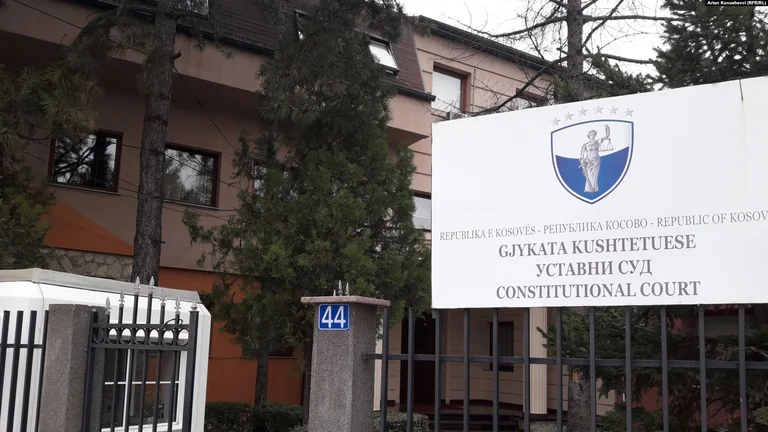
(2 years ago)The Constitutional Court, as the ultimate authority for the interpretation of the Constitution, risks failing the quorum at the end of 2024. On December 30th of this year, the mandate was completed to the two judges of the Constitutional Court. When is President Gresa Caka-Niman's mandate expected to end and Judge Selvette Gerjaliu-Krasniqi? Constitutional Court Speaker Judge Caka-Niani has been decreed as judge of [...]
The Constitutional Court, as the ultimate authority for the interpretation of the Constitution, risks failing the quorum at the end of 2024. On December 30th of this year, the mandate was completed to the two judges of the Constitutional Court.
When is President Gresa Caka-Niman's mandate expected to end and Judge Selvette Gerjaliu-Krasniqi?
Constitutional Court Speaker Judge Caka-Niani has been decreed as Constitutional Court judge by the president on December 30th 2015. While she has been elected chairman of this court on May 17, 2021. Thus, Caka-Niman completes the mandate of the president of this court on May 17th of this year, until its term as judge ends on December 30th, 2024.
On December 30th 2015, on the same date as Caka-Niman, Judge Selvette Gerjaliu-Krasniqi was decreed by the president as the Constitutional Court judge of the Republic of Kosovo. Thus, on December 30, 2024, even Gerjaliu-Krasnici completes her term as Constitutional Court judge, reports “Justice bet”.
As a result at the end of this year, after the end of the term of Judge Caka-Niani and Judge Gerjaliu-Krasniqi, the Constitutional Court remains with six judges.
Under the Law for the Constitutional Court, the Constitutional Court has quorum if seven (7) judges” are present. So, if by this date the Assembly does not propose new judges for decree to the president, the Constitutional Court remains without quorum
How and how many processes had failed to select judges in the Constitutional?
By 2022 four processes have failed to fulfill the positions of the Constitutional Court judges.
On May 5th, 2022, in the second round of voting in the Assembly, out of 97 deputies attending, two invalid votes were marked. None of the proposed candidates received sufficient votes for the court at the Constitutional Court.
According to the Constitution, the decision to propose new Constitutional Court judges depends on 2/3 of all Parliament deputies participating and voting. So in this case, for the Constitutional Court's proposal, any of the candidates would have to get a total of 64 votes. That didn't happen. Official results show candidate Albert Avdiu won 60 votes, Bardh Bocshi 52 votes and Etrur Maloku 39 votes.
In the same year, the three candidates' proposal failed because of insufficient parliamentary votes. In this round of voting from the Parliament were 94 deputies, of whom 49 voted Fargan Qorrollin, currently deputy minister of justice, 38 voted Haxhi Xhemajli, and 7 ballots were invalid.
The majority of votes needed for the new Constitutional Court judges' proposal were not even reached at the session held on May 26, 2023. In the first round of the secret vote, 97 MPs participated, where there were invalid 6 ballot papers. Candidate Hasan Shala received 42 votes, Bardh Bocshi 40 votes and Emrush Kastrati 9 votes, which were insufficient to consider a successful vote.
It happened at the June 15th 2022 session, where Kosovo's Assembly failed even in the second round to elect a court for Constitutional. In this round of voting, the candidates were Hasan Shala and Bardh Bocshi, where Shala received 44 votes, while Bocshi 46.
Thus, this court has long continued to function without full composition, but if it continues, in the absence of quorum, decision-making will be suspended on December 30, 2024.
What if the Constitutional Court remains without a quorum?
If new judges are not decreed, by December 30th, 2024, the Constitutional Court will be non-functional and will not be able to exercise its competencies and responsibilities, as the same will remain without quorum. In such a situation, the main institution for the protection of the Constitution and the rights and freedoms of citizens will not function, as this mechanism will not be able to address the set requirements.
All citizens whose cases are being handled or deposited in the meantime will not have access to this tribunal.
On the other hand, all bills opposed by 10 or more MPs, before the same are sent for decree to the president, will remain suspended.
If the Assembly completes its regular mandate, parliamentary elections should be held later on 16 February 2025. The new judges' failure to decree will cause the Constitutional Court to be dysfunctional during holding elections, constitutionalising the Assembly, electing the Government, and so on.
What did the Government intend to do with the Constitutional Court?
At the end of 2023, the government introduced a Non-Recorruption Strategy Project. On page 12 of the Strategic Court, the repeated “Model of complexities stemming from the process of appointing the chief state prosecutor, as well as its interaction with the judicial process at the Constitutional Court, underscores the necessity of addressing the issue of direct constitutional supervision, regulations and decisions of the two councils under the judicial system... The strategy will include measures aimed at establishing direct constitutional oversight of illegal acts and judicial system decisions...”.
In turn, on page 13 of the Draft-Strategia is highlighted that Government “ ... [will] provide constitutional oversight of decisions adopted by KDR and KKP”. One of the activities set out in the Strategy Action Plan is “The completion and adoption of the completion of the Constitutional Court Law changes to ensure supervision of the KRK and KPK rules and decisions”.
In January of this year, the Kosovo Institute for Justice (IKD) published Kosovo's “analysis without the Anti-Corruption Strategy”. According to the IKD report, this solution is contrary to the Constitution of the Republic of Kosovo and the principles on which constitutional justice functions.
The constitution of the Republic of Kosovo in Article 4 has defined provisions dealing with the division of powers. In the face of legislative, executive and judicial powers, there are two institutions operating outside this division: The president of the Republic of Kosovo and the Constitutional Court. Thus, the Constitutional Court's definition as the institution overseer of justice system institutions is contrary to the Constitution of the Republic of Kosovo. Moreover, this model set out in Strategic Drift is also contrary to the concept of constitutional judgment itself. Article 4.6. The Constitution of the Republic of Kosovo stipulates that the “Constitutional Court is an independent body of constitutional protection and makes final interpretation of the Constitution”, while Article 113.1. The Constitution of the Republic of Kosovo stipulates that the “Constitutional Court decides only for cases filed before the court legally by the authorised” side. Thus, it is not in the nature of an institution like the Constitutional Court to serve as the body overseer of another KRC and KK”, the report published by the IKD said.
On the other hand, the IKD report stressed that the KDR and KKP's decisions are not beyond the scope of the Constitutional Court's supervision. But this oversight is exercised in the way constitutional justice is developed through initial cases.
Thus, in each case, each of the parties authorised to raise cases near the Constitutional Court can also raise cases against the KKP and KDR's decision. Pay attention here to the fact that this Court has cancelled the KKP's decision to propose to Chief State Prosecutor (See Court case, No. KI99/14 and 100/14, with thankfully Syla and Laura Pula, Act of July 8, 2014, KDR's decision to propose Supreme Court President (See Court case, No. Kli34/17, with predeceiver Valdete Daka, the act of June 12, 2017, the KRK's decision to appoint President of the Appeals Court (See Court case, No. K55/77, with preliminary Tonka Berisha, the July 17th 2017 Act, etc. Thus, KDP and KKP decisions are not excluded from the Constitutional Court's jurisdiction. However, the Constitutional Court's action in these cases acts in line with the concept of normal functioning of constitutional justice and not through an unknown model in contemporary Constitutional Justice, that of determining the Constitutional Court as the institution overseer of another institution”, the IKD report noted. / Justice Trust