a minute ago
Balkans in Second Plan at Munich Security Conference
Periskopi(2 years ago)
(2 years ago)Like any other year in February, Munich is the scene of many discussions on the current world security situation for three days. The topics of the Munich Security Conference (MSC) this year were, as could be expected, the war in Ukraine and the Middle East war. These two crisis points were determined in a way [...]
Like any other year in February, Munich is the scene of many discussions on the current world security situation for three days.
The topics of the Munich Security Conference (MSC) this year were, as could be expected, the war in Ukraine and the Middle East war. These two crisis points were thematicly defined most of the discussions during the three-day conference at the luxury hotel Bayerischer Hoffman.
An opportunity for bilateral talks
But in addition to open public discussions, the MSC has been known since the Cold War for conversations behind the backstage of government representatives who normally stayed apart in public. The large concentration of important participants and luxury hotel mazes offers opportunities for more intimate conversations away from the curious eyes of media representatives.
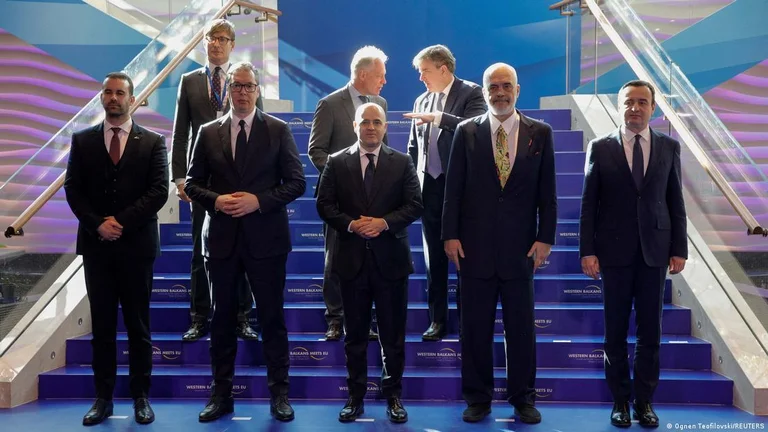
The participants of Western Balkan countries, for whom the meeting in Munich is an essential meeting at the beginning of the political year, know this. This year, the presidents of state and government of all countries created after the breakup of Yugoslavia were back in Bayerischer Hoffman, but they themselves, except Macedonian President Steve Pendarovski and his Montenegrin colleague, Jakov Milatovic, did not participate in public panels.
The leaders of Western Balkan countries boasted of numerous bilateral meetings: Serbian President Aleksandar Vuciq met with British and Chinese Foreign Ministers David Cameron and Wang Yi, the US Senate delegation, as well as the informal host, Bravaria land Prime Minister Markus Söder, who invited him to visit Belgrade. As Vuciq told reporters in Munich, he complained to all about the position of Serbs in Kosovo.
At the same time, Kosovo Prime Minister Albin Kurti was in the bavarez metropolis and, according to a communique from his office, in a conversation with representatives of the US Senate, he has accused Belgrade of the last problems that were born after the decision to ban the dinar. Jeanne Shaheen, a member of the Senate's Foreign Policy Commission, said during a panel for the Balkans that she spoke with Vuciqi and Kurti and told them that “both sides must move”.
Sarajevo Must Make Reforms
Croatian Prime Minister Andrej Plenkovic did not deal with Serbia and Kosovo, but with his favourite theme when he is on the international stage -- BiH's support from Croatia on its road to the European Union. At the same time, at one of the panels, B-H presidency member Denis Beciroviq called on Brussels in March to open negotiations with B-H for full EU membership.
The German government's representative for the Western Balkans, Manual Sarrazin, told DW in the conference margins that opening negotiations already depends on the coalition in Sarajevo. “The coalition has sent careful signals about progress when it comes to reforms to enable us to follow this path positively, but we also need to see concrete results on the ground”, Sarrazin said.
In other words: you still have to do something if you want us to postpone it. Sarrazin also linked the issue of membership in the European Union to the issue of stability and security, especially in light of Russian aggression against Ukraine.
EU membership as security guarantee
During various discussions in the MSC, NATO membership and the European Union was highlighted on several occasions for Western Balkan countries as guarantees for peace and security. However, the road to the European Union is not easy, Macedonian President Stevo Pendarovski complained, who repeatedly stressed the absurd Bulgarian blockade of membership negotiations. But the panel also discussed the problems of Montenegro and Croatia, which have not yet resolved disputes with their borders, which could be a serious circumstance for Montenegro's EU membership aspirations.
Pendarovski sees the problem of blocking negotiations exclusively as the problem of the European Union. Sarrazza is also aware of this. “If in the Western Balkans the European Union shows that it is unable to solve problems, how will it take us seriously when it comes to much bigger global problems”, Sarrazzin told DW. He noted that Miroslav Lajcak, the EU's special commissioner for negotiations between Serbia and Kosovo, is also in Munich. But he said that “currently has nothing new to say” when it comes to progress in the approach between Belgrade and Pristina.
Russian Destructive Influence on the Balkans
Analysts still see Russia's influence in the Balkans as one of the biggest factors of instability. The way Russia is operating is not only against Ukraine. Russia is a destabilizing factor worldwide. Russia is trying to destabilise the Balkans as well... we do not need new meetings, but we must immediately support Ukraine and give it what it needs”, Danish Prime Minister Mattte Frederiksen said on a panel on the security role of the European Union.
Frauke Seebass, analyst and specialist for the Western Balkans of the German Foreign Policy Association (DGAP), told DW that the pro-Russian narravva in many parts of the Western Balkans, especially in those under Belgrade influence, continues to be a major security problem. “Taking into account the current geopolitical situation, proximity to Russia and ever more open disregard for fundamental democratic values are also disturbing. Public communication is increasingly anti-Western, and Russia is portrayed as the most important ally. Prospects for joining the EU have lost credibility, and therefore their effectiveness over the years, further limiting the influence of Western actors”, Seebass says.
As far as Montenegro is concerned, as President Milatovic says, Russia's reputation is in a downward trajectory. There is no meaning to Russia's activities in Ukraine. My opinion is that Russia has lost its influence in Montenegro,” Milatovic said on a panel for the Balkans on Saturday evening.
The Danger of War Still Small
Although it seems that the EU and the US are making efforts to prevent the opening of new hot spots in the Western Balkans that would threaten the focus of energy in Ukraine, experts like Seebass do not see a direct risk of war conflicts in the Balkans. In view of the mounting tensions, comparisons often occur over the 1990s before the start of the Yugoslavia wars. However, the security situation is different: three Western Balkan countries that are not members of the EU are now NATO members, which makes the fight less possible”, Seebass says. / DW