6 minutes ago
Air pollution, unseen killer in Kosovo
Periskopi(2 years ago)
(2 years ago)Air pollution in Kosovo is harmful to health in many countries, especially in winter. For many families, wood stoves are also used for heating. But this is only part of the problem Kosovo has. The 39-year-old Roma man, Faton Alija, lives in Plemetatina, a village 22 kilolomentra from Kosovo's capital, Pristina. He lives there [...]
Air pollution in Kosovo is harmful to health in many countries, especially in winter. For many families, wood stoves are also used for heating. But this is only part of the problem Kosovo has.
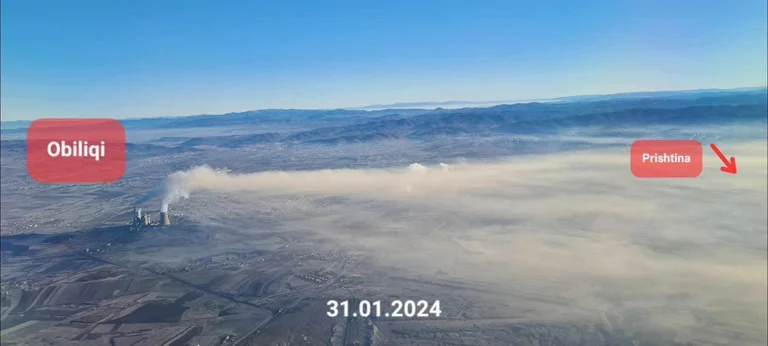
The 39-year-old Roma man, Faton Alija, lives in Plemetatina, a village 22 kilolomentra from Kosovo's capital, Pristina. He lives there with his extended family, including his father and brother living under a roof. A good local standard, but looking west, looking toward the road, you know, nothing's right. Every day it only two kilometers from the house sees smoking chimneys of Kosovo A and B coal power plants, which provide most of the electricity production in Kosovo.
For those of us living in Plematin, air pollution is a disaster. We can't go anywhere else because we can't afford it. We're already used to living in these air conditions here”, says Faton Alija.
The bill holds the whole family. His income as a worker in a ceramic factory is barely enough to live. He cannot afford to leave the main area of power plant influence. He's got four kids. The youngest is three years old and has coughing throughout the winter.
Linjiti - A Causer of particles
There are many causes for air pollution in Kosovo: coal power plants, traffic, the use of coal through houses for heating and cooking, as well as industry.
The air is in the worst condition, especially in winter when citizens use more coal for heating. To provide information about air pollution, a warning sign has been set up in Pristina in the middle of the capital's mall, showing the quality of air with large faces enamelize.
By this means, passersby are warned not to breathe in the maskless air because of high pollution. Warnings are really unnecessary because the poor quality of air can be smelled by anyone because it smells like coal. Mentor Shala from the Pristina Hydrometeorology Institute, which daily reports measurements from Kosovo at the European Air Quality Agency, states.
We are currently monitoring the air flow in Kosovo. For example, we currently have purple in the system everywhere in Kosovo, and this shows how bad the air quality in the country is. We have fine dust at the Dardhisht station near Obiliki PM10 of 70.5 grams per m2. The maximum is 50 grams per square meter”, Mentor Shala says.
According to the annual air condition report for 2019, there have been exceeded pollution by PM10 particles in all measures in Kosovo for a total of 535 days.
Unfortunately, the effects of polluted air cannot be easily removed. <x0.>The air sense causes a lot of cost and also takes lives to”, says Frank Hames, head of Swiss-based IQAyr Quality, known for precise air pollution measurement technology, but also for cleaning equipment.
Air Pollution an Invisible Killer
Pulmologist Dr. Musa Hoxha, director of the Museum Department at the University Clinical Centre in Pristina, knows the problem in Kosovo. “are fine particles of pM2.5 dust, which are so small that they enter human blood through lung alveolas. This is especially a problem for pregnant women, elderly ones, and children because it causes many illnesses. ” says pulmonologist doctor.
For the cities of Obilic and Elez Hani are the highest pollution sites in Kosovo. “Banors in these areas are the people who are at greater risk of becoming chronically ill, such as asthma or lung cancer”.
Experts say 760 people die in Kosovo each year as a result of air pollution. Also affected is Faton's family: my “My mother and two other members of my family were sick because they were constantly breathing in the extremely bad air. Mother was only 49 years old when she died of cancer in the lungs”.
Antti Carartinen, spokesperson for the European Environment Agency, says that according to statistics “Kosovo has the fifth highest mortality rate due to high levels of PM2.5 and ozone”.
Good Filters Cost Much
Environmental Activist and ecologist Adorim Hoxha from Pristina accuses the public sector of not doing enough to keep the air clean. “The coal power plants have not been changed for a long time, so the air in Pristina, Obilic and Pentina is so bad. Costs for good filters amount to millions. So far there has been no money from the public budget for new filters. ”
At Plematin Faton knows the causes, yet he too is a prisoner of this system. There's no heat in his house. Except for the kitchen room, where it has the stove, which he heats with coal. “This year of coal was very poor quality,” recalls it, “Was wet”.
The consequences affect both him and his family directly. After refueling his stove on this cold January day of moving the cover plate, he controls the air in the living room with a measure of IQAIR air quality.
The shocking result: At 320 lb/m3, the air content content of PM2.5 is worse than the higher limit. The screen, which always shows the worst air from green to yellow and red, shows the highest purple level. The picture is scary. He must keep a respirator in his living room. He too is part of the problem he and his family suffer from.
Kosovo has pledged to produce its energy in a neutral manner towards climate by 2050. Apart from a wind park and a solar thermal power plant, there is still no concrete measure on the horizon. You'll need a lot of measures. If these start in Obilic, Faton will be lucky and can live healthier in the Pentile. / DW/