8 minutes ago
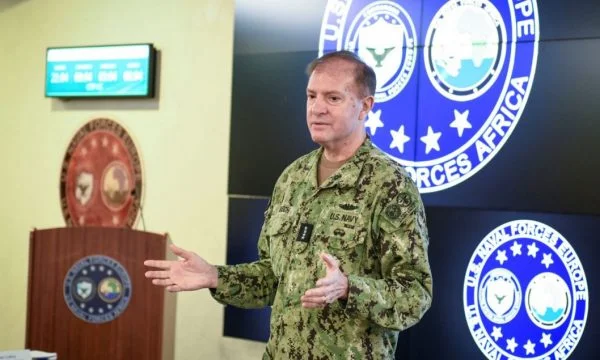
Admiral Munsch: Security situation in fragile Kosovo, political rhetoric concern
Periskopi(2 years ago)
(2 years ago)In an interview for Voice of America, American Navy Commander for Europe and Africa and commander of NATO forces at the base of Naples, American Admiral Stuart B. Munsch said the security situation in Kosovo is stable, but fragile, stressing that the main concern currently is political promotional rhetoric “that can [...]
In the interview, Admiral Munsch also speaks of Russia's efforts to destabilise the region, as well as NATO plans to create stability, through a new coalition corridor, passing through the port of Durres through northern Macedonia, Bulgaria, to the Black Sea, which, according to him, will enable the alliance to strengthen and act quickly.
Voice of America: Admiral Munsch, in your statements Friday, you warned the Kosovo government to refrain from what you think are <x0 unilateral decisions” that escalate tensions and damage the reputation of a trusted international partner. Can you explain what you mean by that statement?
Admiral Munsch: In fact, what I said applies to all governments. NATO is neutral as far as circumstances are concerned here. All governments must refrain from unilateral acts and exploit the relaxed dialogue by the European Union between Pristina and Belgrade. It is the best way to resolve differences and create lasting stability.
Voice of America: NATO has increased its forces on the ground, with troops and equipment, since the incident in Banjska last year and pending further tension that lasted throughout the past year. What are the main threats to security in Kosovo?
Admiral Munsch: We added the number of forces and also the weapons and equipment they brought along to prevent other cases of violence. The year 2023 was the most violent year in Kosovo in the past two decades, along with the attack on KFOR forces in May and then with the next attack in September, during which a large quantity of weapons was discovered. We extended the number of forces so KFOR will be able to protect itself and also be willing to intervene in cases of a war between the two states.
Currently, the main concern is political rhetoric in this period, which can promote either individual actors or non-state actors to take violent action to manifest their discontent.
Voice of America: What actors are you talking about?
Admiral Munsch: They could be criminal groups, they could be individual actors, they could be foreign states, or they could be grey zone operatives, which are backed by the state.
Voice of America: You referred to incidents in the northern part of Kosovo and the armed attack of an armed Serb group in Banjska last year. Do you have a clearer mirror of what happened that day and the addition of Serb forces along the border with Kosovo, which later took place? Are you concerned about such incidents?
Admiral Munsch: The event in Banjska is a matter of law bodies and investigations into it are being done by law enforcement. We are aware of their findings as they have defined them. When it comes to increasing forces at the border, we continue to maintain close communication with both sides of the border, with armed forces authorities. There is transparency, there is clear communication of goals. As far as military forces are being gathered at this point, there is no concern.
Voice of America: How concerned are you about the security situation surrounding KFOR's mission, Kosovo and the countries of the region?
Admiral Munsch: The situation is stable now, but fragile. It is stable because we understand our circumstances and have our strength in the field. But the fragility stems from the fact that violence can erupt here very quickly. Again, the main concern currently is political rhetoric that can inspire disgruntled parties to take violent action.
Voice of America: Many experts have repeatedly warned that Russia can exploit the tensions that exist in the region and use Serbia as a channel to destabilise the Balkans. Do you see such efforts from Russia, and what are the measures you are taking to combat that influence?
Admiral Munsch: Historically, Russia aims to create instability in surrounding countries, thinking it is safer. Mostly it targets small countries to create instability, as they have less resources to counter Russian activities. Russian activities are popular in the cyberspace, but they are also physical. So countries are working together to counter what the Russians are doing. Mainly, their actions manifest themselves in disinformation, which spread them to exploit any distinction there is in an effort to create the impression that differences are far greater than they really are.
Voice of America: Do you expect tensions this year or in the near future in Kosovo and in general in the region?
Admiral Munsch: We are always ready to face any challenge that may arise. Sometimes we establish additional strength to be prepared for any situation that violence can bring. An example of this is the Allied Response Force, which NATO created last summer and made the first dislobal in the region to maintain stability.
Voice of America: Are you planning on adding troops and military vehicles to KFOR?
Admiral Munsch: We have the opportunity to do so if necessary. That is what we decide according to our circumstances
Voice of America: NATO recently inaugurated the eighth corridor, which enables NATO troops to deploy via land from the Durres port in Albania to the Black Sea. How does this affect the security facility in the region?
Admiral Munsch: Transport corridors are vital to ensuring circulation of logistics, ammunition, fuel and other supplies. The strong nature of the corridors is in itself preventative against any aggression against NATO, simply because we can reinforce and act quickly.
Voice of America: This new corridor passes near Russia's (Serbia) ally, with whom NATO has had a war. Is this an obstacle, or is it another step to confronting Russia?
Admiral Munsch: The goal of the corridor is to be ready for any opportunity. Being ready, this in itself means prevention.
Voice of America: Would you like to add something else?
Admiral Munsch: I want to congratulate the countries on their 25-year commitment to peace and stability in Kosovo. KFOR has been with us for 25 years with extraordinary success. It has improved the circumstances here, enabling economic development and peaceful reconciliation, making Kosovo a much better country.