9 minutes ago
Visa liberalisation, which sectors are expected to be mostly affected by migration?

Periskopi(2 years ago)
(2 years ago)Visa liberalisation finds Kosovo in a dynamic rather than other countries in the region at the time when they were offered free movement in the EU. From 2012 to 2022, over 338 thousand citizens have emigrated from Kosovo. In 2022 alone, 41,553 citizens emigrated, and this year power [...]
Visa liberalisation finds Kosovo in a dynamic rather than other countries in the region at the time when they were offered free movement in the EU.
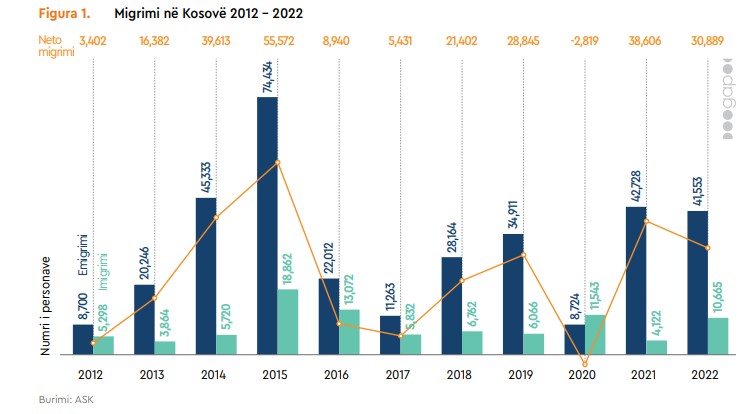
From 2012 to 2022, over 338 thousand citizens have emigrated from Kosovo. In 2022 alone, 41,553 citizens emigrated, and this year the workforce has been reduced to 21,571, while the non-active workforce has been reduced to 14,698.
So says one GAP Institute report. To measure the trend of migration of citizens, the GAP Institute has conducted in December 2023 a domestic public opinion research at the level -- 29 in 38 Kosovo municipalities -- using the technique of “mostra expensive with random selection”.
Under this research, 1,066 Kosovo citizens over 18 have been surveyed, reflecting on it also the ethnic structure in Kosovo, and research is said to have a level of credibility of 95% with a margin of +/-3 error.
The results of the poll conducted by the GAP Institute in December 2023, regarding plans and the tendency of Kosovo citizens to emigrate after visa liberalisation, show that 28% of Kosovo's citizens over 18 plan to emigrate in the first part of 2024.
The main destinations of Kosovo citizens who plan to emigrate are Germany at 71.4 percent, followed by 11.7 percent, and Austria by 5.3 percent.
But who?Are the sectors expected to be affected the most?
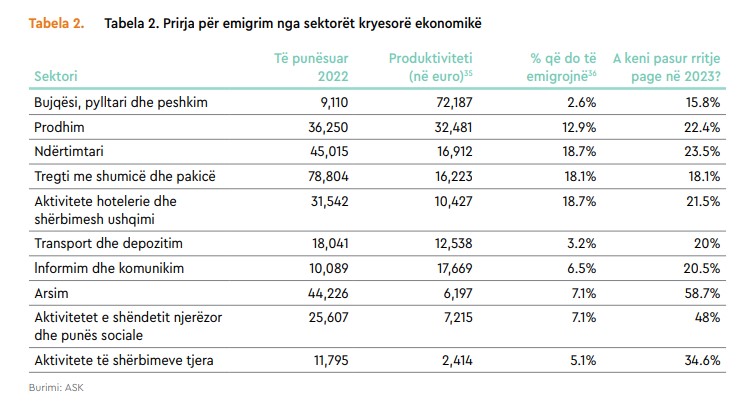
Comparing the number of employees and productivity of the sectors in which they work, it turns out that the tendency to emigrate will mostly affect the trade sector in large numbers of 79 thousand employees, the construction sector, which numbers about 45 thousand employees, and the hotel and gastronomial sector with over 31 thousand employees.
The same “are among the sectors with the highest number of employees and where employee productivity is high, but where wages continue to remain low. In 2022, the average gross wage in the most influential sectors was lower than the average wage in the country. In all, in the gastronomy sector, the average gross salary was 323 euros, in construction of 444 euros, in trade 449 euros, production 409 euros, etc.
Some of the sectors that will be influenced at least by migration are the agriculture, forestry and fishing sector, which once has the highest productivity of all sectors but only 2.6% claim to emigrate. While some other important sectors, such as education, health, IT, will be influenced to smaller extent, some 7% have claimed they have plans to emigrate”, the report said.
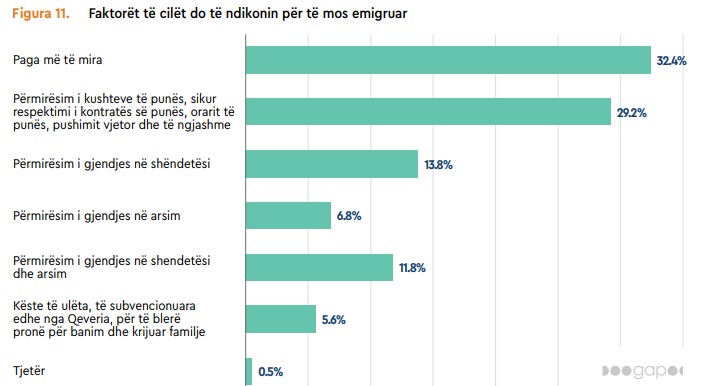
According to survey data, some of the main reasons that would motivate citizens not to emigrate and stay in Kosovo are better salaries (32.4%), improving working conditions such as respecting work contracts, working hours, annual and similar cuts (29.2%), improving health situation (13.8%), etc.
GAP stresses that addressing the issue of migration from Kosovo requires addressing a host of economic, political and social factors that contribute to the departure of people from the country.
Given that the very nature of immigration control violates the freedom of individual movement, immigration policies should be given importance and care.
Through this report, the GAP Institute encourages the Government of Kosovo to work in:
The implementation of policies and initiatives that stimulate economic growth and job creation. This may include supporting small and medium-sized enterprises, attracting foreign investment and promoting enterprises;
The development of skills such as investment in educational programmes and professional formations to increase labor force skills and adapt them to job market demands;
Improving healthcare and educational systems to raise the quality of life for citizens
diaspora programmes encouraging citizens in Kosovo to promote their involvement in the country's development. This could lead to the creation of programmes that allow diaspora to contribute to economic and social projects;
Encouraging technology development and innovation. Focusing on these areas can attract a newer workforce, with technological knowledge and create new opportunities;
Strategic planning and development of long-term plans addressing the root causes of migration and provide a guide for sustainable development;
The collection of systematic data for volume, age, skills and other characteristics of immigrants so that forecasts of the labour market needs in Kosovo are as accurate as possible.