9 minutes ago
Migrating after visa liberalisation: What do statistics show?
Periskopi(2 years ago)
(2 years ago)On January 1st, Kosovars enjoy the right to visa-free travel through the Schengen area countries, comprised of 27 European countries. This process also brought concerns about the impact visa liberalisation may have on youth migration. According to data from the Kosovo Statistics Agency, during 2022, from Kosovo [...]
On January 1st, Kosovars enjoy the right to visa-free travel through the Schengen area countries, comprised of 27 European countries.
This process also brought concerns about the impact visa liberalisation may have on youth migration.
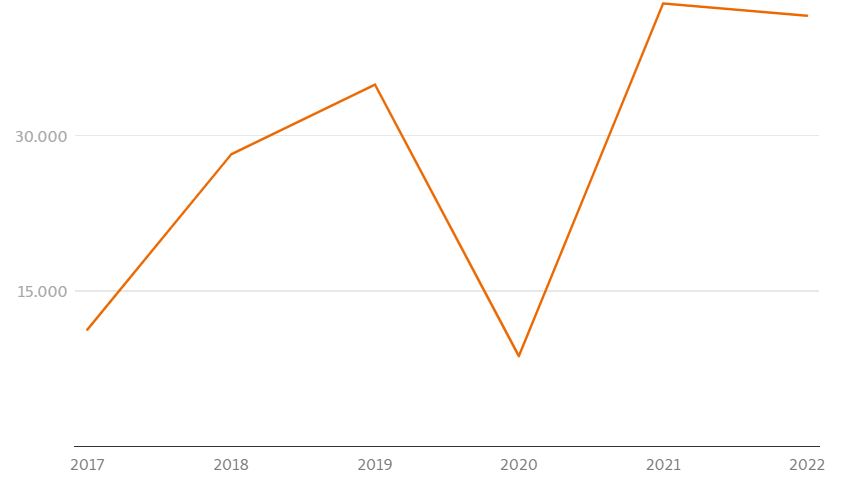
According to data from the Kosovo Statistics Agency, during 2022, about 41,500 people left Kosovo. One of the reasons for immigration was employment.
World Bank says that according to projections, the job market will continue to be influenced by legal migration of labor powerNew even after visa liberalisation, as in the past.
Other Western Balkan countries went through the same phase. Serbia, Montenegro and Northern Macedonia won visa-free travel through Schengen in December 2009, while Albania and Bosnia and Herzegovina won a year later.
However, visa liberalisation had no obvious effect on the number of cases identified for illegal employment in European Union countries.
Visa-free travel should serve mainly for tourist or family visits and not for employment purposes.
Although the number of identified cases of illegal employment did not steadily increase, some EU countries voiced complaints about this, especially Albania and Serbia.
For Bosnia and Herzegovina, northern Macedonia and Montenegro, meanwhile, visa liberalisation prompted more than tourist visits: more young people started studying in EU countries.
Since citizens of these countries could travel visa-free to EU countries, the number of cases of illegal border crossing declined. At the same time, however, the number of visitors exceeding the allowed length of their stay in the Schengen area increased to 90 days within six months.
Such an illegal attitude began to increase mostly in the period since 2012. Again, the largest number of identified cases came from Albania and Serbia.
Albania and Serbia were the two countries that had the most cases of their citizens caught using false documents to enter the Schengen area.
Problems such as using false documents, exceeding the length of allowed for visits, led to an increase in the number of citizens of the Western Balkans who submitted to mandatory returns procedures. Again, the largest number was from Albania.
In 2019, the Netherlands sought to suspend visa liberalisation for Albania, but the European Commission estimated there are no conditions to take such a move.
Two years later, the then Slovenian EU presidency prepared a document where numerous examples of visa-free travel abuses from Albania, Serbia and Northern Macedonia were cited.
For Western Balkan countries, the European Commission published five monitoring reports of the visa liberalisation regime. The latest, published on December 5th 2022, estimated that all countries have taken measures to meet EU requirements and that those countries continue to meet the criteria for visa liberalisation.
The conditions for visa liberalisation include reforms to reinforce rule of law, combat organised crime and corruption, manage migration and improve administrative capacities in control of borders.
In the event of increasing illegal migration from any country, the EU has the right to temporarily suspend the visa-free travel regime.
This mechanism, launched in 2013, is activated if there is an increase of over 50 percent of illegal access from a country and illegal standing, if there is an increase in more than 50 percent of asylum applications, whether there is a decrease in the co-operation for mandatory return, and if it is estimated there is an increased risk to the security of EU member states. /rel