21 minutes ago
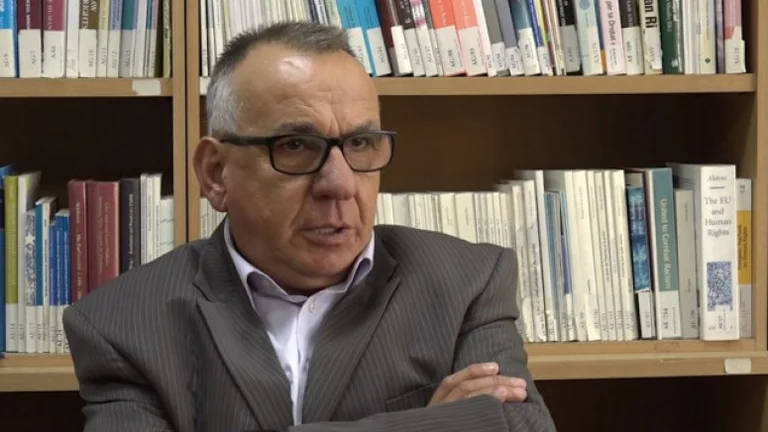
Hasani: Serbia shifting pressure to Kosovo back
Periskopi(2 years ago)
(2 years ago)Four months after the attack by Serbian paramilitaries at Banjska's location in the north, Kosovo authorities continue to demand the US and the EU to make public the conclusions of investigations into the terrorist attack”. Also called for sanctioning Serbia as sponsor of this aggression. But Professor Enver Hasani confidently says Serbia will not [...]
But, Professor Enver Hasani says with confidence that Serbia will not be charged with responsibility.
Serbia's only responsibility, according to the international community's request, consists of condemning the leaders of the terrorist act in Banjska. This will be done by the Serbian state in the future because everything will be monitored by external factors. For that, he has given consent to the Serbian state itself”, he says.
Reflecting on the event that marked 2023 in the Balkans, Banjska says there has been no potential for measurable, but another effect of the beginning of the rapid implementation of commitments made in Brussels and Ohrid.
It does not rule out revenge acts for the Serb losses there, while rejecting the war scenario. War rhetoric is being made from the start to legitimise the formation of Serbian political-territorial autonomy. Nothing else there is”, he is convinced.
Hasani insists now and many months that with the reach of agreements in Brussels and Ohrid, Kurti has laid the foundation of creating what in constitutional law is recognised as a material constitution. According to him, he has opened Kosovo's status and has given up mutual recognition. Enver Hasani's interpretation, which for two terms has led the Constitutional Court of Kosovo, for the European Proposal for the Association of Serb Majorities, which the West expects Kosovo to implement, is quite disturbing.
The “Rendi created under this draft state is a closed constitutional judicial order, which cannot be influenced by the outside nor deformed without the consent of its representative body ) Community Assembly”
Hasan says what Europeans have proposed cannot be changed because it is the inevitable product of the Ohrid Agreement of Brussels and Annex.
Commenting on recent steps of the Serbian side Hasani says “Serbia is sending messages to the EU that it is implementing its vows, such as license plates, energy, very soon I believe in reports with the unemployed and everything else.
With these steps, Serbia is shifting international pressure overall at the expense of Kosovo, especially in relation to the rapid implementation of Serbian political-territorial autonomy”, he says.
Attempts to postpone association by holding elections, according to Hasani, would cost Kosovo more.
Kosovo gets nothing. The longer the implementation of commitments made in Brussels and Ohrid is postponed, the heavier the price for Kosovo and its prospect”
Total interview:
You have been an active observer and commentator this year of political developments in the country. In addition to dialogue in Brussels, Kosovo and Serbia or the structure within it were included in a serious incident such as Banjska's on 24 September? Was there potential here for greater conflict, even though it was finally managed?
Hasani: There are three narrations in the Banjska incident. The first is that of Kosovo and that does not match any other nationalism. According to him, there has been Serbia's aggression against Kosovo in Banjska, which has been averted due to the bravery of Kosovo's elite security units and police. For this current power has provided evidence, through media, which has been associated with a unilateral and completely political interpretation. If someone thinks about using them for any criminal procedure, they're compromised and they don't work. The second nation is of another extreme Serbia official and power there. According to this decree, three Serbs have been heroicly fallen in Banjska, defending the threshold of the house from Pristina's daily power attacks on local Serbs. The third concern is that international, which is more accurate and closer to reality: there has been a terrorist act in Banjska by certain paramilitary forces. This act, according to this decree, cannot be said to be attributed to the Serbian State: hence, the terrorist act has not been promoted, terrorists have not been trained, supplied, financed, or supported by Serbian state bodies. This stance relies on international law, under which to exist the international responsibility of the state, the violent act contrary to international law must be attributed to the relevant state according to objective criteria. The first criterion in that sense is for the illegal act to be an act of state, and that is when the state's bodies (laws, executives, or judiciarys) are carried out. In the case of Banjska, such a clear charge is lacking because it is about acts of private persons (premilitar groups), which the state holds responsible for only if it can prove that there has been effective control of them and the violent acts committed by them. This standard is known as standard “Nicaagua”. For this reason the international community has not held and will not hold the Serbian State accountable for the Banjska case -- the only responsibility Serbia has, according to the request of international co-operation, consists of condemning the leaders of the terrorist act in Banjska. This will be done by the Serbian state in the future because everything will be monitored by external factors. That's why the Serbian state itself has given consent.
For all these reasons, the Banjska case has not had the potential of further escalation, beyond fear of power in Pristina, with the goal of speeding up the process of dialogue and launching implementation of commitments made in Brussels and Ohrid, in the first order of pledging to create Serbian political-territorial autonomy in Kosovo. That this is so, it has been seen from the moment Serbian paramilitary photos appeared, leaving Kosovo's territory in a calm manner, as if they had been at a wedding, not in the exercise of terrorist violence against the structures of power in Kosovo and its citizens. You see, it has started at great speed implementing commitments made in Brussels and Ohrid, something that has reference points to the tragedy in Banjska, where Kosovo hero Africa Bulnjak and three Serb paramilitaries, citizens of Kosovo, lost their lives.
We are closing the year with warnings by Prime Minister Kurti of a possible attack by Serbia. Meanwhile after each such statement has recently come a response from KFOR, which shows they are patrolling at the border. How do you read that?
Hasani: Mr. Kurti's war rhetoric relates to the formation of Serbian political-territorial autonomy in Kosovo. This has started since the beginning of dialogue on the second mandate of his government. The meaningful struggle of the two countries' battle formations for a long time and the characteristics of an armed conflict cannot be found. The possibility of exercising revenge acts of local Serbs for the losses they suffered in Banjska is not ruled out. Something like that I think is inevitable. But, I repeat, there could never be intense violence in the war in which the two countries' armed formations are engaged, the official armed structures of the two countries. As a result, the rhetoric of war is being made from the beginning to legitimise the formation of Serbian political-territorial autonomy. There's nothing else there.
Various commentators view these warnings of difficult situations in the country as prime minister's propaganda because of the situation he is in should start implementing association for what he has principled before key European leaders. Do these make sense, is the prime minister overreacting?
Hasani: Such estimates are completely correct, as I described earlier.
You have analysed a draft statute for association that the EU proposed, alarming that it will destroy the country's current constitutional order. The EU, or mediator Lajcak, said arrangements can be made in the text. Can you avoid what you have warned?
Hasani: I have made it clear from the day of reaching the agreements in Brussels and the annexes in Ohrid that Albin Kurti has laid the foundation of creating what in constitutional law is known as a material constitution. With these two agreements, which are a complete break with Kosovo's commitments in 2013 and 2015, Albin Kurti has laid the foundation of the debacle of the state of Kosovo: that you now see Serbia's reactions, which makes it clear there will be no recognition or acceptance in the UN, because Mr. Kurti has accepted it in Brussels and Ohrid when he introduced the clause “prejudice against the status of Kosovo<x1. The parallel with that, Serbia is sending messages to the EU that it is implementing its vows, such as license plates, energy, very soon I believe in the report with the dead and everything else. With these steps, Serbia is shifting international pressure overall to the expense of Kosovo, especially in relation to the rapid implementation of Serbian political-territorial autonomy.
Let me show you again what the material constitution Mr. Kurt has accepted. Two elements of the material constitution are its distinctive quality in relation to other constitutions. The first is the normative material element, which consists of sanctioning a given configuration of power that reflects the power and relative organization of the given social group (people, nation, nation or people, religious sect, language group, class, and so on). As such, this configuration is always an expression of power relations, where one or more social groups can impose themselves in relation to others. This group is, in other words, able to shape the political goal defined by the formal constitution in a completely different and contrary way by giving itself and the configuration of power another substance of constitutional norms, which is different and contrary to the formal constitution in force. That's what the statue does for the special social group Kosovo Serbs. Besides this material norm, the material constitution has another quality. It's about its essential content. While the normative material element is related to material relationships that stand on the basis of any constitutional (formal or informal) standards, the essential content of the material constitution indicates the content (the essence or substance) of material standards created: namely. Who does what and what are the reports between different levels of power, what is the individual's role and position and social group in society and so on. This element, the essential content of the constitution, therefore, acts as a center of unification for community life in our case, the Serb community ʹ that distinguishes it by protecting it from the outside world, from other communities living in other spaces, and by organizing from within the opposite interests of such a community even through violence through the precision and protection of interests considered the most subliances in relation to others. The essential content of the material constitution not only expresses the fundamental principle of the other constitutional order of the political community different from the formal constitution in power and contrary to it, but also institutionalizes the new relationship between the ruling social forces and the governing social forces.
What I described, no doubt, is clearly reflected in any draft-Sttutum provision of the Community of Serbian municipalities expected to be put into existence at the time that comes. This cannot be changed because it is the inevitable product of the Ohrid Brussels and Annex Agreement, with which Mr. Kurti has taken over at the expense of Kosovo's pledge to reopen Kosovo's status when he introduced the provision for failing to prejudge his country's statute in reports with Serbia and has given up mutual recognition with Serbia as an essential precondition for resolving all disputes we have with our northern neighbour. With these steps, Mr. Kurti has stripped Kosovo of any arguments based on international law, depreciating even the legal power of the new UN advisory thought for Kosovo. King Zog did the same with St. Nahum, if you remember. He had forced Albania's Parliament to vote on granting Saint Nahum Yugoslavia, which with the International Court of Justice ruling had met Albania. The only difference is that part of the territory does not now approach Serbia, but all its sovereignty and territorial integrity.
The prime minister averted the act of drafting a draft status proposal for association, leaving the mediators to do so likely to escape responsibility. This seems to be trying to do even with the draft decision. Can he escape, or is it only the government's duty to bring the evaluation draft to the court?
Hasani: According to the 2015 Act, which is now in effect and represents the only parameter for assessing the constitutionality of forming Association/ The municipality of majority Serbs, both procedurally and in that material, Stattuti must be sent to the Constitutional Court by the Government of Kosovo, which reveals the judicial act called the decision, thus not the decree, because the decree issues the prime minister. It doesn't matter who makes the statue. Moreover, after sending for constitutional control, the government has the right- when asked by the Constitutional Court to express itself for the constitutionality of the statue to defend a completely different and opposite position with any provision of draft-Sttutute. The court finally gives her verdict. As you can see, I'm using the expression “Association/counition of Serb majority municipalities”, because that's how it figures in the 2015 Act and in the 2013 and 2015 agreements. The proposed Draft-Statut now does not rate an association, but a community of Serbian municipalities: in its content, it is the end of a new constitution of Kosovo Serbs, a material constitution or a second constitution of Kosovo that applies only to local Serbs; this new material constitution stands parallel and in full opposition to any provision of the Kosovo Constitution, as the formal constitution currently in force. The political entity formed with the proposed draft-Stitut, meanwhile, has features of political-territorial autonomy, but in fact its attributes are entirely state-owned: the functions of the Serb municipality are state functions that exercise central power under the Constitution of Kosovo; at the moment of launching the implementation of the draft-Status, they are exercised by the bodies of the Serb community. The order that comes with this draft state is a closed constitutional law enforcement order, which cannot be influenced by the outside nor distorted without the consent of its representative body. Disagreements over the exercise of Serbian municipal co-ordination functions are resolved by an extra-coherance mechanism, which has the form of arbitration, something unprecedented in the constitutional and international European legal history: neither in the case of the Free City of Dansing, Memel territory and the Saar region between the two world wars, or the Free City of Trites, the City of Jerusalem, nor other similar cases when the specific sovereign and independent states' scopes post-World War II has not existed so perverse and international judicial solutions.
There was an interesting movement from Serbia, which made the decision to accept RKS license plates, which Kosovo Serbs provided for in recent months. The dialogue seems to be giving some results, however, that show that we are within a ongoing scenario. How do you see this?
Hasani: These steps of Serbia are expected: Serbia has business with the EU because it has received pledges. It has started to implement the vast majority of its commitments made in Brussels and Ohrid. With these steps, she is throwing out the burden of responsibility in Kosovo, and this is bad for us. In the end, Serbia, but also the EU itself, will report to the UN General Assembly and to the Security Council for the achieved agreements, in which Kosovo renounces mutual recognition, and from prejudice on its status as sovereign and independent, the two worst concessions Kosovo has made from 2011 onward. These concessions, as I said, lead only to the gradual deterioration of the state of Kosovo declared on February 17, 2008.
If there is a tendency to delay implementation of agreements and dialogue after regular elections in Kosovo, The EU and the US, what would Kosovo benefit from this?
Hasani: Kosovo wins nothing. The longer the implementation of commitments made in Brussels and Ohrid is postponed, the heavier the price for Kosovo and its perspective will be. In fact, postponement and deadlock are a safe way of breaking the state: with this Kosovo proves fourfold that it does not meet one of the fundamental conditions for being a state of international law, but also a UN member is a skill for implementing international obligations.
What would Serbia benefit?
Hasani: SThe heat has already won. It has restored the situation before the February 17th 2008 declaration of independence: it has cemented non-recognition by states that until yesterday have had dilemmas on whether to recognise Kosovo as a sovereign and independent state; it has introduced Kosovo into the UN reporting mechanisms, out of which it has fared on February 17th 2008. The only UN-based authorisation has been that of security and defence, and still remains in force as such, where KFOR's presence is being made at the invitation of the state of Kosovo. From now on every day and more we will be left in the mercy of Euro-Atlantic integration processes, where Serbia walks safely and rapidly, while Kosovo lags behind with years of light away. The only salvation, if that is true, is whether in the future any radical rerun occurs in the international force report, which is certainly reflected in the Balkans, where Serbia would take the wrong side as in the time of Serbian dictator Slobodan Milosevq. Such a scenario may even happen, but this is a speculation and divination, for which I have no vocality or will. I have never radically changed the positions expressed under the rules of the profession I keep and his ethics. I'm not even going to do this right now, throwing false lies and speculating about events that might happen in the future.