7 minutes ago
100 days after the start of the Israeli-Haam war, concerns about expanding conflict
Periskopi(2 years ago)
(2 years ago)100 days from the start of the Israeli-Hamas War, there are no signs that the conflict is nearing its end, even there are concerns that it could extend even wider to the Middle East. The war began after armed members of the Hamas militant group entered Israel and carried out the deadliest attack in this country's history. [...]
100 days from the start of the Israeli-Hamas War, there are no signs that the conflict is nearing its end, even there are concerns that it could extend even wider to the Middle East. The war began after armed members of the Hamas militant group entered Israel and carried out the deadliest attack in this country's history. Tel Aviv then retaliated by bombing and launching a ground attack on Gaza.
It all started after armed members of the militant group entered Israel and carried out the deadliest attack in this country's history. This attack seized Israel's military and security services completely unprepared, raising fears of uncertainty in the country as it highlighted the details of the massacre by Hamas militants.
The attack killed more than 1,200 people, the largest loss of lives in one day since the founding of the state of Israel in 1948.
The Israeli response was immediate, beginning with systematic air raids and followed by an ground intervention that together destroyed Gaza and forced almost 2 million people to flee their homes.
Almost 24 thousand Palestinians have been killed and 60 thousand injured, according to Gaza health authorities.
Three months later, Israeli troops are still fighting the Hamas militants in the ruins of Gaza and are looking for architects of the October attack, such as Jahya Sinwar, the leader of Hamas in Gaza and Mohammed Deif, the military leader of the movement.
Most Gaza hospitals have been destroyed, hunger is a growing threat, and a terrible humanitarian crisis threatens to end up killing even residents that the Israeli army.
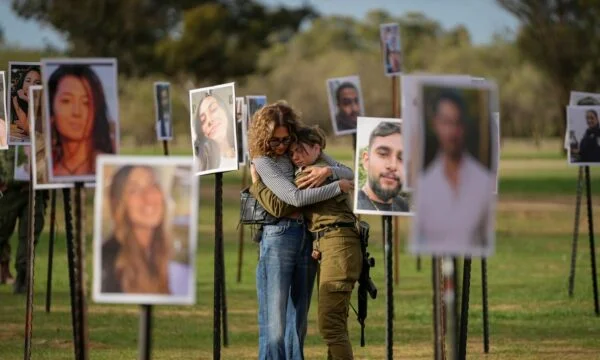
Hostages of hostages still held at the Gaza Strip began a 24-hour rally in Tel Aviv on Saturday evening, urging the government to work harder to bring their loved ones home.
Thousands of people were spilled into the “hostage station” in Tel Aviv, a central square in front of the Israeli Defence Ministry that has served as a collection point for activists.
More than 100 hostages were released during a temporary ceasefire in November, but 132 are still in Gaza.
There are still 136 hostages in Gaza. We're waiting on everyone, every minute, every second. They were kidnapped because the state failed, because we failed, and now we state must do everything, everything, to release”, says Eyal Waldman, the father of Danielle, a girl who was killed at a music festival in Israel during the Hamas attack.
Other protesters called for holding new elections in Israel and blocked a main Tel Aviv highway, clashing with police who arrested and tried to deter the crowd. Other protesters gathered near Prime Minister Benjamin Netanyah's private residence, demanding his departure.
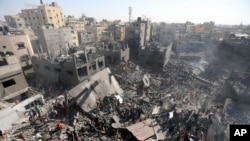
One hundred days after Hamas ' attack in Israel, Gaza has now become a ruins. Image footage shot in recent days shows the extent of the destruction in this territory.
For 64-year-old Sahinaz Bakr and her family, the house these days is an improvised tent camp in Rafah. For some 2.3 million people in Gaza, life has become a nightmare.
We moved from one place to another. I don't know where my boys, my brothers, my family. I can't communicate with anyone. I don't know anything about anybody, but we're here, looking for something to eat and drink,” says Bakr in her tent that she shares with daughter Heba, 32, and four grandchildren.
Heba is pregnant in the sixth month and she is terrified about the future of her unborn child.
I don't know what my baby's condition is, I don't know anything. I don't know where she'll be born, how they'll treat me when she's born”, she says.
Efforts to agree to a ceasefire so far have failed and no one knows the end of this conflict. Throughout the Arab world, there was anger over Gaza's murder and destruction. Washington, Israel's closest ally, has also requested restraint.
South Africa, meanwhile, has filed a case at the International Court of Justice, accusing Israel of genocide -- a charge Tel Aviv rejects as unfounded in fact.
The United States and other powers have called for a revival of a process for establishing an independent Palestinian state after the war, but Prime Minister Benjamin Netanyahu's right government has so far not responded.
The other two militant groups, Hezbollah in Lebanon and Huth in Yemen, have also been brought into play. Both groups have Iran's backing, an enemy sworn to Israel. Also at play is the political future of Israeli Prime Minister Benjamin Netanyahu, which depends on the outcome of the war. / VOA