24 minutes ago
Weber: Vuciq position <x0win-win”, Kurti “lose-lose” is making mistakes
Periskopi(3 years ago)
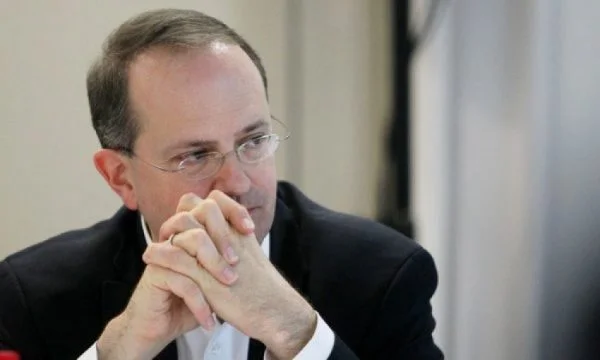
(3 years ago)The recogniser of the political circumstances in the Western Balkans and Democratisation expert Policy Council (DPC), Bodo Weber, has talked about the September 14th meeting between Kosovo Prime Minister Albin Kurti and Serbian head of state Aleksandar Vuciq. Weber has said that behind closed doors, Western officials are increasingly accepting [...]
Weber has said that behind closed doors, Western officials are increasingly acknowledging that the process of dialogue with the current approach and the Constitutional Agreement are failing.
He says this dialogue process, aimed at reaching an intermediate solution instead of a final agreement, was viewed from the start as failing. According to Weber, the EU High Representative Josep Borell eventually sealed up when from Ohrid declared what Weber calls a largely empty “document” to be successful.
In fact, the whole process, with this approach aimed at a step of mediating instead of a step with final and comprehensive agreements based on Belgrade's domestication, was doomed to fail since its beginning in August last year, its fate was finally decided when Borell in Ohrid decided to declare a largely empty” document, German expert on Express has said.
Here's the expert. The DPS says what is currently happening in negotiations is that Kosovo and Serbia are brought in with the goal of never being implemented and that their eyes are on new elections in the European Union, more specifically at the end of Borell and Lajcak's mandate.
This Weber argues by saying that Kosovo, rightly and unfortunately, does not trust the process and the West enough to be willing to make the compromises required.
Weber says Serbia's president, Aleksandar Vucic, finds himself in a position of <x0win “, since according to him the West has chosen the continuation of the soft policy towards Serbia, instead of using the possibility given by the war in Ukraine for a strategic turn of Serbia by pressuring Belgrade on all three fronts, that of geopolitical balance between East and West, Kosovo and democracy.
Bodo Weber says it creates a favourable position for Vuciqi with Western centres and with Kurti Centre “making sure the blame for the failure of the process is imposed on Pristina, not Belgrade”
Expert The DPC emphasises that the other aspect and indication of the failure of the current phase of dialogue is the fact that never in the long history of the decade of dialogue has negotiations taken place for a deal and the signing of the agreement been associated with worsening the situation on the ground, the transition to the north instead of the de-pass.
So when this current initiative will ultimately fail, there will be status results as before, but in fact regras for the north, the status of Kosovo Serbs in Kosovo and reports between the Serb community Kosovo with authorities in Pristina”, Webster has said.
He points out that the situation in the north is worse than before signing the 2013 agreement.
Even more dramatic “, with the West not preventing Vuciqi last November from ordering Serbian police, judges and prosecutors in the north to leave Kosovo institutions, we have a worse situation than before signing the 2013” agreement, has stressed, adding that there were at least policemen and judges who carried out their work, until now it is a total institutional vacuum in terms of rule of law.
German expert says those who have suffered most of the dialogue failure since 2015 are Kosovo Serbs, when they were originally designed as the main beneficiaries of dialogue.
Nothing symbolizes this boring dynamic more than the issue of association. Since 2014, and especially in the current negotiations, the issue has been reduced to “fulfilling obligations” and “impulation”, totally without any substance. It should be remembered that the association was first introduced in 2013 as a tool for the integration of northern Kosovo Serbs within the state and Kosovo society, as well as, even more forgotten, the West in 2013 allowed Belgrade to create the Serbian List as an integration tool” has launched the Bodo Weber.
The knower of the political circumstances and the Kosovo-Serbia dialogue process, in this interview for Express now points out that the constructive approach “unclear” of Brussels through 2013-15 and the postponement of character and functioning of association, without ever having a long-term strategy for dialogue, has caused the issue of association to deteriorate into a <x2feftless”.
He says that in the history of dialogue, there has never been more focus on Association than today, and that the discussion has never been further from the essence, which is the real needs and interests of Kosovo Serbs as citizens of the Republic of Kosovo.
Weber says that even worse, Kurti Government and its team are “changed in their dogmatic views and access to Kosovo Serbs, especially in the north”, from the goal of the West putting Kurt in a corner along with its ill-designed “ “.
Integration of Serbs, Weber says that only with Western support and through Belgrade, but adds that since the West lacks a consistent policy, such a thing will happen.
A painful fact remains that the Serb community in Kosovo, especially in the north of Ibri, continues to live in a dark area in and between two Kosovo and Serbia. This means that the outcome of integration into the state and the society of Kosovo can only happen to Western support and through Belgrade, which means that while the West lacks a consistent policy of dialogue, it will not happen”, says Bodo Weber.
Meanwhile, it says Kurti's evidence through unilateral action based on the false “narrative of rule of law” and special units can only lead to integration of territory without population.
Its “Provatory through unilateral actions, as Pristina currently does, supported by a strict type of (false) rule of law, with the help of special police, can only lead to integration of the territory without the population”, the German expert points out.
Regarding Prime Minister Albin Kurti's harsh language used against Slovak emissary Miroslav Lajcak, Weber says it is the reflection of a deeply broken report between Kurti and negotiators.
He further adds that while Kosovo has been placed in a position ofʹlose-lose” from the West, Berlin, Paris, Washington and Brussels, the Kurti Government in many ways is acting in a counterproductive way towards Kosovo's interests and its position in negotiations.
Weber says Kurti has thus helped Western centres convince themselves that the current problem lies in Pristina and has at the same time made Vuciqi's position even more comfortable.
The “Doing so has assisted negotiators and has urged Western capitals to convince themselves that Pristina is the main problem in the current initiative, rather than the initiative itself (and Belgrade), and has made the position of Vuchiqi even more favourable”, the potential Weber.
In the end, Weber says he is certain that Prime Minister Albin Kurti's recent rigour against EU's emissary Lajcak can be prepared for new elections. He says what he sees is that even the opposition secretly thinks the same about Kurti's doubts about the current approach of dialogue and EU and US performance, but adds that they can't say it publicly since small Kosovo can't afford to openly contradict the US. ”
This shocking situation reminds me of the performance of Kosovo's political elites during the period of Moghrini-Grenelli-Thaci-Vuchic exchange madness. Which shows that the current approach to dialogue is having an adverse impact on Kosovo's domestic policy, domestic democracy”, has ended Bodo Weber.