23 minutes ago
The government and the EU disagreement on association: Now what?
Periskopi(3 years ago)
(3 years ago)Despite the European Union's repeated call for Kosovo to start work on establishing the Association of Serb-run municipalities, the Government of Kosovo does not express willingness to take steps in this direction at least not for the time being. The EU demanded that work on establishing this association be launched on Tuesday, “pa [...]
Despite the European Union's repeated call for Kosovo to start work on establishing the Association of Serb-run municipalities, the Government of Kosovo does not express willingness to take steps in this direction at least not for the time being.
The EU urged on Tuesday that work on establishing this association should begin “without new delays”.
The European bloc's foreign policy chief, Josep Borrell, also reiterated that Kosovo and Serbia must implement the basic agreement for normalising relations, based on the EU's own proposal.
This proposal calls for implementation to begin with the “opening of the negotiation process for the statute of instruments for self-enamination of Serbs in Kosovo“, which means the Association of Serb majority municipalities.
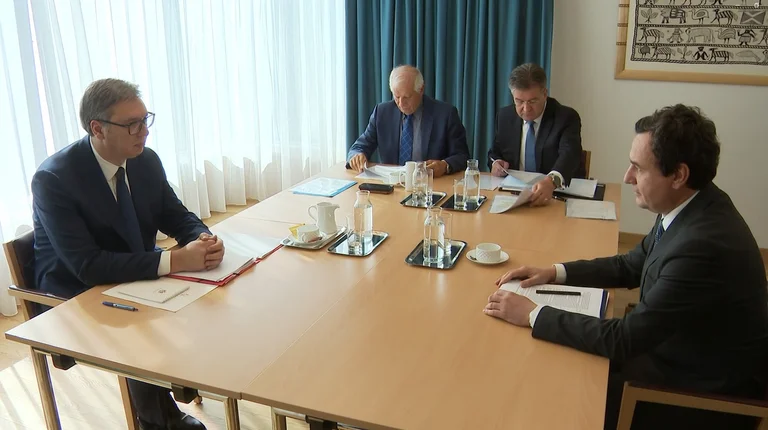
The proposal was given in the final round of talks between Kosovo and Serbia, which was held last week in Brussels, but that, according to EU diplomats, was rejected by Kosovo Prime Minister Albin Kurti, and accepted by Serbia's president, Aleksandar Vuciq.
In a written statement given to Free Europe Radio, Kosovo Government spokesman Progress Kryeziu said that “is wrong to establish constitutional conditions” for implementing the basic Agreement, when neither in the very text of this “agreement does the constitutionalizations (”).
The basic agreement must be implemented in all, without delay, without conditions. Even in Anex [of implementation of the agreement] it is clearly said that all articles apply regardless of”, Kryeziu said.
The agreement in question was reached in February in Brussels, while the sides agreed to the Annex for its implementation in March in Ohrid.
The 11-nenenene agreement envisions, among other things, a level of self-awareness for the Serb community in Kosovo and mutual recognition of state symbols, while calling for Pristina and Belgrade to implement, as well, all previous dialogue agreements.
For forming the Association of Serb majority municipalities, Kosovo and Serbia have reached agreement since 2013.
Despite continued international and Serbian demands, Kosovo has never implemented that agreement, fearing it could affect the functionality of the state.
Kurti, in some cases, has said he cannot allow the establishment of a single-ethnic association that would have executive competencies, as Belgrade requires.
After completing talks without any results last week, Kurti has said that Serbia's “provisionalisation of the formation of association “has been transformed into the attitude of EU Emisars”.
Speaking at a conference with journalists a day earlier, he said the EU's special envoy for Kosovo-Serbia dialogue, Miroslav Lajcak, is “eligible against Kosovo” at the 14 September meeting.
Kurti also said that in the coming days there will be meetings with “all international factors who have accepted the state of Kosovo”.
The EU said on Tuesday it does not comment on Kurti's baseless “acles”.
REL asked Kryeziu if Kurti would respond to the EU's invitation for a new round of talks with Vucinqi, if there is one, but he did not comment.
Ruge: EU Change Focus
Majda Ruge, from the European Council for Foreign Relations, says he does not believe Kurti is closing the doors to future meetings with the EU special representative, but is adopting, according to her, a tactic that will make it more difficult for the EU to continue with the current approach.
This approach, Ruge says, consists of “the exercise of all pressure on the weaker side, to implement the [covenation agreement] of the Association of Serb majority municipalities, while requiring almost no concessions from Serbia in exchange for”.
If defined as restoring a balanced negotiation process that has chances of success, it is to change focus. The EU should not legitimise the idea of an association as an autonomous de facto unit, which Vuciqi” insists on, says Ruge.
According to her, the EU “should insist on implementing the rule of law in northern Kosovo” where the majority population is Serb and promote a solution that “ensures that the Serb minority in the north can exercise a sufficient degree of cultural, educational and religious autonomy”.
It is important to understand that the kind of association Serbia's president, Vuciq, does not necessarily aim to promote the cultural and religious interests of the Serbian people in the north, but rather an institutional mechanism of political control and Belgrade's intervention in Kosovo's internal affairs. The EU should not accept this”, Ruge says.
Ker-Lindsey: Kurt offers you something serious
But for James Ker-Lindsany, professor at London School of Economics, Kurt's movement is “very, very dangerous for Kosovo” and “is losing great international support”.
I don't trust Lajcak, I don't trust Borrell. I will address you directly to member states... What should member states do? Do you expect them to download Lajcak, do you expect them to unload Borrell? Not”, says Ker-Lindsay for Radio Free Europe.
Saying that these two diplomats come from non-recognising states of Kosovo Slovakia and Spain, Kurti “wants to please his local audience” and “play with the nationalist card”, he adds.
According to him, Kurt should sit down and talk about establishing association, if “is really interested in rebuilding relations with the European Union”.
Kurti “must come up with a kind of plan for Association, but it is clear that he does not want to do so and joins in battle with the EU. He will not come up with a diplomatic winner in this”, Ker-Lindssay says.
The Kosovo government, earlier this year, has come up with the so-called Croatian “model” for Association, but it has not moved forward.
Ker-Lindsay says that “if Kurti offers something really serious” concerning association, international pressure, then, will shift over Serbia.
Russia's ally Serbia, but also a candidate country for EU membership, does not recognise Kosovo's independence and engage in campaigns for its refusal in various international organisations. /rel/