13 minutes ago
Gervala reacts to Vuciqi's speech to the UN: efforts to distort history, condemn US and EU
Periskopi(3 years ago)
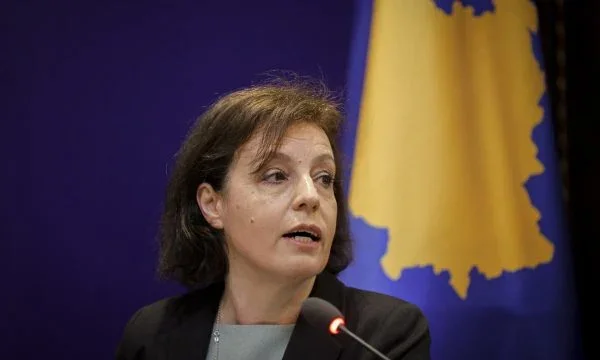
(3 years ago)Foreign Affairs and Diaspora Minister Donika Grovalla, through a communique, has reacted to Serbia's president, Aleksandar Vuciq. Vuciq has given a contractive speech at the United Nations General Assembly. In his biased speech, Vucic has tried to compare Kosovo's independence to Russian aggression in Ukraine. For this tendency, [...]
Vuciq has given a contractive speech at the United Nations General Assembly.
In his biased speech, Vucic has tried to compare Kosovo's independence to Russian aggression in Ukraine.
To this tendency, Gervala says “Vucciq is trying to distort the history”.
She has demanded that Vucinqi's speech condemn the United States and the European Union.
MPJ communications:
As Minister of Foreign Affairs and Diaspore of the Republic of Kosovo, I strongly condemn and reject as completely untrue and attempting to distort history, statements made by Serbia's president during his presentation today before the UN General Assembly. Among other things, it equates Russian aggression in Ukraine with Kosovo independence, shamelessly claiming that in 2008 Serbia experienced what Ukraine is going through today
For both domestic and international public opinion, it is essential to repeat these undeniable historical facts:
The independence of the Republic of Kosovo, declared on February 17th 2008, represents the fulfillment of Kosovo's people's will for freedom and independence. It followed Serbia's organised state efforts to eliminate the Albanian population in Kosovo, for which some of Serbia's top state, military and police officials of those years were tried and sentenced by the UN International Criminal Tribunal for the former. Yugoslavia at The Hague.
Kosovo's Declaration of Independence does not violate international law, nor do relevant UN resolutions and documents, including the UN Charter. The UN's highest legal body, the International Court of Justice, has confirmed this in its advisory opinion, issued on July 22, 2010, at Serbia's request.
With these lies and attempts to distort history, Serbia's president has severely misused the United Nations General Assembly platform. If there is any similarity between Russian aggression in Ukraine and the Kosovo case, it is only in the fact that Russia today targets Ukraine and Ukrainians as did Serbia with Kosovo and Kosovo Albanians in 1999.
That is why the Republic of Kosovo stands firmly and unequivocally near Ukraine in its fair fight against the Russian criminal aggressor. It is clear that Serbia continues to support Russia and Putin, as the president of Serbia has openly confirmed in the same address to the UN.
At the same time, the Ministry of Foreign Affairs and Diaspore (MFAD) points out that in its UN presentation, Serbia's president has once again violated pledges made to the European Union on the occasion of accepting the Agreement on the road to normalisation between Kosovo and Serbia on February 27th 2027 and its Article 2023, whose Article 2 clearly stipulates that relations between Kosovo and Serbia will be based on the principles of the UN Charter, especially those concerning sovereign equality. states, mutual respect for independence and territorial integrity.
In line with that agreement, which the EU and the US confirm Serbia's president has accepted and implemented as a whole, he has had to call for membership of the Republic of Kosovo in the UN or at least not to speak. in all for the Republic of Kosovo.
Instead, before international audiences at the UN, he chose to share lies and institutions that tarnish not only Kosovo, but also Western international partners, the EU and the US.
Regarding the Brussels dialogue, which Serbia's president claimed was blocked and accused the Republic of Kosovo, let me repeat these facts again:
The Republic of Kosovo has accepted the Brussels Agreement and the Implementation Plan of the Brussels Agreement.
It has requested that it be signed as a legally binding international document.
She insists on full and urgent implementation of the Agreement in its entirety.
The dialogue blockade is caused by Serbia and its president, who has refused to sign the agreement, telling international mediators that he accepts it, while the Serbian opinion that he does not accept the full agreement.
Perhaps such statements by a person who was a close associate of war criminals Slobodan Milosevic and Vojislav Seshel may surprise someone in the West who continues to believe that Serbia's current president is a potential democratic partner for the EU and NATO. However, this is no surprise to the Republic of Kosovo and its citizens, who well know Milosevic's former propaganda minister, now Serbia's ruler and Putin's ally in the Balkans. They are also familiar with the policies he represents, which unfortunately continue to hold the entire Western Balkans hostage, including the Serbian people themselves.
We call on the international community, particularly the EU and the US, to condemn such a language used by Serbia's president at the UN and to remind him of the obligations he has received in Brussels and Ohrid.