5 minutes ago
In whose favor is the failure to negotiate?
Periskopi(3 years ago)
(3 years ago)The conclusion of the recent run of Kosovo-Serbia dialogue, without any reconciliation between the parties, has raised new questions about the future of the process mediated by the European Union for normalising relations between the two countries. EU spokesman Peter Stano said at a news conference on September 15th that “dialog has not failed”, but [...]
The conclusion of the recent run of Kosovo-Serbia dialogue, without any reconciliation between the parties, has raised new questions about the future of the process mediated by the European Union for normalising relations between the two countries.
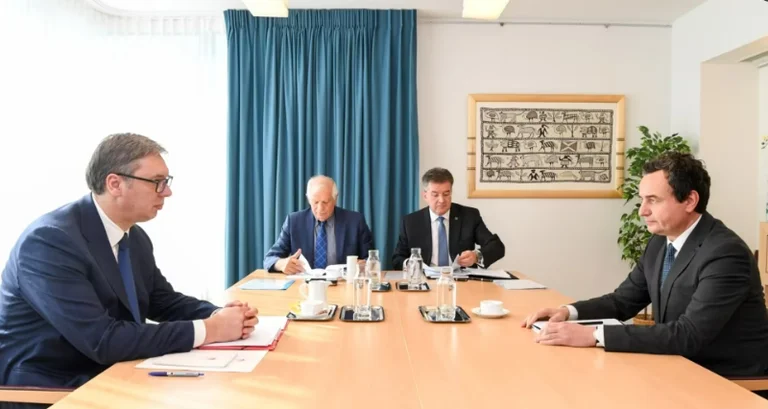
EU spokesman Peter Stano said at a news conference on September 15th that “dialog has not failed”, but that the last meeting between Kosovo Prime Minister Albin Kurti and Serbia's president, Aleksandar Vuciq, held a day earlier in Brussels, “has not yielded results”.
“Piles are unable to overcome their” differences, Stano concluded, stressing that the EU is only mediator in dialogue, and that progress in this process depends on Kosovo and Serbia.
In Annex for implementation of the Agreement for normalising relations between the two sides, it is written, among other things, that Kosovo and Serbia will face consequences if they fail to meet the commitments that come out of the deal.
This has been confirmed by the EU's high representative for foreign policy and security, Josep Borrell, who said on September 14th that “normalisation will have no European future either for Kosovo or for Serbia”.
Free Europe Radio has turned to the Government of Kosovo with questions about future steps, and about whether the EU has warned any punitive measures due to the impasse in implementing the agreement. Until the moment this text is published, Kosovo executive has not responded.
On this issue, they have not even responded from the Office for Kosovo in Serbia's Government.
What are the next steps?
The European Union has warned consultations with member states and with the United States on future steps following the latest unsuccessful talks between Kosovo and Serbia.
Sources in the EU have not specified whether measures against Kosovo and Serbia are under consideration, but have only said the EU-set measures towards Kosovo will not be taken, as conditions for this have not been met.
Meanwhile, the US announced, too, that it will be “contracted inside and with European partners for further steps”.
We expect the two countries to take seriously their obligations to the Agreement on normalisation of relations, which have arrived earlier this year. Time's going past”, says the response of the US State Department for REL.
In whose favour is the “failure of the talks”?
Pristina political process recogniser Agon Maliqi estimates yesterday's outcome of talks in Brussels “creates a favourable political context for Serbia”
He suggests that European top diplomat Borrell's warning about the European future for Kosovo and Serbia hits the first one more.
For Serbia, there is no problem, because there is no belief in Serbia that integration is moving forward. In this context, what awaits us is that Kosovo is stuck in the country, and for Kosovo the status quo is punishment. More is being missed is the international position [of Kosovo], including EU punitive measures, as well as the risks of escalation of the security situation in the north, which could lead to a form of "let's call it the international protectorate over north”, Malqi says of the REL.
It explains that such protectorate means that the peacekeeping mission of the North Atlantic Treaty Organisation (NATO) in Kosovo, KFOR, takes over the primary role of security in the north, not the Kosovo Police, as the local security responsible authority.
However, Maliqi emphasises that it is up to the EU, but also to the US, to decide whether to focus more on punitive measures or incentives on parties to push the dialogue process forward.
According to him, the US will take into account next year, but even EU institutions enter electoral processes, another diplomatic effort on their part can be expected for the Kosovo-Serbia dialogue to mark success.
We're at the end of the deadline to reach an agreement. Therefore, I read it as a signal of a hurry to move forward”, Malchi claims.
“Kurti created new reality in north”
Dusan Janjic, from the Forum for Ethnic Relations in Belgrade, calls “the statement of EU senior official Borrell, that the 14 September talks were unsuccessful. He believes Kosovo Prime Minister Kurti actually had the greatest success.
Borrell directly accused Kurti of failing the talks, because he refused a <x0 ... compromise proposal” for both sides to implement their obligations in parallel.
Whatever they say about Kurt, he's the most successful of all. He created a new reality in the north of Kosovo”, Janjaq points out, adding that this situation poses security risks.
According to him, Pristina and Belgrade should not even discuss implementing the Annex agreement on normalising relations until northern Serbs return to Kosovo institutions.
Last November, Serbs from Kosovo's north left Kosovo institutions to prevent Kurti's government from removing plates issued by Serbian authorities for Kosovo's cities.
Meanwhile, a new crisis occurred in late May, because after the April elections, which were boycotted by the Serb population, Albanian leaders came to power.
What did Kurt and Vuciq say after the unsuccessful meeting?
For the prime minister of Kosovo, the next steps are the continuation of talks on implementation of the agreement “sequenced”, respectively, to implement the agreement provisions as listed in the Agreement for normalisation of relations.
Kurti has stated several times that the Association of Serb majority municipalities cannot be “pre-condition” for implementation of the agreement, and that the issue should be resolved under the ten provisions of the basic Agreement, which both sides have accepted at the end of February, with the EU proposal.
For such a thing, intensive negotiations must be organised by [the EU] mediators. I hope that soon we will be invited [in a new round of dialogue]”, Kurti said on September 14th.
On the other hand, Serbia's president, after the last meeting in Brussels, said he does not know what the next steps are, but that “will always have to talk”.
I don't think this is the end of the world. I'm sure we'll hear who's responsible, it's something that, just, has to happen. But what's important to us is that I'm sure we should continue talks”, Vuciq said.
Asked whether the EU has mentioned any punitive measures, the Serbian leader dekari that this “does not want the Albanian population in Kosovo”.
Normalising relations is a condition for Kosovo and Serbia to progress in the process of integration into the European Union.
Kosovo has applied for EU membership last year, while Serbia is a candidate country from 2012.