26 minutes ago
I don't care. Even Donika Gervala publicly admits Kurti gave up Kosovo's de-jure recognition from Serbia
Periskopi(3 years ago)
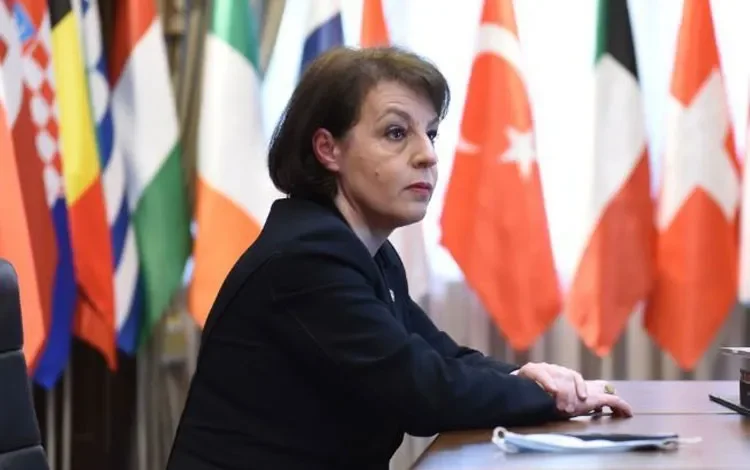
(3 years ago)Kosovo Foreign Minister Donika Grovalla said in an interview with the Voice of America that reconciliation with the Ohrid Agreement, which ensures recognition of ão facto rather than “de jure”, is the biggest compromise Kosovo has made. But she points out, no recognition of this compromise has been seen. Minister Gervalla said [...]
Minister Grovalla said Kosovo institutions have expressed dissatisfaction on the road about the way European envoy Miroslav Lajcak heads the talks with Serbia, but last week according to her, “has filled the Cup”.
Voice of America: Mrs. Gervalla, the European Union called on Kosovo clear and unequivocally to start work on establishing association of Serb majority municipalities, without delay and no preconditions. What are your government's plans?
Donika Gervalla-Schwartz: The government of the Republic of Kosovo, in fact the institutions in general, have pledged and accepted a proposal, originally called Franco-German, which envisions the de facto recognition of Kosovo on Serbia's part. This agreement we agreed on, we agreed on in Brussels and later on in Ohrid, both sides, Serbia and Kosovo, this is our guide to a normalisation agreement. Now, if Kosovo remains the only side that insists on implementing this agreement, which is consistently, before giving us our approval, which we have given despite the reluctance we have had about the content of that agreement, then we remain the only side, which protects this agreement, we wonder where are those who proposed it and where did the strategy change in the middle of the road? Why other demands and plans now arise, and we do not take seriously the implementation of this agreement, which was then called by some commentators as well as historic agreements.
Voice of America: However, Mrs. Gervalla in the Ohrid Agreement, which your government agreed on, is not forecast to recognise Kosovo from Serbia. Is that a change of attitude on your part?
Donika Gervalla-Schwartz: The very fact that we as step in the middle agreed, that first we go with an agreement, which makes recognition de facto and not de jure of the Republic of Kosovo, is the greatest compromise we've made. In the meantime, though, we have not seen any assessment of this compromise that reinforces our attitude that we should be extremely careful with our promises and agreements, their content, and the various guarantees given about these agreements.
Voice of America: The minister's lady, after failing talks last week, warned the European Union of deepening punitive measures to decide on Pristina. Are you worried by such a thing?
Donika Gervalla-Schwartz: You see, it is not last week or the first time the European Union's representative in the dialogue, Miroslav Lajcak, has shown himself completely unilateral in a process of dialogue, in which the European Union should be impartial to ensure that both sides see that their representation is taken into consideration. We have at times expressed our dissatisfaction in an interesting way about how Miroslav Lajcak leads this dialogue. The cup was filled last week. So Lajcak's stance in Serbia has been too open. They were presented as having been presented as having EU documents that were Serbia's. So it has become impossible for us to continue this process in this form. We have called on the European Union several times in our internal channels to be more careful so that this dialogue can have a chance to succeed. So far, we're not seeing the necessary care.
Voice of America: Mrs. Gervalla, when you said that the cup has already been filled, what do you mean, that Mr. Lajcak can no longer be a mediator in the talks between Kosovo and Serbia? So, there's a third party, a pair of mediators, there's only two parties on the table? And how do you now see the future of the talks after the harsh language and criticism that Kosovo Prime Minister for Mr. Lajcak has used?
Donika Gervalla-Schwartz: Kosovo's prime minister has not used harsh language; it has shown the reality of developments in dialogue. We think that this process of dialogue in Brussels, which has no strategy or which has strategy only from meeting to meeting, and in the next meeting we change again, is destined to fail. The past two years have testified that what Miroslav Lajcak has wanted to accomplish, or at least has stated that he wants to realise under the dialogue process, has failed. We need a process, which is more fair towards both sides. I'm not the one who needs to teach the European Union what to do. But we have our request that the process be fair to both sides, which we have not seen so far.
Voice of America: However, there have been reactions from both Brussels and Washington regarding the position it holds in the talks, Mr. Lajcak. How do you view their attitudes?
Donika Gervala- Schwartz: Attitudes cannot distort the reality, which is the failure of a process of dialogue without strategies, without plans, unilaterally and with no chance to realise the agreement we have agreed on both in Brussels and in Ohrid. We call on all our partners to support us in our efforts to implement it as soon as possible. The words, when we accepted the deal, were for July of this year. July has been months. We don't have time to waste. We invite everyone to help us to activate the agreement that we are told is an agreement that goes in favour of Kosovo -- an agreement that needs to be connected and implemented as soon as possible. The fact that Serbia has changed its mind about accepting this agreement should not lead to our partners' reluctance to demand even more insist on implementing it.
Voice of America: Mrs. Gervalla, your government has taken several steps towards extending the situation in the north, such as lowering the presence of special police units, has expressed readiness for holding elections, but the European Union has named them insufficient. What is expected next, and are you willing to do so?
Donika Gervalla-Schwartz: But that's also part of the problems we have with Lajcak, because if our commitment is made to implement certain requirements and it is said to be enough to enforce the situation even then along the way changes our mind, then we don't know what the European Union strategy is. In fact, we've never received clear, precise demands so far, as to what extending the situation north of our country means. If you go to northern municipalities today, you'll see that the situation is calm, it's not tense at all, people are off the road, institutions continue their work, and we have already cleared the way for new elections. Now it is up to Serbia, it is up to the representatives of Serbs in Kosovo, it is left to the European Union and our partners to accomplish what has been asked to realise the petition with 20 percent of the signatures in order for the elections in that four municipalities to be held. Institutions of the Republic of Kosovo have done everything necessary. From our point of view, we have not only fulfilled them but have fulfilled the requirements given us. If not, then we don't need general statements that we need stress, but we need precise points on what tension means, because different channels have different ideas and visions and that just complicates the situation.
Voice of America: I'm going back to my question about Mr. Lajcak. Would Pristina sit down, would the prime minister sit in talks with Serbia if the mediator were Mr. Lajcak? Are you asking for his departure from talks with Serbia?
DonI ran Gervalla-Schwartz: We've never put an ultimatum on anyone, much less our partners and our allies. We seek a strategy in the dialogue, which promises success because going to Brussels to achieve nothing, is not an appropriate step. The institutions of the Republic of Kosovo in the 2021 elections have pledged that they will provide another climate for economic development, rule of law, fight corruption, try to develop the economy. These are our main goals. Of course, it would be ideal if we could normalise relations with Serbia, because we are not naive not to see the increasingly tense geopolitical situation in Europe. However, normalisation means that both sides are interested in normalisation. And we don't see this interest in normalisation at all in Serbia. Rather, we see the interest to use Kosovo's theme to retain power in Serbia and on the other hand to the European Union mediator we do not see the right determination to find a solution, which would be acceptable to both sides.
Voice of America: Madam minister, the opposition has sharply criticised your government for undermining relations with Western allies. How do you respond to such criticism?
Donika Gervalla-Schwartz: But the opposition, in fact, has that job to criticise the government, otherwise it would not be the opposition. However, it has been said very generally and you see that even in the support figures that citizens of the Republic of Kosovo have for the strategy of institutions related to talks with Serbia. Support is, depending on where you look, between 70 and 96 percent. Hence, it cannot be ruled against the will of the citizens, nor can it be governed with past ideas that do not promise success. I invite the opposition even from this studio, to be more constructive in finding common ways to deal with the challenges we have with our neighbour, and I think that such a constructive approach would also serve the opposition to play its role.