17 minutes ago
What's going on with the veting in justice, over five months after being sent to Constitution?
Periskopi(3 years ago)
(3 years ago)The development of the vetoing process in Kosovo's justice system, launched by the Government led by Albin Kurti since the beginning of its mandate, continues to be in the initial phase. The process of reevaluating the figures of prosecutors and judges is aimed at boosting their professional, fighting corruption and stopping [...]
The process of reevaluating the figures of prosecutors and judges is aimed at boosting their professional, fighting corruption and halting the influence of politics or other illegal elements in providing justice.
In its four-year programme, the Kurti Government has pledged completing the necessary legal framework for realising the vetoing process. Preparation of the legal base, Kosovo executive launched it in 2021 on 13 October, the concept of the document vetoing justice was adopted.
This concept-document also made an assessment of the Venice Commission.
The Council of Europe's advisory body found that in the context of Kosovo, an effective veto would require combining different measures, which would have a positive effect on the integrity and efficiency of the justice system.
The commission initially recommended verifying high levels in the judiciary and the prosecutor.
Following the Venice Commission's acceptance of the opinion, which paves the way for vetoing justice, this process from Kosovo institutions was launched in two ways: vetoing for high levels, as well as legal reform HINA or regular vetoing for all judges and prosecutors.
An ad-hoc Kosovo Parliament commission, backed by the Ministry of Justice, concluded drafting constitutional amendments to vetoing for high levels.
Vetting in Constitutional Court
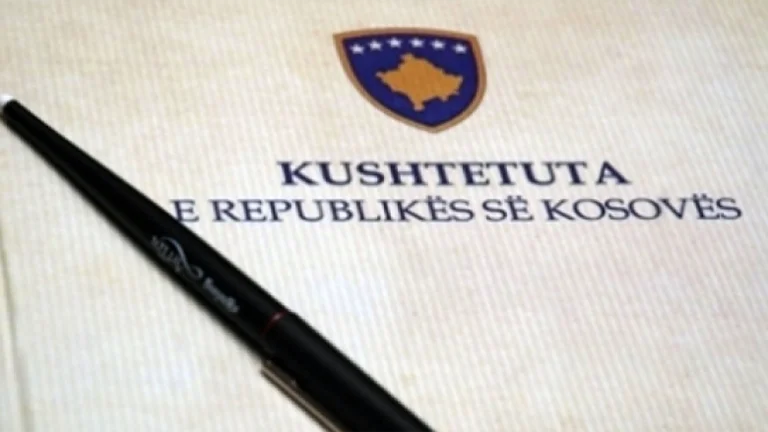
Parliament Speaker Glauk Konjufca, in early March this year, submitted amendments to the Constitutional Court for assessment, with the request to clarify whether the proposed changes were in line with chapter 2 of the Constitution of Kosovo.
Although over 5 months have passed by sending amendments to the Constitutional Office, the Justice Ministry says they have no notice from the Court about their review.
But, the Constitutional Court says the request is under consideration and that all interest and opinion sides will be announced for its decision-making.
Under the Law for the Constitutional Court, this court must, in principle, give recognition within six months of accepting the request.
Regular always on the fastest road
As for legal reform for regular vetoing of all judges and prosecutors, the Justice Ministry says about REL that working groups have submitted final reports and recommendations in May.
“In the second phase of this process, legal interventions and changes are expected to take place, which are related to strengthening existing mechanisms for controlling the integrity of judges and prosecutors, their performance assessment, strengthening mechanisms for the declaration of property and other discipline and actions, stemming from joint pledges”, says Genc Nimani, senior adviser to Justice Minister Albula Haxhiuu.
The Kosovo Institute for Justice has repeatedly reiterated since 2015, the importance of the veto process.
The organisation's executive director, Ehat Mittaraj, says about REL that vetoing is the necessary opportunity and way to clear the judicial system and the prosecutor, from officials who, as he claims, “do not deserve to be part of this system because of their lack of integrity”.
According to him, “as the government itself has been delaying in addressing this issue, due to mismanagement and mismanagement, is good news that constitutional amendments have finally gone for assessment at the Constitutional Court”.
Miftaraj estimates that “is important for the Constitutional Court to address this issue within a reasonable deadline, given the importance of this process of rule of law in Kosovo”.
Kurti: Vetting is the solution
At the recent Kosovo Government meeting, held on 9 August, Prime Minister Kurti, while speaking of the inefficient system of justice, re-focused the need for the vetoing process to begin as soon as possible.
He said reform is necessary, while vetoing, according to him, is the solution.
Kurti asked the Constitutional Court to open the way to life of this reform as soon as possible.
Time is ticking. The time spent is lost”, the Kosovo prime minister said.
Referring to judicial statistics, according to which the Court of Appeals has turned 1.754 cases into retrial in 2022, the chief executive has said it burdens the justice system, narrows it down and delays justice.
According to the United Nations Organisation Development Programme (UNDP) and the United States Agency for International Development (USAID), public Pulse, published this year, only 29 percent of citizens are satisfied with the work of Kosovo's justice system. /