11 minutes ago
U.S. takes its astronaut on yet another Russian flight
Periskopi(3 years ago)
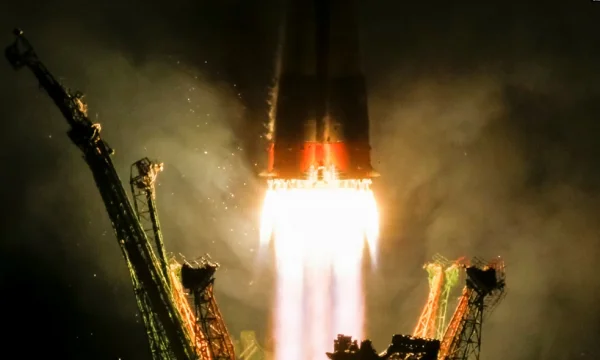
(3 years ago)The Russian and United States space authorities have reached agreement to send an American astronaut to the International Space Station via Russian spacecraft, Soyuz MS, the Interfax news agency reported on Friday. This is a rare sign of bilateral co-operation between them at a time when tensions are [...]
This is a rare sign of bilateral co-operation between them at a time when tensions are high, due to the war in Ukraine.
The flight is part of an agreement between the Russian Space Agency, Roscosmos, and NASA in the United States for flights to the International Space Station (SHI).
One of the Americans has been left [on board] for two missions. We have added another flight to compensate for the past time at” station, Interfax Sergei Crickalev, executive director of the state corporation Russian space software.
This is a business benefit for both sides, we interact with each other and we ask for the best option. In principle, a good story about the exchange of flights adds a little credibility to our” program, he stressed.
Washington and Moscow have maintained spatial co-operation, although their relations affected the lowest point in recent decades due to the war in Ukraine, with astronauts staying together in the SHI, and flying together.
Under an agreement signed last year as part of the US flight programme, three Russian cosmonauts will fly on the US space shuttle Dragon, and three American astronauts with Russian spacecraft, the Soyuz MS, during 2022-2024.
Russia has said it will give up the International Space Station, and that it will establish its independent space station in the future, though plans are still being discussed on how and when that will happen.
SHI, a science laboratory with the size of a football field and orbiting about 400 kilometers above the ground, has been constantly occupied for more than two decades by the US-Russia partnership, which includes Canada, Japan and 11 European countries.
Russia's spatial programme suffered a hit this week when the pilotless spacecraft, Luna-25, crashed in an attempt to land at the southern moon pole, three days before India successfully sent its own spaceship, Chandrayan-3.