12 minutes ago
Serbia monitored by Chinese cameras
Periskopi(3 years ago)
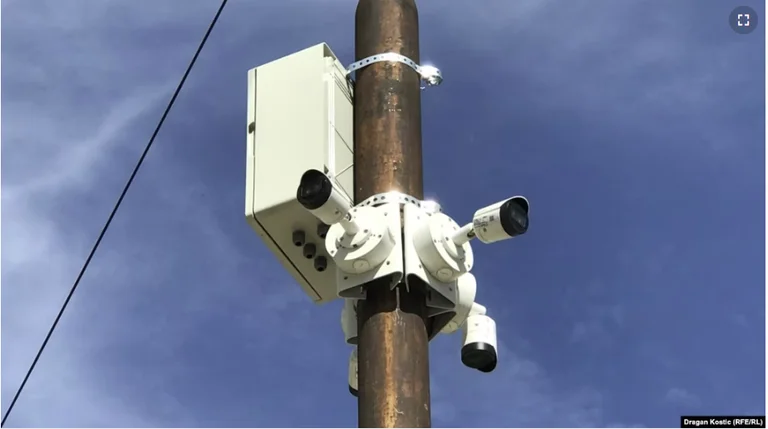
(3 years ago)Only 2,700 people live in central Ossetia, a small town in western Serbia. This city is merely two intersections. But in the last five years, along with the largest city of some 10,000 people to manage it, Chinese safety cameras have been installed in the city. Municipal governments have [...]
But in the last five years, along with the largest city of some 10,000 people to manage it, Chinese safety cameras have been installed in the city.
Municipal governments have bought and placed cameras in both cities, towns and other Serb villages on behalf of security. According to officials, their presence would reduce violations of traffic regulations, reduce crime and make it easier to apprehend criminals.
However, the extent of the surveillance system in Océane, for example, that from a camera for every 100 residents ʹ along with the legal issue of establishing facial recognition technology, which is a nontransparent procurement process and with limited information from Serbian authorities on how systems are regulated, raises serious concerns about what the growth of cameras in the whole country means for Serbia's future.
The Balkan Service of Radio Free Europe investigated for months the procurement mechanisms for video surveillance systems in more than 40 cities and municipalities and found that there was a complicated process in terms of the spread of cameras, which has occurred with little public information or consultation with citizens.
Based on public data, government documents obtained based on requests for information freedom, expert interviews and direct visits to municipalities, roads and public squares of which are covered with Chinese production cameras, REL found that enlargement is financed by local budgets, not Belgrade's central budget, of the Interior Ministry, respectively. A deal that could produce legal barriers.
Radio Free Europe also found that 42 local governments have awarded their contracts exclusively to Macchina Security, a shadow Serbian company, increasingly active in the market of goods and security services, which has won tenders and imported surveillance technologies produced by China in recent years.
There are limited information to the public about where all the green cameras are located and how they are being used in Serbia, but the documents provided by REL show that at least 10 municipalities have bought cameras through the Macchina Security, whose technology has facial recognition skills, a topic that has been a political hot spot in Belgrade for years because the use of these cameras has been done before establishing legal measures to control public surveillance technologies through video and facial recognition technology.
Nevena Ruzic, a personal data protection expert who has previously worked in Serbia's Commissioner's office for Public Importance and Personal Data Protection, told Free Europe Radio that lack of video surveillance was a major legal issue facing this Balkan country, and that the increase of cameras in municipalities created legal uncertainty, as local governments have no clear mandate to use surveillance systems.
“Communs and cities can place surveillance in their spaces, but public areas, with the aim of preventing crime or traffic safety, are not in their hands. This means that [legally] they should not even be able to buy such equipment”, Ruzic said.
A <x0 (2=x1> on the Macchina Security Company
It is unclear why Macchina Security has dominated contracts to distribute Chinese production equipment surveillance in Serbian towns and cities. In the 42 tenders for various Serbian municipalities, which have watched Radio Free Europe, Macchina Security faced competition in only eight cases.
The security machine and companies that competed against it rejected numerous requests from Radio Free Europe to comment on the tender process.
According to documents provided by Radio Free Europe, Serbia's government has approved 15 different types of cameras by various producers from Poland, Australia, the United States, Italy, Slovakia, Hungary, even a local Serbian company. However, the Chinese firm Dahua appears to have been chosen over other options.
Nemanja Nenadic, director of Transparency Serbia's programme, the National Committee of the Watch Organisation Transparency International, told Radio Free Europe that the low level of competition in the tender process was common in Serbia and that it requires further investigations.
“Judging by various ads, there are a large number of companies that may be supposed to have the conditions to apply for tender. In such a case, the Public Procurement Office should monitor and find out why there is such low level of competition”, Nenadic said.
The security machine has been operating since 1994 and is owned by Velibor Buljevac. There is little public information about Buljevac and he did not respond to Radio Europe Free for comment.
Macchina Security, on the other hand, has expanded its activity in recent years, despite the fact that the company was registered earlier in neighbouring Montenegro, where it was forced to close its branch five years ago due to a scandal involving misuse and funding for a tender to provide equipment for monitoring the maritime border between Croatia and Albania.
Free Europe radio contacted Montenegro's Government, Special Prosecutor and the European Union delegation in Podgorica.
The EU delegation confirmed that judicial procedures in the case were under way and that the bloc provided funds for the project, which were allegedly misused.
“We expect that all accusations of misuse of EU funds will receive reliable, independent and effective institutional answers”, the EU delegation to Montenegro told Radio Free Europe.
A Silent Enlargement
Concerns about establishing monitoring systems and lack of regulation are not new in Serbia.
After years of negotiations, Serbia began installing surveillance cameras in recent years produced by China's Huawei through a Safe City project for Belgrade. The government is currently in the process of presenting about 8,000 surveillance cameras Huawei with facial recognition technologies, thousands of which have already been deployed in the Serbian capital.
Belgrade said face recognition software is not yet set because of the lack of needed legislation. But use of technology and possible abuse has been a source of concern for activists, the country's political opposition, civil rights groups and cyber security experts.
The government has tried several times to push ahead legislation that would give broad authority for public use of surveillance technology and facial recognition within new laws for police, but has withdrawn the bill at the end of December 2022 because of protests and public pressure.
However, while Chinese Huawei systems in Belgrade have attracted attention in Serbia, the deployment of surveillance cameras across the rural area through agreements with Macchina Security has taken place quietly, with the Dahua cameras another important Chinese surveillance technology supplier that are the most popular choice.
According to documents provided by Radio Free Europe on the basis of requests for information freedom, 10 out of 42 municipalities and cities with available data have facial recognition equipment, where all buy the same DSS technology PRO Dahua.
Beyond buying Dahua equipment, other information can be seen in official documents. The records are said to be passed to the local police station, but there are no details on how the police materials will be used.
Cameras for public observation and use of facial recognition technology are spreading globally and are fuelling debate and controversy over the legitimacy and ethics of their use. These concerns exist regardless of the manufacturer's origin country, but some Western governments and independent experts have warned against spreading cameras by some Chinese vendors. They have expressed concerns about data security and lack of safeguard clauses to prevent abuse of this technology.
Dahua, for example, was placed on the list of sanctions in the United States in 2019 because of claims to be an accomplice in human rights violations in China.
The company developed software for facial recognition that could identify ethnic waters in China's western Ksinjiang region, where Beijing has conducted a massive campaign of oppression against rocks, Kazakhs and other Muslim minorities. Some Western parliaments have known this campaign as genocide, and the United Nations has said that violations could also constitute crimes against humanity.
Beyond Belgrade
Despite the legal complications raised by Ruzic and concerns about the tendering process, municipalities and cities appear to be moving ahead with an agreement in which local municipalities buy equipment from its budget, but they are used by the Interior Ministry.
Nenadic said this is a strange deal that could undermine the stated goals of using such technology to improve public safety.
“If security is the reason for these procurements, the question arises why it should be up to the municipal government to make the necessary decision and not the Interior Ministry”, Nenadic said.
Local police rejected Radio Europe Free for Commenting on the way technology was used, addressing reporters at the Interior Ministry, which declined to comment.
The only answer came from the town of Becej, located about 120km north of Belgrade, whose municipal administration declared its systems were not yet fully installed.
Other cities are also behind schedule at camera installation. For example, Subotica A town in northern Serbia near the Hungarian border has revised its deadline several times and has not yet installed all cameras.
The city administration of Becej told Radio Free Europe that technology was purchased due to public safety concerns and that the procurement has been paid by the local budget, which is financed by the collection of fines in traffic.
The municipality added that after being installed by local government, equipment will be used by police and regulated by a joint contract for technical co-operation between the two subjects.
Nenadic said linking such a contract is not standard and could present legal problems between the Interior Ministry and the municipality.
When state bodies link such contracts, they often violate the law because it is a way to bypass their legally defined duties and obligations. It is unclear whether this is the case right here, but there are many signs that state bodies should investigate”, Nenadic said. / REL