10 minutes ago
Searching for a Home for Limited Persons
Periskopi(3 years ago)
(3 years ago)Nine disabled people, over the age of 18, live in the House for Children with Mental Limited Skills in the town of Shtime, in the central part of Kosovo. They have remained sheltered in this institution, in the inability of the family union or the adoption, say the Ministry of Justice. This house was built in the year [...]
They have remained sheltered in this institution, in the inability of the family union or the adoption, say the Ministry of Justice.
This house was built in 2002, for disabled children from all over Kosovo, from 0 to 18, who were abandoned or did not have parental care.
All those abandoned and disabled have been minors in the house. They have been brought into this environment by the Special Institute of Zoom.
The nine people without parental care and abandoned who live there are already of age.
Throughout Kosovo, there are eight children with special needs, who have been abandoned or do not have parental care, but who are located in the housing family.
The child without parental attention, by law, implies the child whose parents are not alive, or are unknown, missing, or for whatever reason, temporary or permanent, do not carry out their parental duties or parental care.
The ombudsman in Kosovo, in the annual report for 2022, has recommended that authorities find a solution for those who continue to be accommodated at the House for Children in Development, who have reached adulthood, in order to free facilities for children in need.
The problem has not been solved, says a response to Radio Europe Free from officials of this institution. They say that there is no room in this house for fostering children with mental disorders and special needs.
The solution, according to the Ombudsman, is to increase capacities in community-based homes in order to displace those who have reached adulthood.
Lack of Homes for Young Adults
So far, no other institution, home or centre has been designated.
Social work centres have failed to ensure the family union or adoption of these disabled people because of their condition.
Justice officials say, therefore, that these people continue to receive services in residential housing in the Shtime, as there is so far no other shelter for young, disabled adults.
They claim that on the basis of legislation in effect and protective forms for children without parental or abandoned care, they consider priority the possibilities of family unity and the deployment of housing.
Unable to ensure such a thing, MD officials declare that these disabled persons could be placed in residential shelters, in this case at the House for Children in Shbire.
This house, by the beginning of this year, has been run by the Health Ministry.
In a response to Radio Free Europe, this minister has indicated that, following the ombudsman's recommendations, they have applied to the Department of Social Policy and Family, within the Ministry of Justice, for continuing or interrupting the attitude of persons who have reached adulthood, but that no solution has been offered.
Conditions in the House of Children
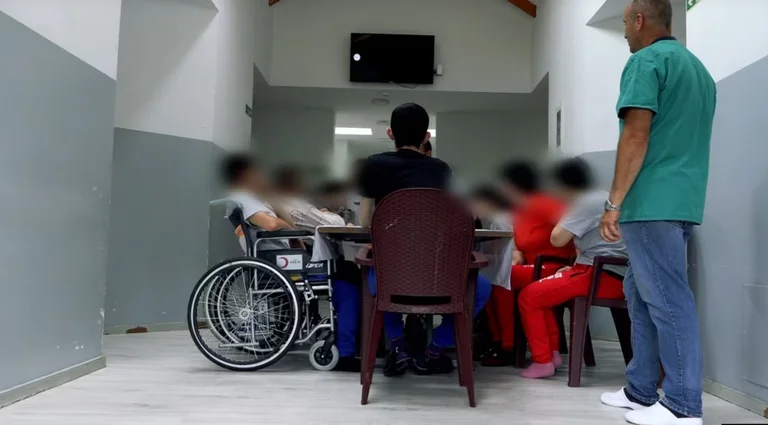
On August 2nd, Radio Free Europe has visited the House of Children, in Entrance. She has five rooms, with ten beds. Those in need care for ten qualified persons.
24 hours a day are offered in this house. The host is offered medical attention, nutrition, and care in maintaining personal hygiene.
The director of the House for Children's Office, Jeton Ademiaj, has said that the institution he heads is not competent to decide on the position or removal of disabled persons who have reached adulthood.
The house is a priority [for child housing] until the age of 18. But we only offer services here, but for moving to any other institution or family, or for staying in this house, legal guardians are the Social Work Centre”, Ademiaj said.
During the visit that officials of this institution have made to this house, it has been noted that the centre's staff has a close and friendly approach with residents, while accommodation conditions are generally good.
The report says that rooms in this house have sufficient space, that health and psychiatric services are in common with the Special Institute in Development, and that the psychiatrist visits residents once a week, while sometimes they are also sent to the Special Institute's ambulance.
In case of need, other health and specialist services -- residents of the House for Children -- were offered by the Family Medicine Centre in Development, and by the University Clinical Centre of Kosovo in Pristina, the report said.
Residents at the House for Children where there are no isolation rooms and no mechanical restriction forms are used every 6 months for laboratory tests at the Family Medicine Centre in Enhance, the report reports.
In Kosovo, 529 people under the age of 18 are without parental and abandoned care. Currently, 415 children without parental care are in the family home of relatives, another 51 children are in family shelters outside relatives, and 63 children are in residential shelters, in three organizations caring for these children. /rel