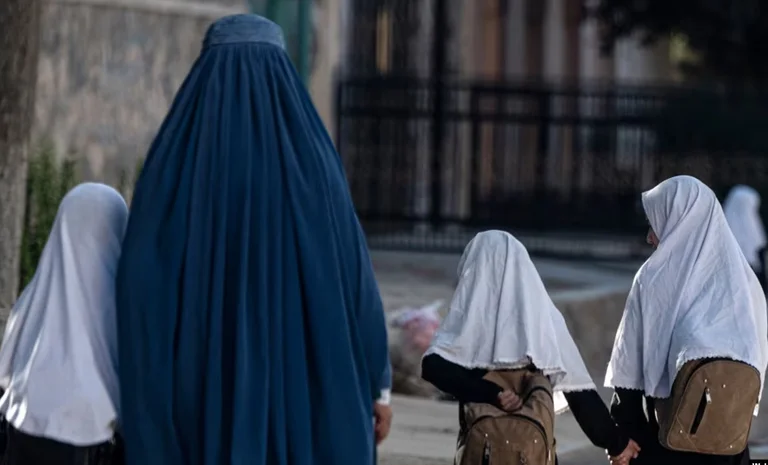

But the Taliban, rulers of Afghanistan's hard line, have banned Afghan teenagers from attending the lesson after the sixth grade. The stop was made after Islamists were made Back to power Two years ago. This ban expanded in December of last year, including women attending university studies.
Numerous protests held by Afghans within the state, international pressure and lobby of Muslim scholars and clerics have failed to persuade Taliban fundamentalist leaders to reopen schools.
Taliban Seek Full Control on Education in Afghanistan
Experts are divided whether the stop is rooted in the way the interpretation of Islam by the Taliban is shaped by the conservative tribe's cultural customs and practices, or whether it is driven by the way senior Taliban idealists interpret Islamic teachings.
Most of the Taliban leaders are also ethnic, Sunni Muslim clergymen. Most of them were educated in the Deoband meds in neighboring Pakistan. Debandism emerged as a Puritan Islamic re-launch movement in British colonial Indies in the 19th century. Based on the Sunnit law school, Hanef, this movement creates major tensions between Islamists in Afghanistan and Pakistan.
Tribal Influences
Sami Yousafzai, an Afghan journalist and commentator, argued that Taliban restrictions on women are related to social customs and cultural practices in the north and east of Afghanistan.
Most of the Taliban leaders come from various rural communities, while in areas bordering Pakistan.
“They believe that the woman's place is either inside the house or in the grave”, said Yousafzai, of the basic Taliban faith influenced by the status of women in the families of clerics and religious leaders in these regions, so on.
“Grave living in the homes of current Taliban policymakers have never been educated and never left the house”, said Yousafzai, who has reported on the Islamic group since it appeared as a militia in the South Afghan province of Kandahar in late 1994. “These women have never had positions in Government and have never worked in any nongovernmental organisation”.
Yousafzai said the Taliban support policies shaped by this understanding that tilt towards Islamic teachings that support these ideas. He said the Taliban leaders are backed up by claims attributed to the prophet Muhammad discouraging women from leaving their homes.
Their fundamental belief is that girls in puberty should not get out of the house under any” circumstances, he said. So this is why they see women coming out of the house to get educated or work as those involved in moral corruption”.
In Afghanistan, a Muslim state of close to 40 million people, activists and human rights applicants have accused the Taliban of applying <x0-parteid gender” by denying women to be educated, working, having freedom of movement and deciding how to look in public.
Taliban impose new dress code and separation at universities
Most Muslims agree that Islam allows women to be educated. However, the Taliban publicly say they will allow girls access to education only after a complete gender division is provided and other undesigned conditions.
Almost all high schools in Afghanistan are divided into gender bases, and universities established strict divisions between women and men after the Taliban took power.
Yousafzai said that in conservative and traditional Muslim societies worldwide, some clergymen also favour restrictions on women's schooling, employment, and their role in public life. But governments in these countries usually oppose or limit such ideas.
In recent years Saudi Arabia has allowed women to drive cars and has given them freedom of movement without escorting. These steps are part of a reform and modernisation promoted by the Crown Prince, Muhammad bin Salman.
The ban on schooling by the Taliban has demanded universal punishment from Muslims worldwide.
The Taliban's ban on women's schooling is not rooted in Sheriat's [Islamic] law, but reflects cultural prejudices that conflict with Islamic teachings”, Salam al-Marayati, president of the Muslim Public Affairs Council in the United States said.
The Historic Conflict
But Islamic scholars and those who have tried to convince the Taliban to reopen schools for girls provide another explanation.
John Mohammad Butt, an Islamic and former newspaper researcher at the BBC who is the only person from the West to have completed studies at India's Darul Walom Deoband, argued that the Taliban's policy towards girls' schooling is not tribal, but is shaped by the centuries-old conflict over modern schooling.
The problem is that girls' schooling in Afghanistan really is contemporary education in general in this state has generally been introduced as part of a secular agenda”, he said.
Taliban War Against Afghan Women and Girls
In the 1920s a coalition of conservative clerics, tribes and community leaders ousted King Amanullah Khan. He wanted to modernise Afghanistan in line with Turkish leader Kemal Ataturk's secular policy, which advanced modern education and women's rights.
This rejection of modernity and secularism continued and conservative clergymen opposed women's schooling and their right to work. This opposition became a key part of the Islamist opposition to the pro-Soviet Afghan governments after the April 1978 military stamp ended the Afghan monarchy. Mujahedins accused the Communists of spreading immorality by promoting women's schooling and empowering them.
This has led to special care from conservative circles in Afghanistan with regard to the schooling of girls”, Butt said.
“
Obaidullah Baheer, professor of political science at the American University of Afghanistan, became part of efforts to abolish the ban on schooling that the Taliban took last year.
But, he said the efforts failed because the “ban is a matter of deep ideological conviction” for the current supreme leader of the Taliban, Mullah Haibullah Akhundzada.
Baheer said that most of the main Taliban leaders have studied in Pakistani meds and so are cut off from village and tribal lives.
“They are inflated by the Doebandi think school and they now apply to the Afghan people the strictest version of Islam”, he said.
He argued that the ban on girls' schooling is a deliberate policy supported by Akundzada, who, as he said, has adopted the book in Arabic, Islamic Emirat and its system. This book was written by Afghan Justice Chief Abdul Hakim Hakqani. In this book, Haqqani backs the extreme Islamic opinion by choosing one of the wives of the prophet Mühamed, Sawdah Bint Zaméah, who chose to stay at home until his death.
Baheer said that Haqhan has ignored the fact that women and other associates of the prophet have played an active role in many sectors of society and that they were students but also teachers for men.
This thought is not supported by all Taliban leaders, but is one who has absolute sovereignty, the Taliban emir, who seems to back up” fully, he said.
Butt said Haqani has also accepted the principle that if there is something women should act on, then there is also something else women should learn.
I hope the Taliban authorities understand that in a not so far future the girls' schooling will make Afghan Muslim women better”, he said. The “will enable them to make more powerful contributions to the welfare of their state”.
Doctor? Engineer? As the dreams fade, Afghan girls turn to medres
Two years faced with this issue, Western diplomats seem to have encouraged conservative Afghans and clergy circles to find ways to end the stop.
Tom West, the United States representative for Afghanistan, has recently written on X that Afghan women should be educated and contribute to the economy so that their country can stand up.
If political changes are made, it will be because Afghans have demanded that these changes be made, not as a consequence of foreign demands”, he wrote.