8 hours ago
“Censorsing culture”: Court in Serbia banned Albanian author's films
Periskopi(3 years ago)
(3 years ago)By the Supreme Court's decision in Vranje, the film's screening “is banned by Albanian author Gani Wessel. As it says in response that this court has sent Radio Free Europe (REL), the court has assessed the Public Prosecutor's Proposal based that this action “avon and promotes discrimination and [...]
As it says in response that this court has sent Radio Free Europe (REL), the court has deemed it based on the Public Prosecutor's proposal that this action “avon and promotes discrimination and hatred”.
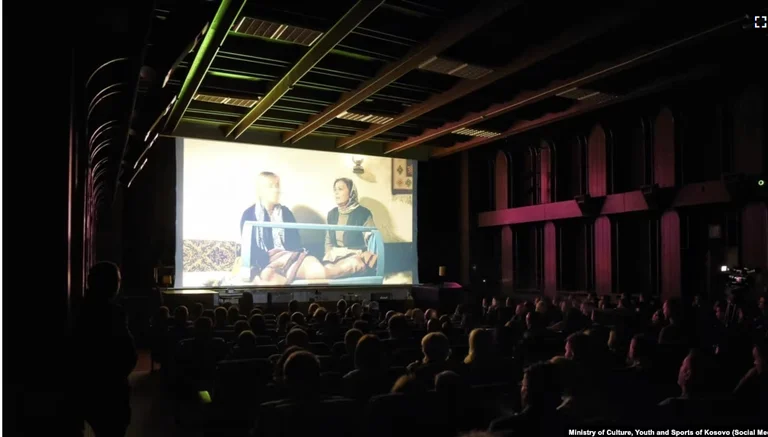
The same decision has allowed the screening of another film by Wessel, titled “The case kills”, but provided, among other things, the logo of the Republic of Kosovo, is removed as a sponsor of the film.
Film producer Gani Veselin says he is disappointed with this decision and that he will not remove Kosovo's symbol, since her government has financed the films.
Two short films of the production house Colosseum Production from Presevo were found in court, prior to their premiere in Bujanoc, after police received an anonymous report that they incite hatred and discrimination in June. These claims are rejected by movie authors.
What do they say in court?
The public has not yet been informed of all the details of the decision that was made on August 14th by the Supreme Court court in Vranje.
In response to the court's sending Radio Free Europe, it is said that the court has found that the film “unfaithful” is contrary to Article 28 of the Law for Cinematography.
The article says that the circulation and public appearance of cinematographic work that promotes discrimination and promotes national, racial, and religious hatred.
This article also states that a ban can be imposed on public appearance of a pornographic cinematic work or content that protects or promotes violence and openly insults human dignity.
As for the second film, called “The case kills”, the court allowed public appearance with several preconditions. In addition to the request for the removal of the symbol of the Republic of Kosovo by warning features, warnings are also required to appear that the film is not recommended for persons under the age of 16.
The Vranje High Court's <x0-Colegy in case of making the decision, along with all the evidence and other proposals of the chief prosecutor in Vranje, particularly praised the basic and complementary findings of Serbia's Film Centre, as the professional institution that does works in the field of cinematography, defined by the Law on Cinematography”, is said in the response of the Supreme Court in Vranje.
REL has contacted, via e-mail, Serbia's Film Centre, asking to explain the thought given in this case, as well as to show who the commission members were who gave that opinion. But until the conclusion of the text, the answer has not come.
This is the first-instance judicial decision against which the authors and production company have the right to complain. The second-degree ruling is taken by the Court of Appeals in Nis.
What does the producer say?
In a proposal for Radio Free Europe, Gani Veselin says he feels disappointed after the court's first degree decision, as the project is financed by the Government of Kosovo through the National Council of Albanians.
The project was dedicated to Presevo and of course I had the greatest desire to show it there”, says Wessel.
He says he cannot comply with the Supreme Court's recommendation to remove Kosovo's state symbol from the “paper kills”.
I have even declared in court that I will not remove the logo of the Republic of Kosovo, because it allows me neither professional nor moral nor human ethics. Above all (Kosovo's state) is direct sponsor”, says Wessel.
In an earlier pronouncement for Radio Free Europe, Wessel has clarified that films “are based on popular confessions.
“Abundus” speaks of a man passionately passionate about weapons and his best friend denouncing him to the police, while the theme of the second film is that some young men kill their uncle in a robbery and murder is discovered after 20 years.
Wessel says that through this project he has taken five films to film, four of which have already been shot, and the fifth will be completed in September.
“Actually, five films will not be able to appear in Serbia, because they have the logo of the Republic of Kosovo”, says Wessel and adds:
The “is currently a problem for all Albanians and must be painful for all, because it is a direct censorship in culture. I, absolutely, can't push with my chest in front of a state machine”.
The premiere screenings of films “The case kills” and “the unfaithful” was scheduled for June 10th. However, they have been cancelled after an anonymous complaint at the local police station, that movies incite hatred and discrimination.
Instead of being at the premiere of the films, Gani Veselin and Culture Centre Director of Bujanoc, Jethmir Ismajli were to be interviewed at the Bujanoc police station. After giving their testimony, they were released and the public screening of films was banned until a second announcement.
Judicial System Status
Ragmi Mustafi, former head of the National Council of Albanians in Serbia, tells Radio Free Europe that the Supreme Court's decision in Vranje cannot be understood differently than as censorship of Albanian art and culture in the Presevo Valley.
“The artistic display of popular stories of Presevo, Bujanoc and Medvedja, with the support of the Government of Kosovo, only shed light on the true state of the judicial system in Serbia. In essence, this is a political judgment on Albanian culture”, Mustaf estimates.
According to him, the ban on showing films is “the most brutal reform of violence and pressure affecting the identity and cultural life of Albanians”.
Political “Tensions, cultural differences or historical events should not influence the content of cultural products”, Mustaf says.
What is disputed in the court's decision?
Marko Milosavljevic from the Nongovernmental Youth Initiative for Human Rights (YIHR) praises for The REL is difficult to comment on this judicial decision, as it has not yet been put forward to the general opinion.
But, he stresses that the court, prosecution and police have taken the position that freedom of expression for Albanian national artists is not allowed.
This ban is now confirmed with the court's decision”, Milosavljevic says.
According to him, the court's explanation concerning the film “The case kills”, whose transmission is conditional on the removal of symbols of the Republic of Kosovo, is controversial.
This is not in accordance with Serbia's obligations from the Ohrid Agreement, with which Serbia is obliged to recognise Kosovo symbols”, Milosavljevic says.
In the agreement reached in February of this year by Kosovo Prime Minister Albin Kurti and Serbia's president, Aleksandar Vuciq, in Ohrid, it is said that both sides “will mutually recognise their national documents and symbols, including passports, diplomas, license plates and customs stamps”.
Marko Milosavljevic considers that the ban on the premieres of two Gani Veseli films, at the Culture Centre in Bujanoc, has to do with the decision of the director of that cultural institution in the south of Serbia to ban the screening of the film “Balkan planet” in 2019.
That film describes the Russian Special Forces action at Pristina Airport, shortly after the bombing of the former Federation Republic of Yugoslavia in 1999.
I see this as a revenge for the fact that the then director of the Culture Centre in Bujanoc has not allowed (the showing of the Balkan Subject) film. He wasn't a good decision and, in a way, that's a reason for that now, but it can't be the motive for any prosecutor and police to be called into a ban and then make another” ban, Milosavljevic considers.
According to the results of the 2022 census, more than 611,000 members of the Albanian national minority live in Serbia.
Of them, the largest number of Albanians, more than 56,000, live in the municipalities of Presevo and Bujanoc.
In the municipality of Medvedja, about 1,000 Albanians live.